
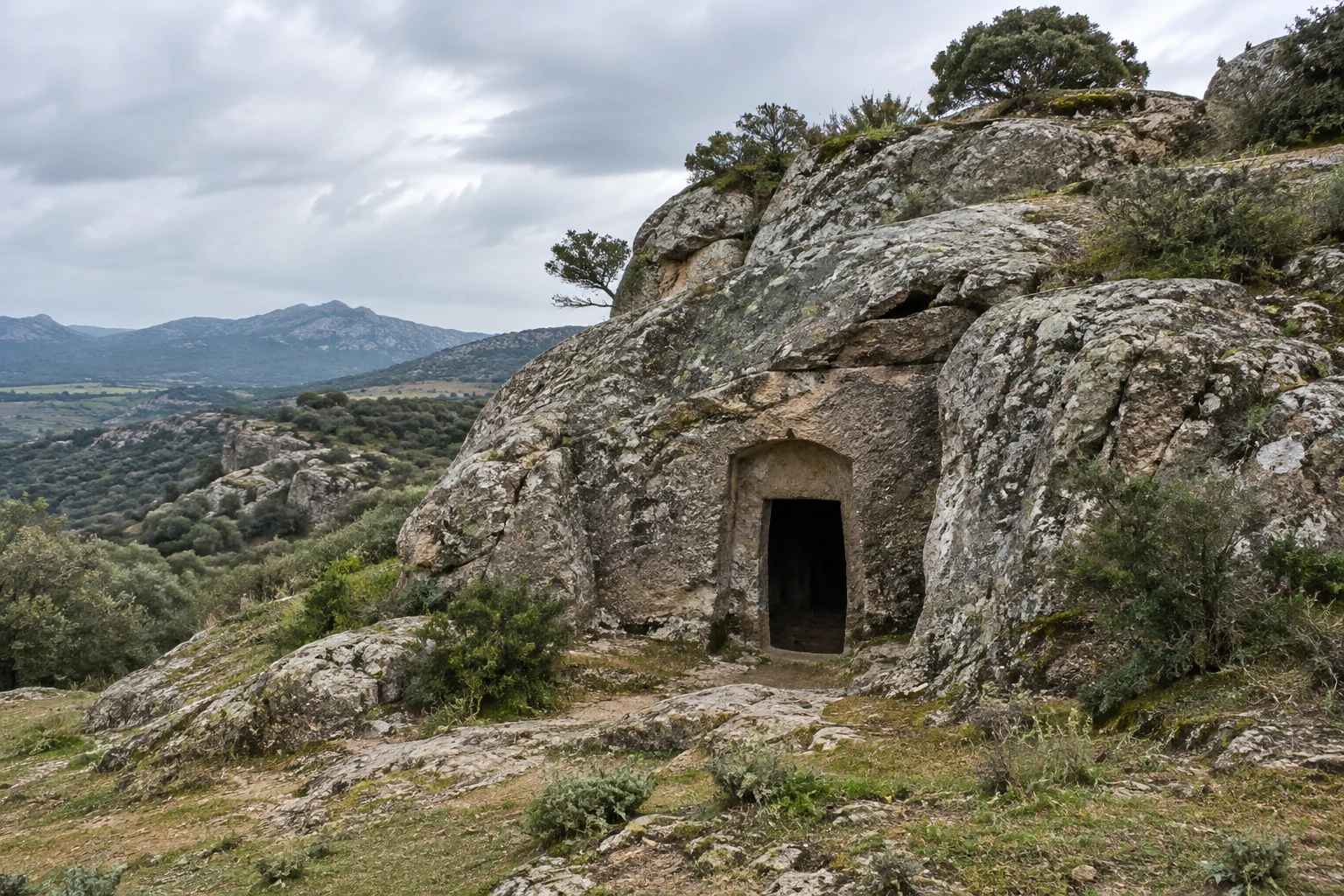
What Are Sardinia’s “Fairy Houses”?
The domus de janas are prehistoric tombs cut into Sardinia’s rock. UNESCO dates these funerary sites broadly to the fifth through third millennia BCE. An Edinburgh archaeological study identifies them as collective burials and uses the more specific range of approximately 4400–2600 BCE. They were burial places, not homes for living occupants.
UNESCO records “fairy houses” as a local name for the tombs. The name is part of how people know the monuments; it is not evidence that fairies built or inhabited them. Their archaeological identity rests on their funerary use.
The distinction helps when looking at a tomb. Its rooms and decoration are physical evidence. What its makers believed those features meant is a further question—one the surviving remains cannot answer in full.
Why Do the Tombs Resemble Houses?
The comparison begins with the architecture. In complex examples, Edinburgh researchers describe an entrance passage followed by an antechamber, a chamber and smaller cells. This sequence helps us picture movement into a tomb, though layouts vary; it is not a floor plan shared by every domus de janas.
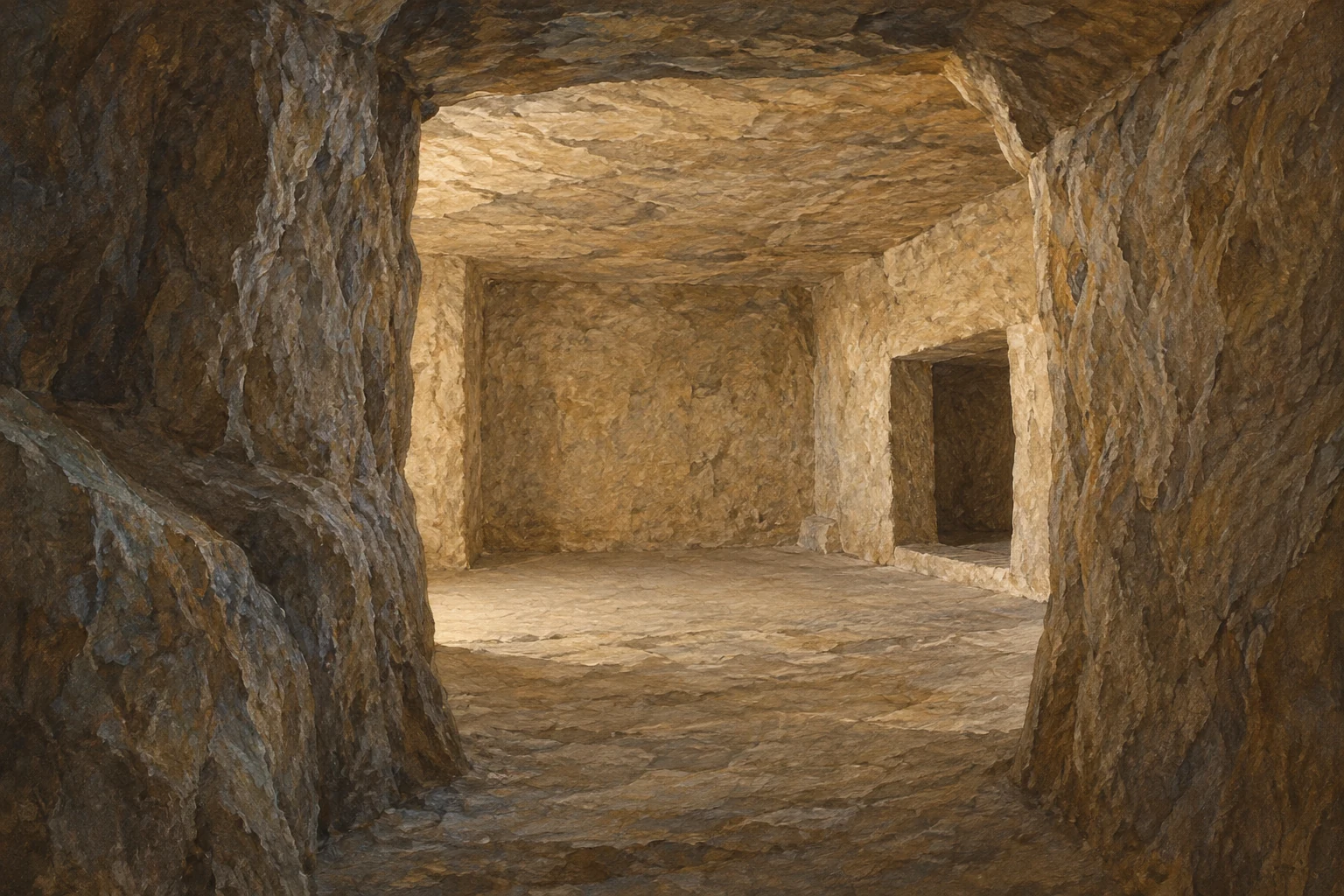
Some tombs also have carved features and painted motifs resembling house interiors. UNESCO describes the tombs as imitating houses of the living. The house-like quality, then, comes from spaces shaped in the rock and, in some cases, details worked onto their surfaces—not from the “fairy houses” name.
These features do not make the tombs ordinary dwellings. They show that some burial spaces were made to resemble places for the living. Why their makers chose that resemblance is a question for interpretation, rather than something the layout alone can establish.
What Can the Decoration Tell Us Directly?
UNESCO documents symbolic and figurative decoration across the sites selected for its heritage designation. Edinburgh researchers describe carved and painted motifs in some tombs. These observations do not imply that every tomb has the same decoration, or that a recurring form always carried the same meaning.
Analysis can identify some of the materials used. In painting samples, researchers identified red ochre or hematite and carbon black pigments. That finding establishes what was present in the sampled paintings; it cannot, by itself, tell us why a color was chosen or what a painted form meant to its makers.
The decoration remains valuable evidence of work done to the tombs. Assigning a belief or intention to that work requires an additional argument, because the people who made it cannot explain it to us directly.
Where Does Archaeological Interpretation Begin?
Interpretation begins when researchers move from surviving features to possible past actions and ideas. A tomb with several connected spaces may suggest funerary activity more involved than placing the dead in a simple opening. Edinburgh researchers cautiously infer potentially elaborate death rituals from complex plans. The plans survive; the ceremonies do not.
UNESCO likewise reads the monuments as evidence of funerary beliefs and social change. That interpretation draws on the tombs, but it is not a direct account from their makers of what they believed or how every burial took place.
The evidence supports identifying collective burial places, including examples with complex, house-like spaces and decoration. It does not establish one ceremony or belief shared by all the prehistoric communities that used them, or a fixed meaning for every motif.
What Does Unesco Recognition Cover—and How Should Visitors Respond?
In 2025, UNESCO inscribed a serial property comprising 18 component parts: selected places considered together for the designation. UNESCO estimates that approximately 3,500 domus de janas are known across Sardinia. The 18 inscribed components are not a count of every tomb on the island.
UNESCO states that those 18 components have national archaeological protection. That does not establish identical access arrangements for every domus de janas across Sardinia. Visitors should follow the instructions at the particular site they visit.
These are burial monuments, some with worked or painted surfaces. Treat them with care: respect site-specific instructions and avoid touching or disturbing the surfaces. The name “fairy houses” can be appreciated without treating folklore as evidence about who built the tombs.