
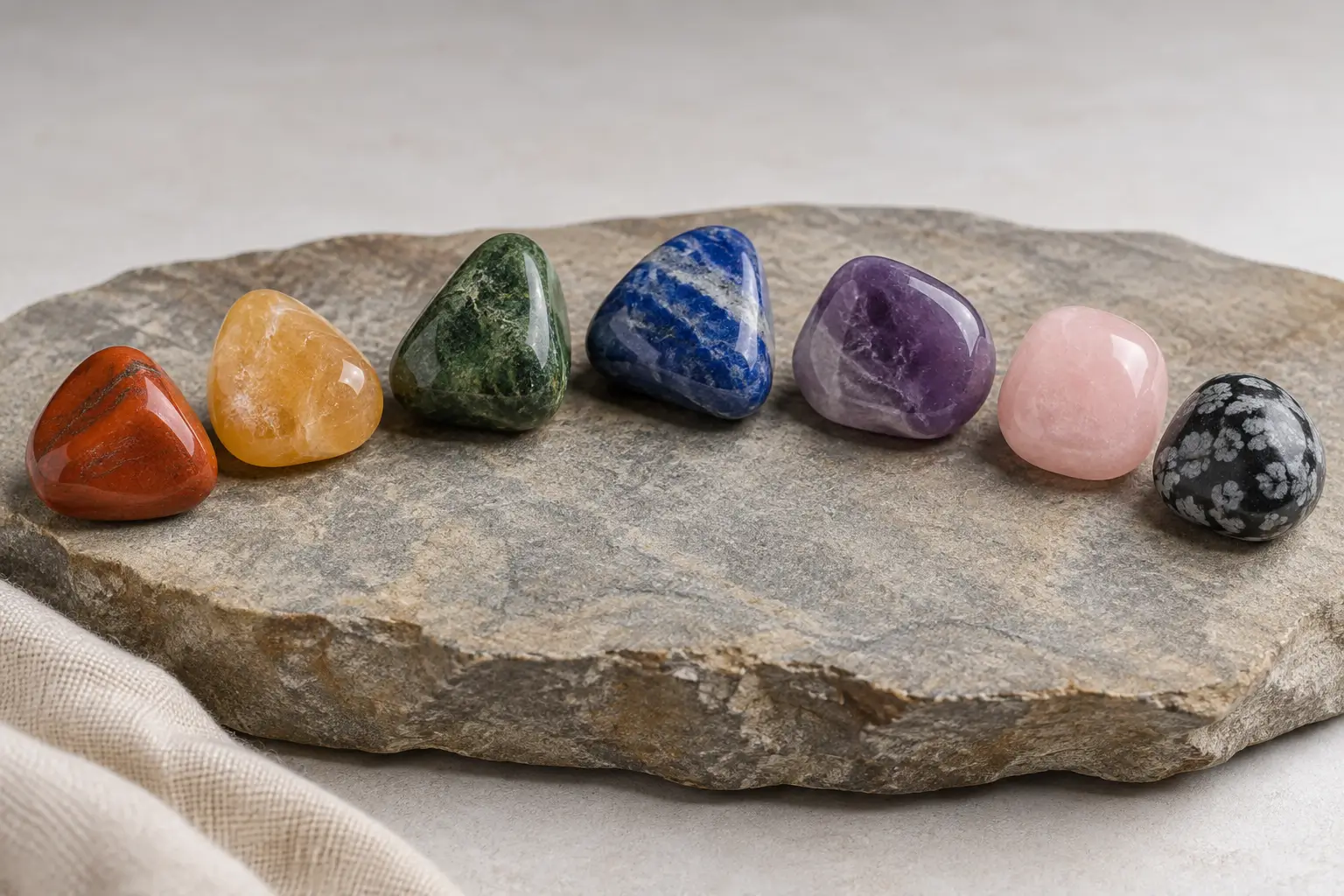
Build a Meaningful Set Without Treating the Mapping as a Fixed Rule
To make a chakra stone set, first establish seven positions. Choose one durable stone for each position, record your reasons, organize the stones in order, and check any treatment-specific care requirements. You can then use the completed set as a symbolic focus for meditation or arrange it on an altar.
You may follow a chakra tradition meaningful to you or create an explicitly personal system of colors, themes, or associations. Whichever approach you choose, distinguish inherited teachings from your own interpretations rather than presenting one mapping as universal.
This project treats chakras and stones as elements of spiritual symbolism. It does not describe them as physical anatomy or make claims about diagnosing, preventing, or treating health conditions.
Separate Documented History from Stone Symbolism
In this guide, a chakra is a concept found within spiritual traditions, not a structure in physical anatomy. A stone correspondence is a symbolic association between a particular stone and a position in a chakra system.
Chakra traditions have a documented historical context. The British Museum dates the emergence of Tantra in India to around the sixth century AD . A British Museum guide also describes a historical scroll organized into seven sections that depict chakras and their symbols .
This evidence provides context for historical chakra concepts and imagery. It does not establish a single, universal list assigning seven specific stones to seven chakra positions. Those assignments may come from a particular teaching, a later spiritual tradition, or an individual’s personal symbolism.
Maintaining that distinction also sets an appropriate boundary for the project. Health-related claims require competent and reliable scientific evidence . The practices below therefore concern symbolism, organization, meditation, and altar use—not promised physical or mental effects.
Plan the Seven Positions Before Shopping
Create a page in a notebook, a spreadsheet, or seven index cards numbered 1 through 7. These numbers establish the order of your set before individual stones enter the picture.
At the top of your record, identify the framework you intend to use. Decide whether the complete set will follow one chosen tradition or an explicitly personal symbolic scheme. Your framework might be:
- A specific tradition or teaching you already follow
- A published source meaningful to your practice
- A clearly identified personal system
- A respectful adaptation suited to your circumstances
Keeping the set within one framework makes it easier to understand and use consistently. If you combine sources or introduce personal interpretations, record those differences instead of blending them into what appears to be a universal system.
Next, write a short selection intention for every position. An intention can identify a color, quality, image, element, memory, prayer, or spiritual theme. Do not name a stone yet. The point is to define what you are seeking before a seller’s inventory influences your choices.
Use a simple planning table:
| Position | Source or framework | Selection intention |
|---|---|---|
| 1 | ||
| 2 | ||
| 3 | ||
| 4 | ||
| 5 | ||
| 6 | ||
| 7 |
If your tradition uses a different order or interpretation, adapt the plan respectfully. The goal is coherence within your chosen practice, not conformity to a supposedly universal chart.
Choose One Durable Stone for Each Position
Work through the seven positions one at a time rather than buying several appealing stones and assigning meanings afterward. For every candidate, compare:
- Its traditional or personal meaning with your written intention
- Its suitability for the handling, display, and storage you have planned
Ask the seller whether the stone has been treated. Request any available details about the treatment, durability, and recommended care before deciding. Gem treatments can alter color or clarity and may affect durability, so disclosure matters even when appearance is your main reason for considering a stone .
Use the following sequence:
- Position 1: Review the first intention and examine suitable candidates. Compare symbolic fit with practical care needs, then record the final stone and why you chose it.
- Position 2: Work only from the intention assigned to this position. Confirm treatment information before recording the selected stone and your reason.
- Position 3: Consider how the stone will be handled or displayed as well as what it symbolizes. Record the decision and any disclosed treatment.
- Position 4: Compare candidates without assuming that color alone determines correspondence. Select one that fits both your framework and intended use.
- Position 5: Ask for available care and durability information before making the decision. Record the symbolic reason and relevant practical considerations.
- Position 6: Check that the candidate has a clear role distinct from the stones already assigned. Confirm its treatment status and record the final choice.
- Position 7: Complete the same review for the final intention. Record the stone, its meaning, any treatment disclosure, and the seller’s care directions.
Reconsider a candidate if its disclosed care needs do not suit your plans. For example, a stone requiring careful placement may not fit an altar location exposed to strong light, while a delicate specimen may not suit frequent handling. You can select another stone without changing the symbolic intention for that position.
When all seven choices are complete, you should be able to explain both why each stone belongs in its position and how you will care for it. The set does not need to resemble anyone else’s. It needs to form a system that is meaningful, practical, and clear to you.
Label and Organize the Completed Set
Assign each stone the number of its matching position. You can place numbered cards beneath the stones, use divided compartments, or keep a diagram showing where each one belongs. Avoid applying an adhesive label directly to a stone unless a qualified source has confirmed that it is suitable for the material and treatment.
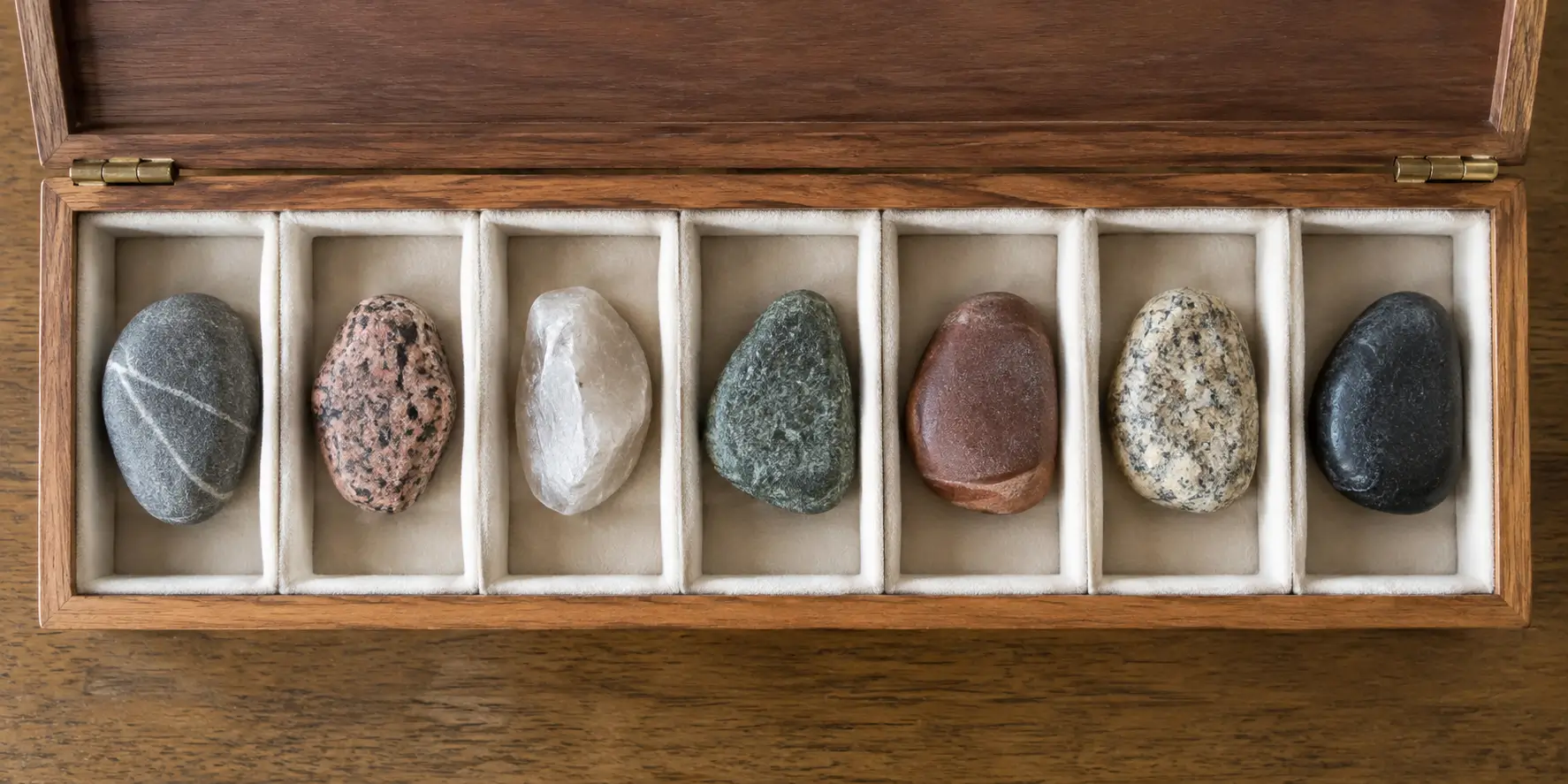
Create a concise record for every stone containing:
- Stone identifier or seller’s description
- Assigned position number
- Chosen symbolic meaning
- Whether the meaning is traditional, adapted, or personal
- Any disclosed treatments
- Seller-provided care directions
Keep the stones in their established order. If you use a pouch or an undivided box, include a simple sketch or photograph of the sequence so you can restore it after removing the stones.
Make sure the wording of your labels preserves the difference between tradition and personal interpretation. Phrases such as “my association,” “adapted from,” or “according to my chosen tradition” prevent an individual choice from appearing to be a documented historical rule.
Finally, cross-check the entire set. Each of the seven positions should have exactly one stone, and every stone should be easy to match with its record. Resolve any missing, duplicate, or uncertain assignments before moving on to care and use.
Store and Clean the Stones According to Their Treatments
Care for each stone according to its identified material and disclosed treatment. Do not assume that one storage or cleaning method will be appropriate for the entire set.
Dyed gems may fade when exposed to prolonged sunlight . Keep a dyed stone out of prolonged sunlight, and follow any more specific placement or storage guidance supplied by the seller. Consider this restriction when choosing a shelf, windowsill, altar, or display case.
Organize the stones so they remain in order and can be identified without unnecessary handling. Divided compartments, individual storage, or a clear diagram can help you maintain the sequence. Add any seller-provided precautions to your storage routine.
Solvents may affect dyed gems . Do not use solvent-based cleaning on a dyed stone unless a qualified source has confirmed that the particular solvent is safe for that material and treatment.
For stones with other treatments—or stones whose treatment status is unknown—use only care methods confirmed as suitable for the identified material and treatment. A method that is appropriate for one member of the set should not automatically be applied to the others. When the available information is incomplete, seek qualified guidance rather than experimenting.
Keep the written care record with the organized set. Consult it before cleaning the stones, changing their display location, or placing them where light, cleaning products, or frequent handling could conflict with the recorded directions.
Use the Set for Meditation or on an Altar
For meditation, arrange the seven stones in their numbered order. Sit comfortably, settle your attention, and begin with the first stone.
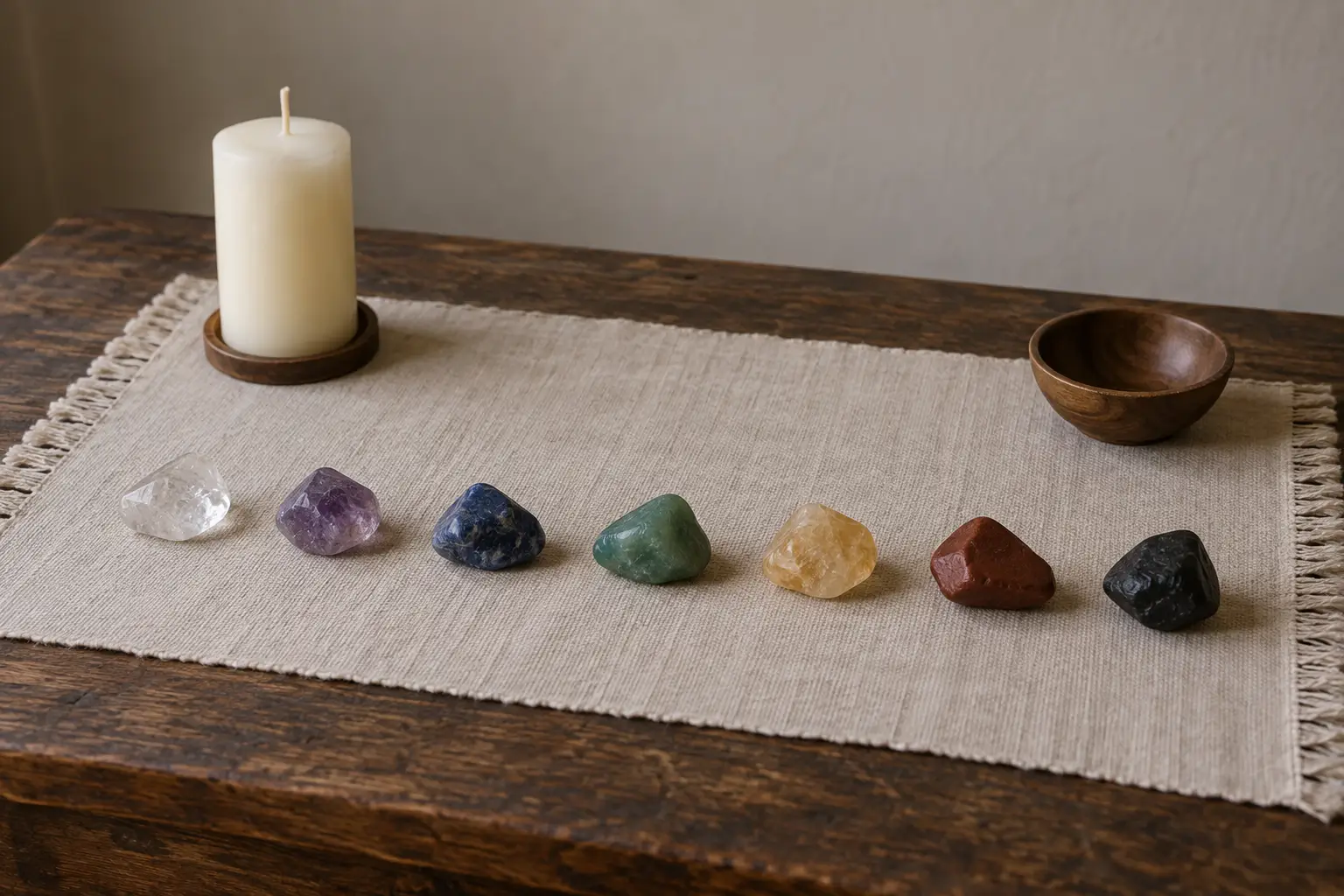
Look at the stone, or hold it if its care directions permit handling. Recall the meaning you assigned to that position and use it as a focus for reflection. Continue through the remaining stones in order, bringing your attention to each chosen theme. When you finish, return the stones to their organized storage or display.
Treat this exercise as a symbolic or spiritual practice, not as treatment. If you notice a response, describe it as personal reflection or spiritual interpretation rather than a guaranteed effect of the stones.
For altar use, place the seven stones in their established order in a way that fits your tradition, available space, and circumstances. The arrangement may be linear, circular, vertical, or part of a larger devotional setting. If the design does not make the sequence obvious, keep a diagram nearby so the order can be restored.
Preserve all treatment-based placement restrictions recorded during the care stage. An attractive location is not suitable if it conflicts with the directions for one of the stones. Adjust the arrangement, provide appropriate protection, or store a vulnerable stone separately when necessary.
Let the Set Remain Personal and Revisable
A successful chakra stone set is coherent, identifiable, meaningful within your chosen framework, and cared for according to known treatments. Its value does not depend on matching a universal list.
You may revise an association as your understanding develops, your tradition offers different guidance, or practical circumstances make a stone unsuitable. Update the label and care record whenever you make a change so the set remains clear.
Keep three categories distinct: documented historical context, teachings inherited from a particular tradition, and symbolism you have chosen personally. Respecting those differences allows your set to remain both intentional and adaptable.