
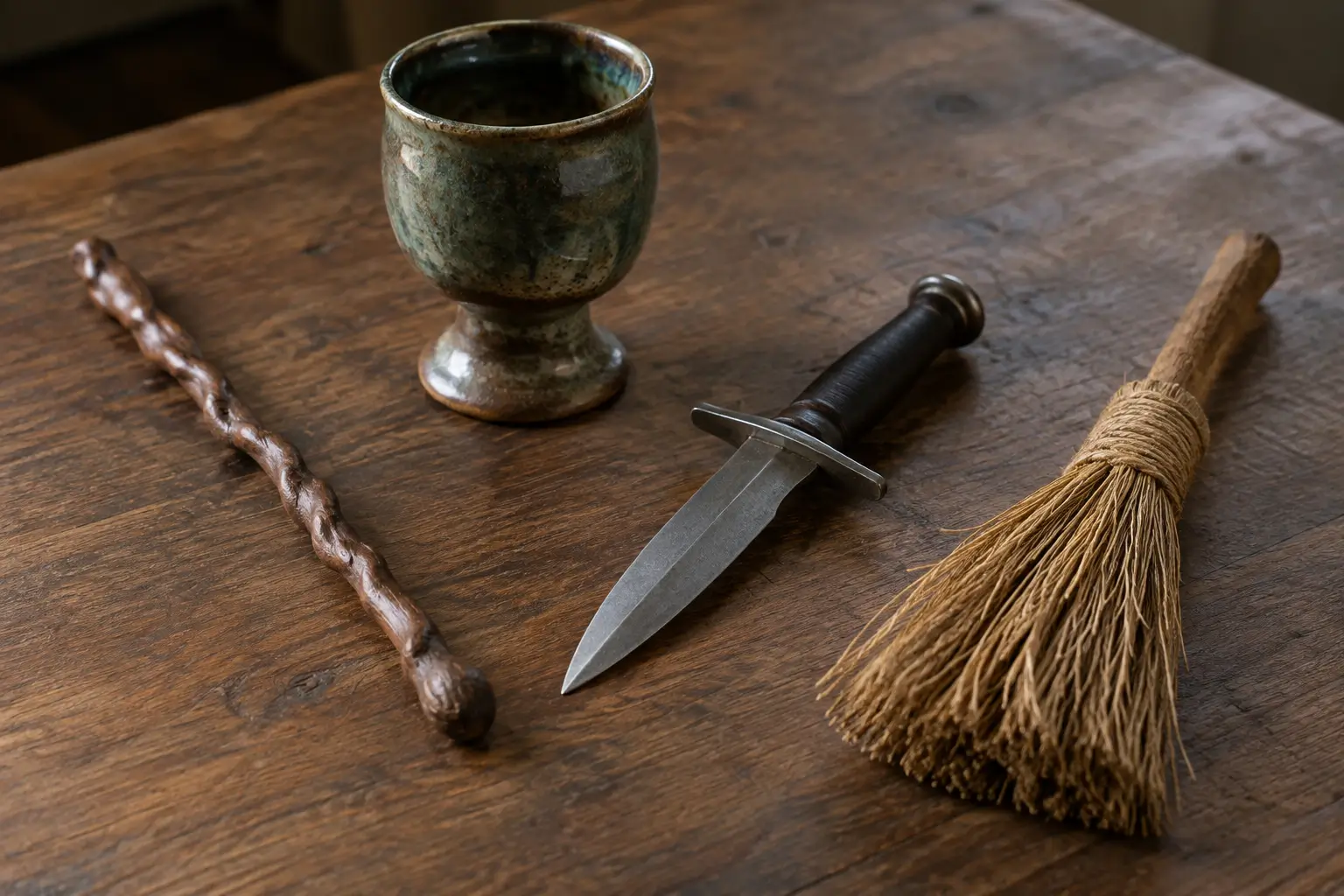
Why do Wiccan tool lists name eight, nine or thirteen objects? The totals reflect different counting boundaries, not competing rules about what everyone must own. A particular Gardnerian first-degree initiation record provides the historical eight. A nine-item account reported in a 2017 Grove and Grotto essay adds one chalice/cauldron entry. The essay’s thirteen-item catalogue counts chalice and cauldron separately, then includes three further objects. Knowing what each source is counting makes the apparent disagreement easier to read.
Where the Historical Eight Come from
The starting point is a Gardnerian text identified as a first-degree initiation. It presents working tools in that ritual setting. It is a record of a particular presentation, not a universal instruction sheet for contemporary Wiccans. The passage begins with a magic sword and then names the athame, white-handled knife, wand, pentacles and censer. Cords and scourge complete the eight-tool inventory discussed in the 2017 Grove and Grotto essay.
Written as a count, the eight are:
- Sword
- Athame
- White-handled knife
- Wand
- Pentacles
- Censer
- Cords
- Scourge
One change of name can make this list seem longer. The Grove and Grotto author calls the white-handled knife a boline. In this comparison, boline names entry three; it is not a further knife that raises the total to nine. Similarly, pentacles is the wording of one counted entry, not an invitation to count each pentacle as a separate place on this list.
The boundary is just as important as the names. These are the working tools presented in the first-degree account; the eight are not a claim that no other object appears anywhere in Gardnerian material. Nor does the list establish what every Wiccan group presents or uses. It gives a defined starting inventory against which the later additions can be counted.
What Distinguishes the Eight Working Tools
The eight are not interchangeable names for ritual equipment. The first-degree text assigns them different roles or places in its account. This source-bound guide describes those distinctions without turning them into instructions or assuming that another tradition assigns the same meanings.
| Working tool | Role or status in the first-degree account |
|---|---|
| Sword | Associated with forming the ritual circle. It is the first tool presented in this account. |
| Athame | Also associated with forming the circle, while remaining a separate entry from the sword. |
| White-handled knife, called a boline by the 2017 author | Distinguished by its stated purpose of making other instruments, rather than by the circle association given to the sword and athame. |
| Wand | Assigned a calling role in the initiation text. |
| Pentacles | Also assigned a calling role, but named as their own entry rather than treated as another name for the wand. |
| Censer | Assigned a spirit-welcoming role. |
| Cords | Described as necessary in the oath within this initiation account. |
| Scourge | Presented as a symbol of power. |
The first three show why a count of objects is not a count of wholly unrelated purposes. Sword and athame share an association with the circle in this text, yet the record names both. The white-handled knife has a different stated purpose. Thus the first three remain three entries: neither a shared role nor the alternative name boline removes or adds an object. That distinction explains the inventory without asserting that sword and athame have identical roles in every practice.
The wand and pentacles offer a similar, narrower lesson. Both receive calling roles, but the text still presents them separately. The censer’s spirit-welcoming description sets it apart from those entries. These are the roles the initiation account gives, not a universal set of elemental correspondences or a prediction of what any practitioner will experience.
Finally, the cords and scourge belong to the historical presentation even though their descriptions differ from those of the other tools. The text places the cords in the oath and presents the scourge as a symbol of power. Naming their place in the record is sufficient to understand why they appear in the eight; it does not make the record a guide to using them.
How an Eight-item List Becomes Nine—or Stays Eight
A separate Gardnerian working-tools passage mentions a cup for cakes and wine. So “not counted among the first-degree eight” does not mean “absent from the historical material.” Equally, the cup’s appearance elsewhere does not make it an automatic ninth entry in the particular inventory above. The passages need to be read with their own boundaries.
The specific nine-item account comes from the 2017 Grove and Grotto essay. Its author reports one Gardnerian coven counting a chalice/cauldron entry in addition to the eight:
8 original entries + 1 chalice/cauldron entry = 9.
The slash matters to this calculation: chalice/cauldron occupies one place on that reported list. This is an example of one coven’s count as relayed by the essay, not evidence that Gardnerian groups generally—or other Wiccan traditions—use a nine-tool inventory. The historical cup helps explain why a vessel can enter the conversation; it does not, by itself, establish that coven’s count as a rule.
The same essay reports another way a chalice can appear: it can replace the censer. Starting with the historical eight, that calculation is:
8 original entries − 1 censer + 1 chalice = 8.
These two lists could both contain a chalice, yet only the first has nine entries. To compare them, look for what happened to the censer. If it remains and a combined chalice/cauldron entry is added, the total rises by one. If the chalice takes the censer’s place, the total stays eight. The replacement, too, is an account reported by the 2017 author, not a rule for whole traditions.
What the 2017 Essay Counts to Reach Thirteen
The thirteen-item total draws a wider boundary. In the Grove and Grotto author’s expanded catalogue, begin with the eight working tools, count chalice and cauldron separately, and then include besom, bell and necklace:
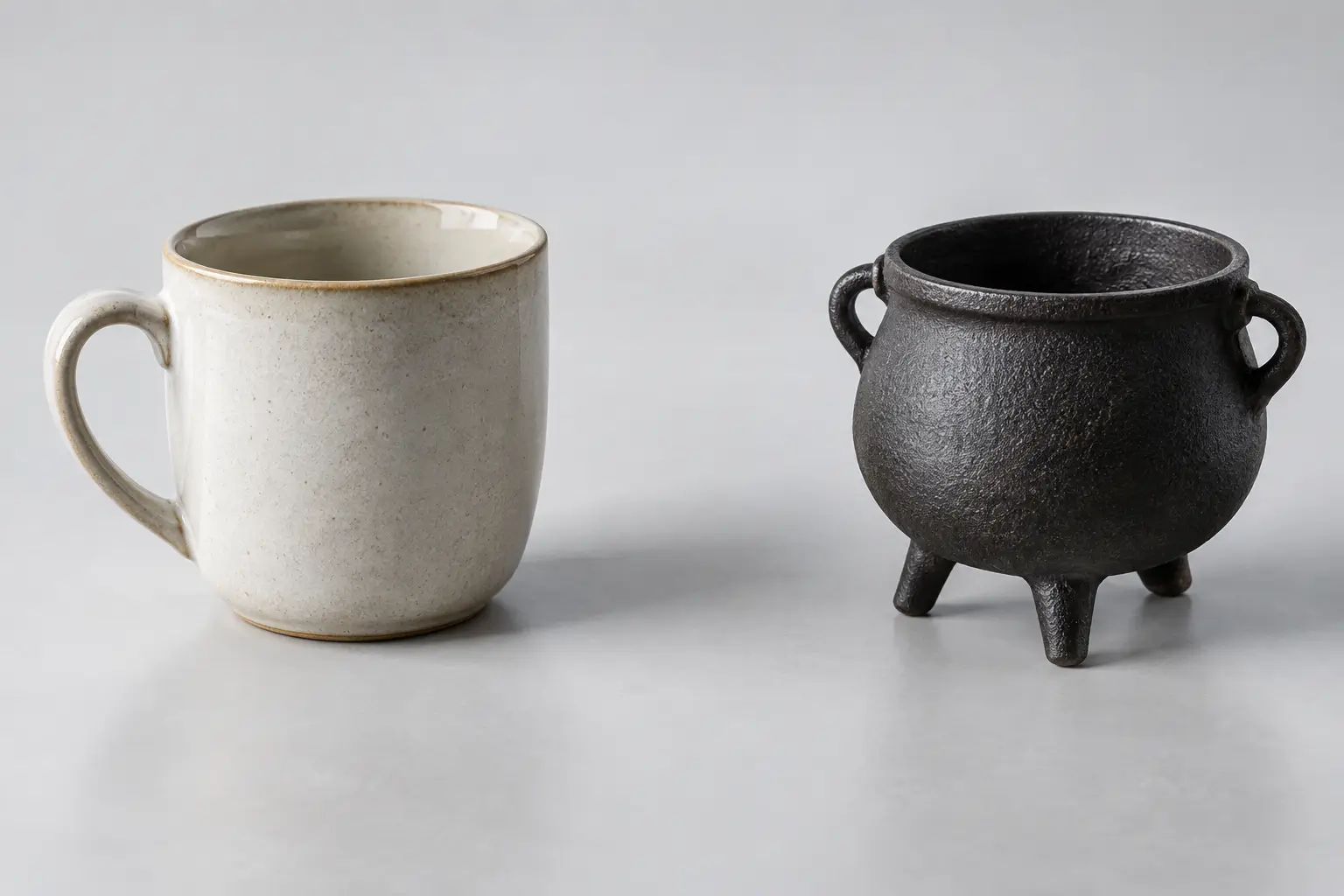
8 working tools + 2 vessels + 3 further objects = 13.
That is not the same calculation as the reported nine. Nine adds one combined chalice/cauldron entry; thirteen gives each vessel its own place, then adds three other objects. The author describes the chalice as a vessel for beverage offerings and distinguishes the cauldron as a vessel that can carry heat. Those descriptions explain the separation in this catalogue. The essay also observes that chalice and cauldron terminology can overlap in Gardner material, so the thirteen-item count should not be mistaken for proof that every historical reference keeps them neatly apart.
The remaining additions are not further names for the original eight:
- A besom is a broom. The 2017 author includes it in the expanded catalogue, although it is not among the eight entries of the first-degree inventory.
- A bell is another object included beyond those eight. Its inclusion changes the breadth of this catalogue; it does not change what the first-degree account names.
- A necklace is counted in the expansion, although the author says it is not among the core tools.
The essay places besom, bell and necklace outside the formal presentation of tools to an initiate. That status explains why the jump to thirteen is more than a longer version of the original list. It combines the eight working tools with vessels and other ritual-adjacent objects. Thirteen is the 2017 author’s editorial count, not a second canonical thirteen-tool initiation inventory or a claim that these objects must all be owned.
How to Read a Different Tool List
When you encounter another numbered list, ask three questions before comparing totals:
- Who produced it? Is it a particular ritual record, a contemporary group describing its own practice, or an author comparing sources?
- What setting does it describe? A first-degree initiation presentation and a brief list of traditional tools may serve different purposes.
- Where is its counting boundary? Check what it includes, what it leaves open, and whether a familiar object was added, substituted or combined with another entry.
Apply the questions to the historical eight. The source is a Gardnerian first-degree text, the setting is an initiation, and the count concerns the working tools presented there. A cup mentioned in a separate passage does not invalidate that eight-item inventory; it shows why identifying the passage and its boundary matters.
Now consider the Coven of the Rowan Star’s account. The coven calls its own traditional-tool list brief rather than exhaustive. It names a broom and says additional altar objects may include an incense burner. By contrast, the first-degree eight do not name a broom; the 2017 essay calls it a besom and counts it beyond those eight. The difference is visible, but the sources need not be forced into identical inventories. One is a bounded initiation presentation, while the coven expressly leaves its brief account open to additional objects. Its list describes that coven’s account, not every tradition’s practice.
The coven’s page also separates its brief list of traditional tools from a later note about other objects that may appear on an altar. It gives an incense burner as one example in that second category. Counting that example automatically as one more entry in the brief tool list would give the coven a total it does not state. The distinction is useful when reading any online inventory: a page can mention tools, vessels and other altar objects together without asking the reader to add every mention into a single numbered set. Classify each object by the source’s own heading before comparing its total with another source.
Absence from a bounded list needs equally careful reading. The first-degree eight do not name a broom; that observation does not show that a broom was forbidden or never used elsewhere. Conversely, a broom appearing on the coven’s brief page does not turn it into a ninth item in the older first-degree inventory. Each statement answers only what its own document includes. When comparing counts, mark an item as present, explicitly substituted, or simply outside the passage being counted. Do not treat silence as a rule about practice.
A final distinction keeps any of these lists from becoming a shopping requirement. The separate historical working-tools passage allows improvisation and says a sword is not necessary. Thus even the supplied historical material distinguishes naming a sword from requiring everyone to possess one. Use a list’s source, setting and stated boundary to understand its number—not to infer that every named object must be owned.