
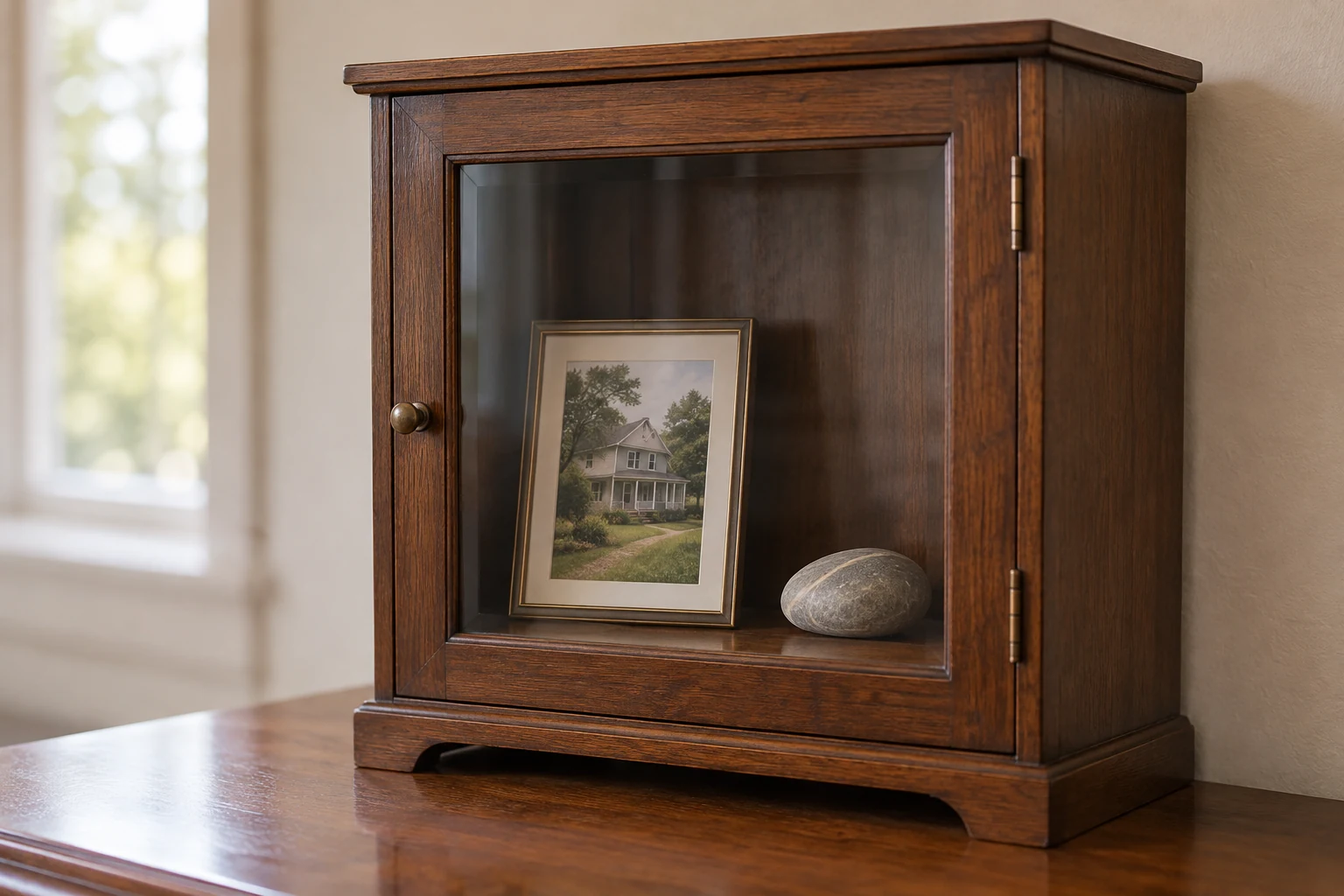
Plan the remembrance first: decide whose memory you want to honor and what would help you remember them. Then choose a location and objects that suit the cat who lives in your home. A photograph, a name, or a written memory can carry the purpose of a display without a candle, food, or a fragile heirloom. If your cat can reach an open shelf, the answer may be an enclosed display—or one you set out only while you are present. A simpler arrangement is no less meaningful; it is one you can use without asking the cat to leave tempting objects alone.
Choose a Location Around Your Cat’s Actual Routes
Before choosing a shelf, watch how your cat uses the room on an ordinary day. Where does it already jump, rest, or investigate? Look for furniture that serves as a stepping stone: a chair beside a bookcase, for example, may change what the cat can reach. Notice whether the cat can approach a shelf from the side or land near its edge. A surface that shifts or wobbles when people use it is a poor starting point even if the cat has not climbed onto it.
This is an access check, not a test of how high your cat could jump. Height by itself does not establish that an open shelf is inaccessible. Nor does an object’s personal importance make it something a cat will ignore. Consider the routes available when people move chairs, open doors, or leave the room, as well as the routes you see while you are watching.
An open shelf may fit if you can control access to it and support its contents in normal use. If you cannot, consider a closed cabinet or another location that genuinely separates the cat from the objects. Check the closure in the way the household will actually use it: does someone routinely leave the door open to look at a photograph, retrieve something nearby, or clean? An enclosure helps only when its contents remain separated during those ordinary moments. It also needs to be steady and suitable for the objects placed inside.
A third option is a temporary display. You might bring out a card and a protected photograph when you want time for remembrance, then put them away when that time ends. This can be a better fit than giving a permanent place to objects you cannot keep separate from the cat. “Supervised” should describe how you will actually use the arrangement, not a hope that someone will happen to notice trouble from another room.
Choose a fixed display only where you can manage both the cat’s access and the support beneath the objects. Choose an enclosed or temporary arrangement when those conditions fit better. None of these choices guarantees that a cat will never jump or knock something over; the aim is to make a workable decision for this animal, this furniture, and the household’s routine.
Build a Stable Display with Keepsakes You Can Protect
Before moving an heirloom into the arrangement, examine it. The Canadian Conservation Institute advises looking over an object before handling it to identify its strong and weak areas. If a frame is loose, a photograph is fragile, or an object has a vulnerable part, you need not make the original part of an everyday shelf. Protect it elsewhere and use a labeled photographic copy or a more robust personal token instead.
A small display might hold a supported copy of a photograph, a card bearing a person’s name or a memory, and one modest, stable token. Those are examples, not required ritual objects. You might choose a single card instead. What matters is that you can recognize the person or memory in the arrangement without depending on something easily damaged or difficult to secure.
Next, check the support rather than relying on the fact that an object is “up high.” Follow the actual shelf or cabinet’s installation and restraint instructions, and check whether the furniture feels steady in its intended location. Look at how each item sits: could it slide as a door opens, shift when the furniture is used, or be knocked past an edge? A heavy loose object does not become safe merely because it is on a shelf. If you cannot support it appropriately, leave it out or keep it protected elsewhere.
Arrange only the few items the space can support, with room between them and the edges. A photograph that needs to stand can have a stable support; a card can be placed where it will not slip into an accessible gap. Avoid building a precarious stack to fit in one more keepsake. The useful question is not whether the finished shelf looks full, but whether each chosen item has a secure place and whether its original, if valuable or fragile, remains protected.
Remove Temptations and Control Anything That Needs Power
Decide what to omit before decorating. If cat access to the display is not controlled, leave out an open flame. The U.S. Fire Administration suggests battery-operated flameless candles as an alternative. You can also choose no candle at all: a photograph or written memory does not need lighting to serve as a remembrance display.
A flameless device begins a separate check; it is not automatically suitable for the shelf. Before placing one, examine its actual battery compartment and position any cord so it is not left loose or accessible to the cat. For a device containing replaceable button or coin batteries, the Consumer Product Safety Commission states that the compartment must be secured so that opening it requires a tool or at least two independent, simultaneous hand movements. If you cannot verify the compartment or manage the cord in this location, choose an unpowered object instead.
Before adding ribbon, decorative ties, or similar trim, consider what happens if the cat pulls or swallows it. The American Veterinary Medical Association warns that stringlike items, including ribbons and tinsel, can become trapped in a pet’s intestines. Omit dangling ties from the display and clear away loose packaging after setting it up. Do not rely on the tie being sentimental, tucked behind another object, or previously ignored.
Treat food and plants as separate decisions rather than as finishing touches. Include a food offering only if you can meet its actual pet-safety needs and keep it inaccessible to the cat; otherwise, a note or image can represent the offering. Apply the same access test to any plant, without assuming an unidentified plant is safe. There is no need to add a plant to make the display complete, and essential oils are not a substitute for controlling access.
These choices can leave you with a spare arrangement. That is useful if every remaining object has a clear purpose and a place you can protect. If a proposed addition brings a flame, a loose string, an uncertain device, or food or plants you cannot keep inaccessible, omit that addition rather than asking the cat’s behavior to make it safe.
Test the Arrangement in Ordinary Use—and Simplify If It Fails
Once the display is set up, observe it during the household’s normal routine. Watch the cat’s usual routes without luring it toward the shelf or encouraging a jump. Notice what changes when someone opens the cabinet, passes the furniture, moves a chair, or uses the room in the evening. Look again after the space has been left alone: is a shelf edge newly reachable, an item out of position, or a material hanging where it was not before?
Test the use of the display as well as its initial placement. If someone needs to open a cabinet to see a photograph, decide whether they can close it again as part of that ordinary action. If a temporary arrangement is pleasant while you are present but stays out after you leave, it is no longer being used as planned. Put it away or close it when supervision ends.
Keep a fixed arrangement if its location, support, and contents remain suitable for the cat and the way your household uses the room. If an object shifts, a route becomes accessible, or a door is often left open, change that condition: move or remove the problem object, choose a more controlled location, or switch to a temporary display. Reassess when the cat’s habits or the furniture arrangement changes. The first setup is a starting plan, not proof that the room will always work the same way.
If no physical placement works well, remembrance can take another form. Keep a card or written memory in a closed record, or use a digital image you can open when you want to spend time with it. You could write someone’s name beside a favorite photograph and return to it on meaningful days, without leaving either item within the cat’s reach. Omitting an unsafe object is not a religious failure or a lesser act of remembrance.
The method is straightforward: control access as the household really uses the space, choose stable objects and protect fragile originals, and leave out hazards you cannot control. Then revisit those decisions as the cat and the room change.