
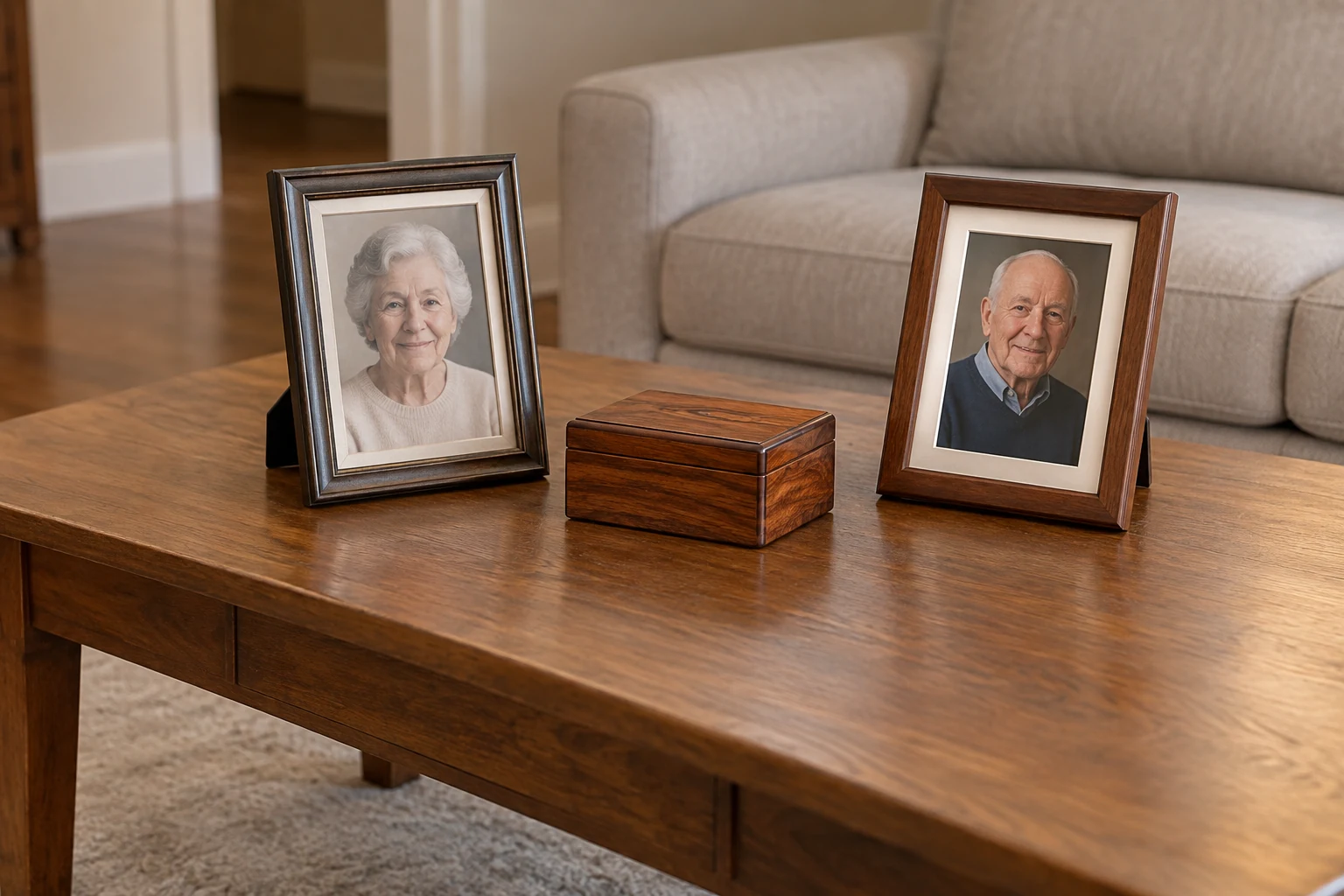
A temporary family remembrance table can be a small, agreed-upon place for photos, objects, and memories during one gathering. Start by deciding whom it will remember and what family members are comfortable sharing. Then choose a location that works for the room, arrange only items you can support safely, and decide who will take each contribution home. People should be free to look, speak, or leave the table alone.
This is a personal arrangement for this occasion, not a prescribed ancestor ceremony. It needs no particular words, objects, or shared spiritual belief. A few contributions with clear permissions and a definite closing plan may serve the family better than a crowded display.
Agree on What the Table Is for and What May Be Shared
Before asking anyone to bring an item, talk with the family members most closely involved. Agree on whom the table will remember, when it will be available, and whether people may use it for quiet viewing, conversation, or both. The purpose can be simple: “We’re setting out a few things that remind us of relatives we miss. You’re welcome to look or share a memory, but there’s no expectation to take part.” That invitation leaves space for people who understand remembrance differently—or who would rather focus on other parts of the gathering.
Invite contributions rather than assigning them. Someone might lend a photograph, offer a small object, write down a memory, or contribute nothing. Ask each contributor what they permit before making a card or placing an item on the table. Permission to display a photograph does not necessarily include permission for guests to photograph it. Permission to show an object does not necessarily include permission to tell its story aloud or name everyone involved in it. If other guests are likely to take pictures, make the photography boundary clear to them as well.
Offer choices that do not require a public explanation. A person might tell the organizer a memory privately, provide an unnamed contribution, or decide that their memory should stay entirely off the table. If a relative is unable or unwilling to answer a question about their item, leave that detail out rather than treating silence as consent. The aim is to make participation possible, not to collect a complete account of the family.
A modest object can carry a specific recollection without being asked to represent someone’s whole life. Child Bereavement UK’s guidance on memory boxes recommends attaching a story or memory to each object. For this gathering, a family could adapt that idea by placing a short, permitted memory beside a contributed item; the organization is not prescribing a remembrance-table format. A note such as “Grandad kept this pencil in the kitchen drawer and used it for shopping lists” tells guests why an ordinary pencil matters. The contributor may prefer to keep that recollection private, in which case the item need not have a public story card.
Check identifying details as carefully as you check permissions. If a date, relationship, or name is uncertain, use wording that shows the uncertainty: “Thought to be Aunt May, photographed in the 1950s,” or “Family members remember this as belonging to Rosa; we have not confirmed who first owned it.” If relatives disagree, or a detail may be sensitive, ask the contributors what may appear publicly. A card can omit a disputed claim and still offer a meaningful memory.
Finally, record who is lending each item and agree on its destination after the gathering. Will the lender take it home that day, or has a particular person agreed to return it later? Write down the answer while you can still ask. An object placed on a shared table remains its owner’s contribution, not a gift to the group.
| Contribution | Lender and return plan | Display and naming permission | Photography and spoken-story permission | Private or uncertain details |
|---|---|---|---|---|
| Record the item or memory | Record the owner and agreed return arrangement | Record separately what may be displayed and who may be named | Record separately whether it may be photographed and whether its story may be told aloud | Keep private notes separate; check uncertain details before making them public |
Prepare the Space and Arrange the Items
Choose the location before laying anything out. Look for a sturdy table large enough for the contributions you have agreed to display, with room for people to approach and read without pressing against it. Check how the gathering will actually use the room: doors and ordinary walking routes need to remain usable, as do seats and other activities people rely on. Keep the display apart from food service and places where handling, spills, heat, or water are likely. If the proposed spot competes with those needs, move the table or reduce the display rather than squeezing items into an unsuitable space.
Prepare the surface before bringing over the objects. The Canadian Conservation Institute advises preparing a destination for an object so that it is clean, large enough, and padded if needed. That is object-handling guidance, which you can apply here by clearing and cleaning the table, checking the available space, and putting suitable padding in place where an item needs it. Do this while the table is empty; it is easier to adjust the space than to rearrange a collection of already-placed loans.
Next, sort the contributions by what can reasonably sit on that surface. A photograph does not have to be an original to be welcome. If an original would be exposed to frequent handling, nearby food, heat, or water, ask its owner whether a suitable protected copy can be displayed instead. Keep the original elsewhere with the owner’s agreement. If an original is used, give it stable support and enough room that guests need not move it to see something behind it. The same decision applies to objects: a fragile, heavy, or awkwardly shaped item that cannot be supported securely is better represented by a copy, a photograph of it if permitted, or a written memory. Leaving the object at home is a valid contribution plan.
Build the arrangement from a small number of pieces, rather than starting with everything the family has offered. Place supported photos and objects where their cards can be read without picking them up. Leave open space between items so cards do not cover photographs and one piece does not have to lean against a fragile neighbor. If several people contribute memories of the same person, they do not all need separate objects. One photo with a few short cards may be easier to view than a tight row of belongings. Conversely, a person without a surviving photograph can still be remembered through a written account, if the person sharing it agrees.
Keep cards short and legible. Each might give a permitted name or description and one remembered detail, rather than a full biography. For example: “Mina — remembered for keeping a notebook of everyone’s favorite meals. This copy of a page was shared by her son.” Use that form only where its details and attribution have been approved. If the owner of a page permits the copy but not their name on the card, omit the attribution. If a date or family relationship is uncertain, qualify it or leave it off. Private notes used to prepare the display should not accidentally become public labels.
A light is optional, not the feature that makes the table a remembrance table. If the family wants one, a battery-operated flameless candle is an alternative suggested by the U.S. Fire Administration; its candle guidance does not prescribe anything about family remembrance. There is no need to introduce an open flame. Place a flameless light so it does not crowd or destabilize other contributions, and keep its batteries and any other small items appropriately inaccessible to children and pets. A table without a light works just as well for viewing photos and reading cards.
Before guests arrive, walk around the setup as a visitor would. Can someone reach the table without blocking a door or normal route? Can they read the cards without lifting an object? Is there a clear place to stand without brushing against the display? Check that a sleeve, bag, or chair is unlikely to knock a piece as people use the room. If the answers are no, spread the items out, remove some, or relocate the table. This last adjustment is part of setting it up, not a failure to include enough: the display should fit the gathering rather than make the gathering work around it.
Offer a Choice to Participate, Then Close and Return the Display
The table can be available for quiet viewing without a formal moment. If a short introduction would help, ask one willing person to explain its purpose and the permissions that matter: “These are contributions family members agreed to share today. You’re welcome to look, and anyone who wants to may offer a memory.” Give people an equally natural way not to take part. They can stay in conversation elsewhere, step out for a while, or simply listen without approaching the table. No one needs to explain their choice.
If memories are invited aloud, make the invitation brief and leave pauses unfilled. Child Bereavement UK says that step four of its memory-box guidance is “completely optional”; for this table, treat speaking aloud as optional too. Speaking may feel right to one guest and not to another. Neither response needs to be treated as the better way to remember someone, and no particular emotional result should be expected from the table.
Someone may offer a new story or object once they see the display. Before adding it, ask what that person permits others to see, name, photograph, or repeat. Also check whether it can be placed without crowding the items already there. If permission is unclear or space is tight, thank them and keep the story private or leave the addition for another time. An unexpected contribution does not have to be decided in front of everyone.
Decide in advance when the display will close and who will oversee that task. That person can remove items deliberately, use the contribution record to match borrowed pieces with their owners, and confirm whether each will go home that day or be returned as agreed. Do not leave the display unmanaged after guests depart and assume someone else will sort it out.
For anything being kept, record its owner and the identification or story that may stay with it before packing it with suitable support. Keep private notes separate from material the owner has allowed others to share. A modest table has done its job when it fits the family, the room, and the permissions given—not when it includes every possible object or asks everyone to hold the same belief.