
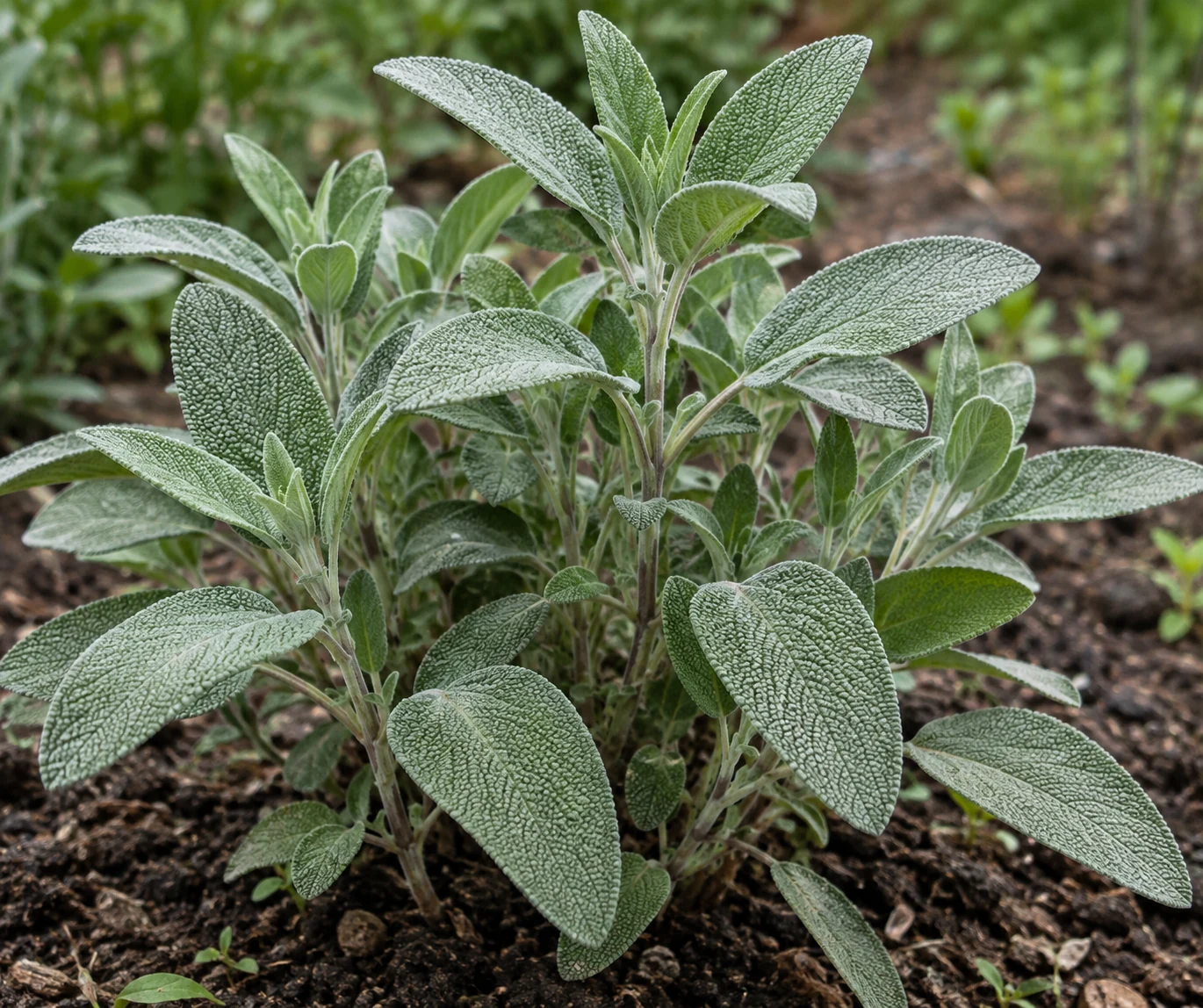
Here, sage means common garden sage, Salvia officinalis. Grove and Grotto identifies that species as the subject of its magickal profile, and A Green Witch likewise names Salvia officinalis as common garden sage. It is not white sage, Salvia apiana. For an ancestor altar, garden sage can serve as a symbol of wisdom, protection, luck or clearing—but those are attributed associations, not effects a plant is known to produce. The useful question is therefore not just “What does sage mean?” but “Which plant does this list name, whose interpretation am I using, and what form of remembrance makes sense for me?”
Which Plant Does “Sage” Mean?
A common name is a starting point, not a species identification. The National Center for Complementary and Integrative Health (NCCIH) notes that “sage” can refer to many plants in the genus Salvia. Grove and Grotto is more specific: its garden-sage profile concerns Salvia officinalis and distinguishes it from white sage, Salvia apiana. A Green Witch makes the same distinction between common culinary sage and white sage.
That distinction matters when an ingredient list offers only the word “sage.” A meaning attached to Salvia officinalis cannot establish that an unnamed ingredient is Salvia officinalis, much less that the same meaning belongs to every plant with sage in its common name. Nor should a plant labeled sagebrush—including one identified as Artemisia—be assumed to be this article’s garden-sage subject. The name to look for when interpreting the associations below is Salvia officinalis.
This is a boundary on interpretation, not a claim that other plants have no meanings of their own. If a list identifies another species, its intended symbolism needs its own context. In particular, substituting white sage raises cultural and sourcing questions beyond a simple change of ingredient; those deserve separate attention below.
Wisdom, Protection, Luck and Clearing
Grove and Grotto presents its sage examples in an account that includes European-derived traditions. In that profile, garden sage is linked with wisdom and good luck, as well as protection and the granting of wishes. These are the profile’s magickal associations, not universal meanings shared by everyone who uses a plant called sage.
A Green Witch offers an overlapping, but not identical, modern list for common sage: wisdom, protection, longevity, clarity and cleansing. Cleansing in that list can help explain why someone might place sage beside an intention to make space for reflection. Luck and wishes, by contrast, are associations explicitly named in Grove and Grotto’s profile; there is no need to make the two lists say exactly the same thing.
For an ancestor altar, the associations can become prompts rather than promises. The following are author-designed examples of reflection, not documented historical rites:
- Wisdom: Recall a piece of advice an ancestor gave, or a quality you associate with how they faced decisions. Ask what you want to carry forward.
- Protection: Name a boundary you intend to keep today. The symbol can remind you of that intention without being treated as a guarantee of safety.
- Luck or a wish: Give words to a hope—for yourself or someone you remember—without assuming that naming it will bring it about.
- Clearing: Set aside a moment for attention before remembrance. In this example, “clearing” describes the purpose of the pause, not a verified change in a room.
These readings leave room for someone whose relationship with an ancestor is complicated. Remembering wisdom need not mean treating every choice that person made as wise; a protective intention might instead be about what you choose to do differently. Those are personal interpretations of the cited symbolism, not further claims about garden sage.
Grove and Grotto expressly limits its occult-property information to historical interest and does not guarantee an outcome. That is the central distinction for using any of these meanings: an association can help shape attention and intention, but the cited profiles do not establish that garden sage will deliver luck, protection, cleansing or a granted wish.
Why Correspondence Charts Differ
A correspondence is a symbolic link a system makes between, for example, a plant and a planet or element. It tells you how that system interprets the plant; it is not a measurable botanical feature. If two charts give different labels for garden sage, first look for the reasoning behind each label rather than assuming one chart must have discovered the only correct answer.
Grove and Grotto places sage with Jupiter because, in its account, sage’s reputation for wisdom, protection and good luck fits that planetary assignment. This explains the profile’s choice; it does not make “Jupiter” a condition for working with a wisdom or protection theme. The same profile reports that some writers, including Christopher Penczak, list sage among Moon herbs. It does not supply those writers’ reasoning in the cited account, so a Moon entry is an alternative to attribute, not an invitation to invent an explanation for it.
The profile also gives an elemental distinction. It calls Air the usual tag for sage and connects that choice with the herb’s fresh smell. It then proposes Earth as an alternative, drawing on its associations with hearth and home and with manifestation. Here the competing cues are visible: scent supports one interpretation in the profile, while home-centered symbolism supports another.
Planetary and elemental labels answer different questions. A Jupiter entry does not require an Air entry, and a Moon entry does not automatically require Earth. When an ingredient list pairs them, read the pair as that list-maker’s selected correspondences unless the list explains more. For a personal reflection, you might find the profile’s hearth-and-home cue more relevant to remembering family, or its wisdom cue more relevant to considering advice. That is a choice about which stated association helps you reflect, not a ruling that other correspondences are false.
A Smoke-free Symbol for an Ancestor Altar
A Green Witch includes altar arrangements among uses it discusses for common sage and explicitly says smoke is not required for cleansing work. It also describes garden sage near a doorway as a symbol of wisdom and protection. The doorway example is useful here for what it demonstrates: the plant can represent an idea without the symbol being a guaranteed protective effect.
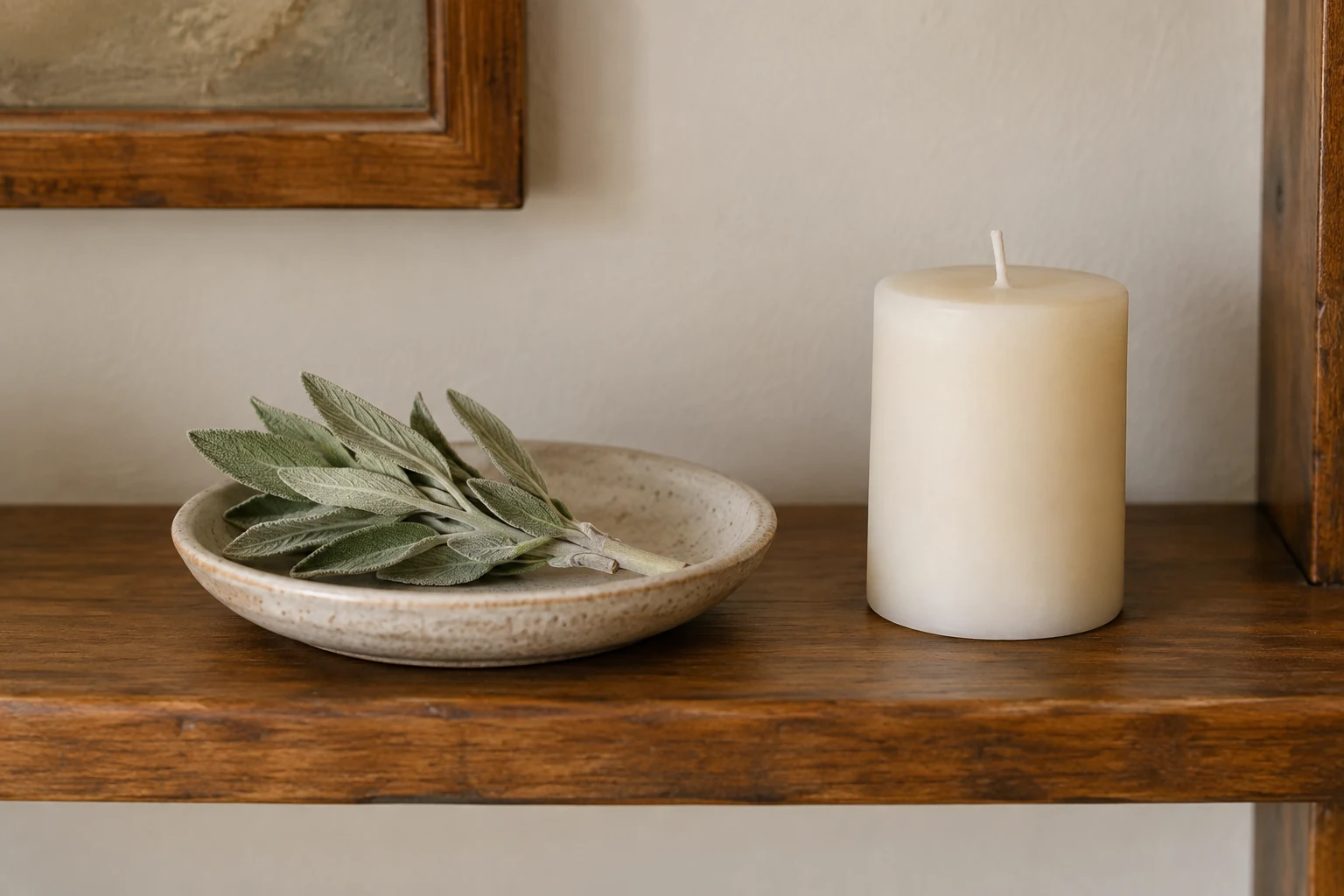
If you already own a plant you can confidently identify as Salvia officinalis, it could simply serve as a garden-sage symbol in an altar arrangement. You do not need to acquire a plant to express the same intended association, though. An author-designed alternative is to write “Salvia officinalis” on a card or use an image identified with that name. The words or image specify which sage you mean while keeping the focus on remembrance rather than on handling an ingredient.
For instance, a brief author-designed reflection could begin by naming the ancestor you want to remember. Consider one piece of advice they offered, or one quality you associate with them. Then write an intention for the day that responds to that memory: something you hope to practice, question or protect. The garden-sage name or image can mark the wisdom or protection theme drawn from the cited profiles. Nothing about this sequence is presented as an inherited rite or as a way to ensure an outcome.
A written symbol may also suit an altar devoted to someone you know only through stories. You need not invent advice they gave you; you could reflect on a quality described in a family account or on a question you wish you could ask. This is a personal use of the wisdom association, not a claim that the symbol supplies an answer. It keeps the altar’s emphasis on the person being remembered.
Where Garden-sage Meanings Must Stop
Symbolic properties are not health benefits. NCCIH cautions that sage may be unsafe in high doses or when consumed for long periods, and that sage use may be unsafe during pregnancy. Those cautions do not turn an altar association into health advice; nor does calling a plant “cleansing” establish a medical effect. The reflection described above needs no consumption or other physical-use route.
The species boundary also has a cultural dimension. The California Native Plant Society describes Indigenous communities as having maintained relationships with white sage over thousands of generations. It also reports wild white-sage poaching on both sides of the border to meet international demand. That account concerns white sage, Salvia apiana, which Grove and Grotto and A Green Witch distinguish from this article’s garden sage, Salvia officinalis.
Those facts are reasons not to treat white sage as an interchangeable stand-in when a garden-sage list seems appealing. They also do not authorize describing an Indigenous white-sage practice as a generic technique available simply because a modern garden-sage profile mentions cleansing. The two species and their contexts should remain distinct. Wild-harvested white sage is not a substitute recommendation for a reader seeking the meanings of Salvia officinalis.
A written scientific name or identified image offers a straightforward boundary: it represents the intended garden-sage association without requiring an unidentified purchase or a physical exposure route. It lets the meaning stay with the ancestor reflection rather than with an assumption that a particular plant—or its use—must produce a result.
Reading “Sage” on an Ingredient List
Suppose an altar list explicitly says Salvia officinalis. You can read “wisdom” or “protection” beside it through Grove and Grotto’s garden-sage profile and A Green Witch’s common-sage list. If the list adds Jupiter, Moon, Air or Earth, treat that as a correspondence choice: Grove and Grotto explains some of those choices and reports others as alternatives, rather than declaring a universal pairing.
Now suppose the list says only “sage.” That word does not establish which plant is intended, so it cannot by itself establish that the garden-sage meanings apply. If the identity matters, the useful question for the list-maker is its scientific name. If you simply want an explicitly garden-sage symbol for remembrance, write Salvia officinalis or use an identified image instead of acquiring an ambiguous ingredient.
The practical rule is to identify the plant, attribute the meaning, and choose a form that fits your remembrance—without treating a symbolic association as a promised outcome.