
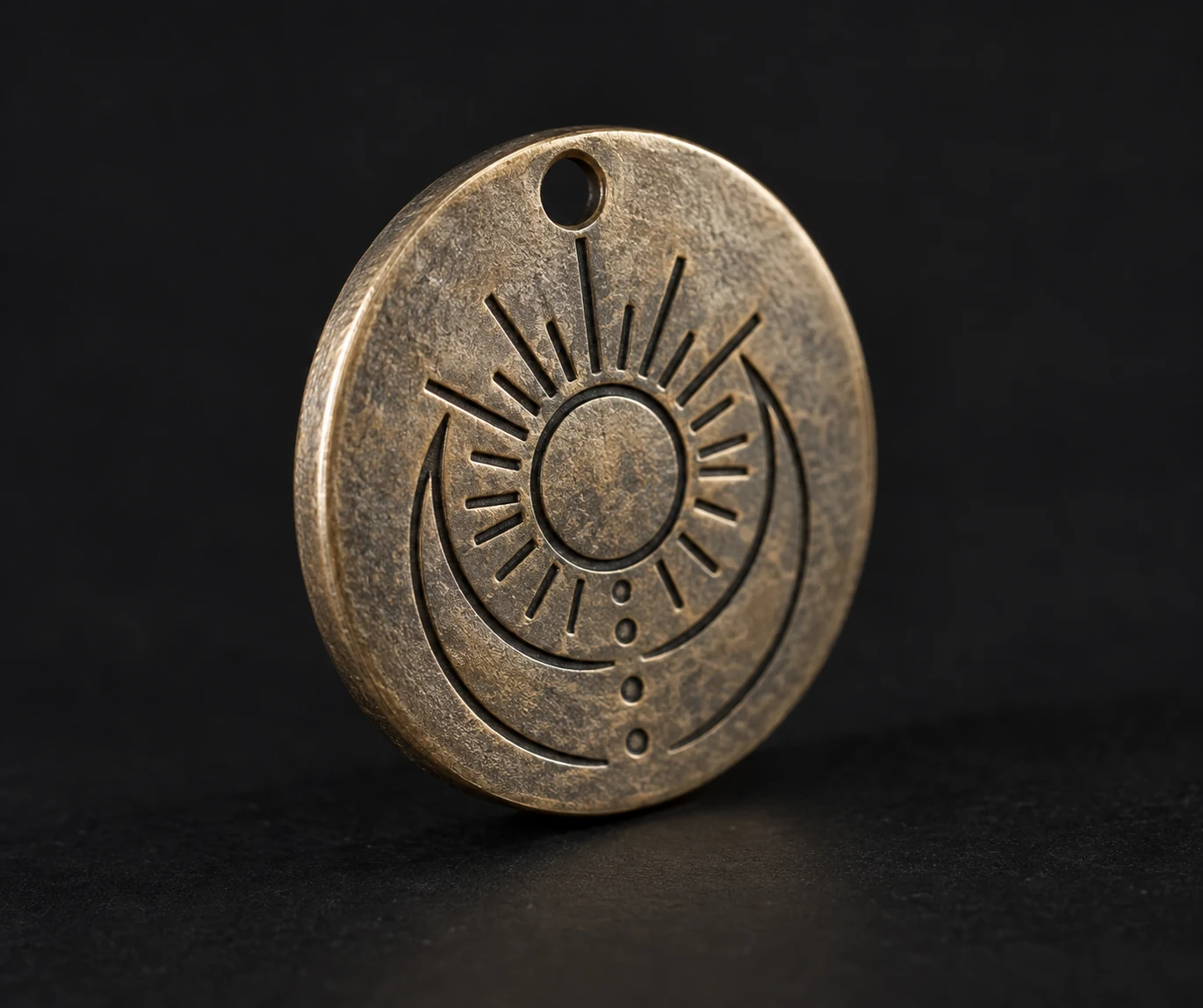
A talisman is an object made or understood to serve a particular purpose, but the word does not have one binding definition across traditions. In one museum account, the important distinction is between an amulet thought to possess natural magical properties and a talisman charged by its creator. In other contexts, the features and acts associated with an amulet are more varied. The label tells you less until you know whose usage it reflects.
“Authentic talismanic materia” has a narrower meaning here: it is Sphere + Sundry’s term for less-fixed preparations that the seller says follow its astrological talisman-making protocols. Its distinction between a lasting object and a preparation used up over time, and its standard for calling the latter authentic, belong to that practice. They are not universal tests for talismans, nor do they establish that a claimed spiritual effect occurs. A useful way to read a listing is therefore to separate three things: what tradition or maker means by the term, what is said about the object’s production, and what evidence accompanies that account.
Why Talisman and Amulet Depend on Context
The American University of Beirut (AUB) Museum offers a clear distinction: in its account, an amulet has natural magical properties, while a talisman must be charged with powers by a creator. It also distinguishes their purposes. A talisman is made for a definite reason; an amulet may have a general purpose, such as averting evil or attracting good luck. That gives a reader two questions to ask of an unfamiliar label: is the object understood to possess a property already, or to acquire one through making? Is its purpose specific or general? These questions explain the museum’s usage; they do not settle every community’s terminology.
The Metropolitan Museum of Art describes ancient Egyptian amulets through a different lens. In that historical context, understood magical power could draw on several features together: shape, decoration, inscription, color and material, as well as words spoken over an object or acts performed with it. That account does not require the reader to sort every object into the AUB Museum’s two categories before understanding it. It directs attention instead to the object and what surrounded it.
Context can matter even before a label is assigned. The Met notes that, outside their original setting, many amulets—particularly naturally formed ones—may be difficult to recognize as amulets at all. An unmarked object in a photograph, for example, might not tell a reader what role it once had; that is an explanatory possibility, not an identification of any particular object. The practical lesson is to look for the tradition, setting and maker’s stated meaning before treating amulet or talisman as a pass-or-fail category.
How an Astrological Talisman Brings Object, Material, Inscription and Timing Together
In Sphere + Sundry’s description, a talisman is classically an object of metal and/or stone. It features inscriptions such as images, names, glyphs or sigils. Rings and pendants are common forms because they can be worn, but the seller does not limit talismans to wearable objects. Here, the body is the lasting thing being made, while the inscription is part of its deliberately chosen design. Neither “metal” nor “pendant” alone describes the whole account.
For an astrological talisman in this seller’s process, an election is the selected time for its creation. Sphere + Sundry describes choosing that time, collecting and preparing base material, planning a design, and carrying out ritual production at the chosen moment. The sequence matters to the meaning of the claim: a seller saying only that a pendant has a planetary symbol has not thereby said when its material was prepared or which part of making was timed.
There is a historical reason to discuss these elements together, without assuming that every modern rule is ancient. A scholarly review of Picatrix in The Medieval Review describes spirits associated with heavenly bodies, materials understood to have sympathy with them, and specially crafted talismans. It also reports instructions in which practitioners wait for an astrally propitious time and sometimes make talismans as part of elaborate proceedings. This supports the narrower point that materials, crafted objects and timing appear in a medieval astral tradition. It does not establish the effectiveness of those practices or show that Sphere + Sundry’s particular chart requirements come from Picatrix.
Imagine an entirely hypothetical inscribed pendant described as astrologically made. Its pendant form would tell you what lasting object the maker intended; a named metal would identify its material; pictured marks or named glyphs would describe its design. A stated date and time would add the maker’s timing claim. Those are distinct pieces of information: seeing the inscription would not establish when it was made, and seeing a date would not establish what material was used. Together, they could make the maker’s account more specific, but this imagined pendant neither exists as an example for inspection nor demonstrates an effect. The point of separating the elements is to understand what each claim contributes.
What This Seller Calls Talismanic Materia
Sphere + Sundry calls a talisman a fixed body. By contrast, it uses talismanic materia for something less fixed that, according to the seller, follows the guidelines and protocols it normally employs in talisman creation. The distinction is not simply between an important object and an unimportant substance. In this usage, it concerns the form in which a claimed making process ends: a continuing object on one side, a preparation that does not remain intact in the same way on the other.
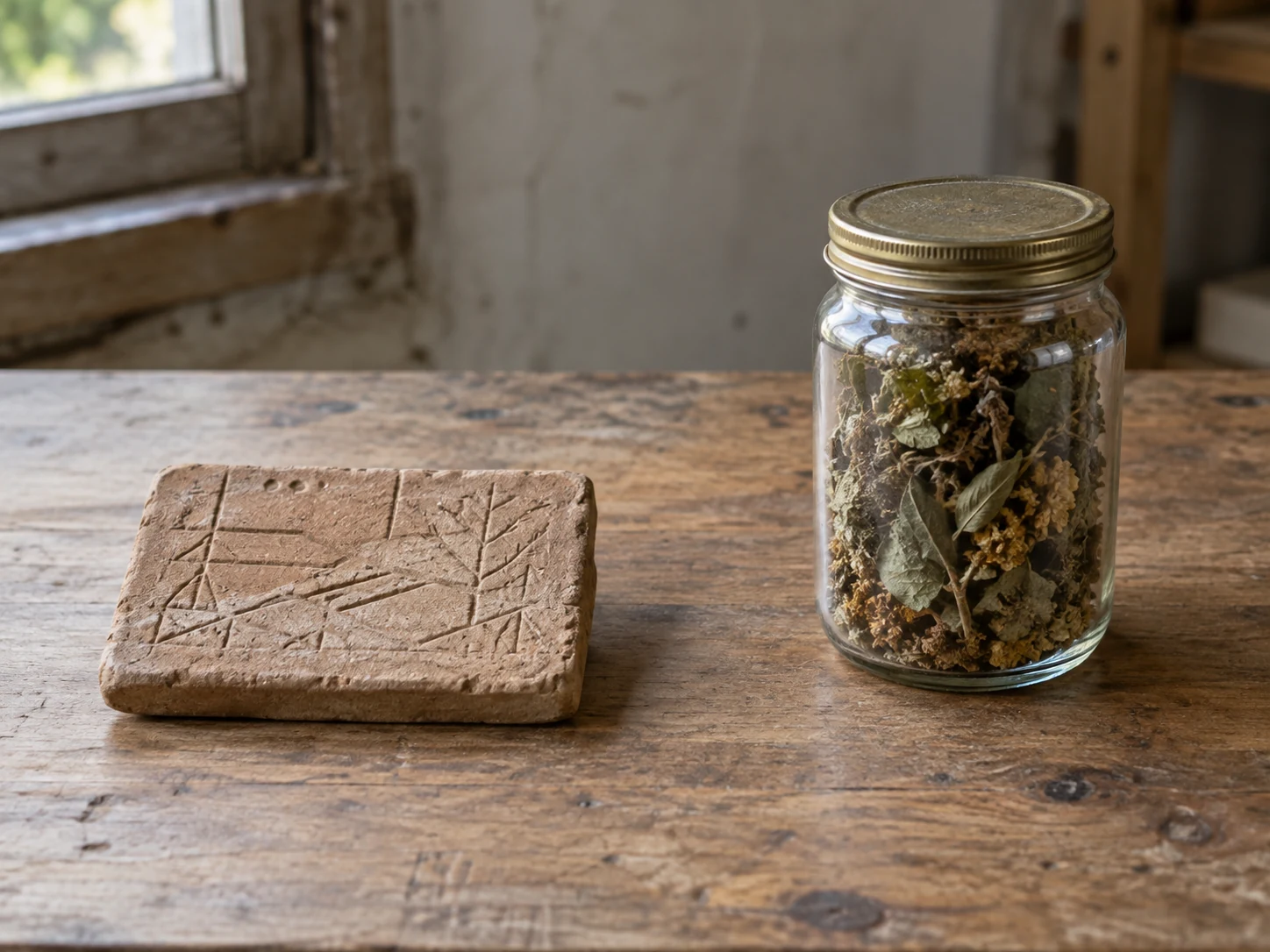
Consider the categories rather than any particular product. A ring can remain a ring and bear inscriptions on its physical surface. Sphere + Sundry contrasts such objects with preparations including oils, candles, water and incense blends. Its explanation points to two differences: oils can deteriorate and candles are used up, while physical water or an incense blend cannot be marked with images and names as a ring or pendant can. The seller also describes talismanic materia as used in doses that deplete the formula. Those features explain why it does not simply call every preparation a fixed talisman.
That distinction helps interpret a listing’s nouns. Calling something materia may signal a claim about how a less-fixed preparation was made, not a claim that it has become an inscribed, enduring object. It does not, by itself, document that the seller’s protocols were followed. Nor does the word establish an effect. A reader can understand the category without accepting either the production claim or the spiritual interpretation attached to it.
What “Authentic” Requires in the Seller’s Account
Sphere + Sundry sets a stricter standard for what it calls authentic talismanic materia than putting a planetary name on a preparation. It explicitly distinguishes its standard from an oil, incense or similar item made at an unspecified time and given a planetary label. A name such as “Venus” may tell a reader what association a maker intends to convey; on its own, it says nothing about whether the seller’s stated process took place.
The seller’s additional requirement concerns the whole election chart, not just one planetary association. In describing its criteria, Sphere + Sundry says the Moon must be supporting and key powers should be on chart angles or in good houses. These are conditions within its astrological account of making. They explain why, in that account, a label or a single selected feature would be insufficient. They are not presented here as an independently validated certification system or as conditions every tradition must adopt.
Three questions remain separate. What is the standard? The seller states its own chart and making criteria. Was a particular item made to that standard? That calls for evidence about an actual production, beyond knowing the criteria exist. Does the item have the claimed spiritual effect? Neither the seller’s definition nor records of a chart settle that question. A reader need not calculate an election to see the distinction: a rule about what a maker intends to do, an account of what happened, and a claim about what it accomplishes are different kinds of statements.
What a Production Account Can—and Cannot—Document
If an item is advertised as astrologically timed, provenance questions can make its claim more intelligible. Sphere + Sundry recommends publishing the working’s date, time and location, preferably with an accessible full chart. Those details let a reader see what time and place the maker is identifying, rather than having only a general phrase such as “made under Venus.” This is a question suited to that kind of advertised production; it is not a documentation requirement for every talisman tradition.
The seller’s own sequence suggests other concrete questions. What base material does the maker say was collected and prepared? What design was planned? Which act does the maker say took place at the selected moment: preparation, inscription, another part of production, or the production as a whole? Asking this does not add a new ritual rule. It helps resolve what an otherwise vague timing statement refers to, using the stages Sphere + Sundry itself describes.
A production account is not the same as independent verification. A maker’s description states what they say they did. Records such as a dated chart or documentation of an object’s design may support parts of that account, while other parts may still rest on the maker’s testimony. Even a detailed, internally consistent account does not establish a magical effect. The useful conclusion is narrower: the reader can identify what is disclosed, what remains an assertion, and whether the available details address the particular production claim being made.
Reading Two Hypothetical Listings
The following listings are author-invented explanatory examples, not observed products, reports of sales or recommendations. They show how the distinctions change what a description actually communicates.
Example one: “Venus” bottle. Imagine a bottle labeled “Venus,” with no stated materials beyond its contents being a preparation, and no production date, location, chart, design account or description of ritual production. The name communicates an intended planetary association. It does not say which materials the maker selected, whether an election was chosen, or whether any act occurred at that time. If the bottle is offered as a preparation that would be depleted, its form resembles Sphere + Sundry’s materia category rather than the seller’s fixed, inscribable talisman. But form and label do not document that the seller’s full-election standard was followed. In Sphere + Sundry’s terms, the available description would leave a claim to authentic talismanic materia unsupported; that is an assessment of the information in this invented listing, not a finding about a real bottle.
Example two: timed pendant. Now imagine a maker describing an inscribed pendant, identifying its material and design, and supplying a working date, time, location and chart. The description offers more to examine: a proposed lasting object, the marks said to be on it, a named material and a specified astrological moment. The chart gives a reader a record of the time and place the maker identifies. It does not, merely by accompanying the listing, show that the material was prepared as described or that the pendant was inscribed or otherwise produced at that moment. Those remain production assertions unless there is further corroboration. The example also does not establish whether the chart meets any practitioner’s criteria or whether the pendant has an effect.
The two descriptions differ in what they disclose, not in any demonstrated spiritual outcome. One gives a planetary association without a production account; the other pairs a described object with specific timing records while leaving parts of the making account to the maker’s word. Neither example calls for a purchase verdict or an election calculation.
The lasting distinction is to read a term within its tradition. Sphere + Sundry’s enduring talisman and depleted materia are categories in that seller’s practice; its authentic standard adds particular making criteria. Production details can clarify and sometimes support what a maker claims to have done. They should not be mistaken for proof that a claimed effect occurred.