
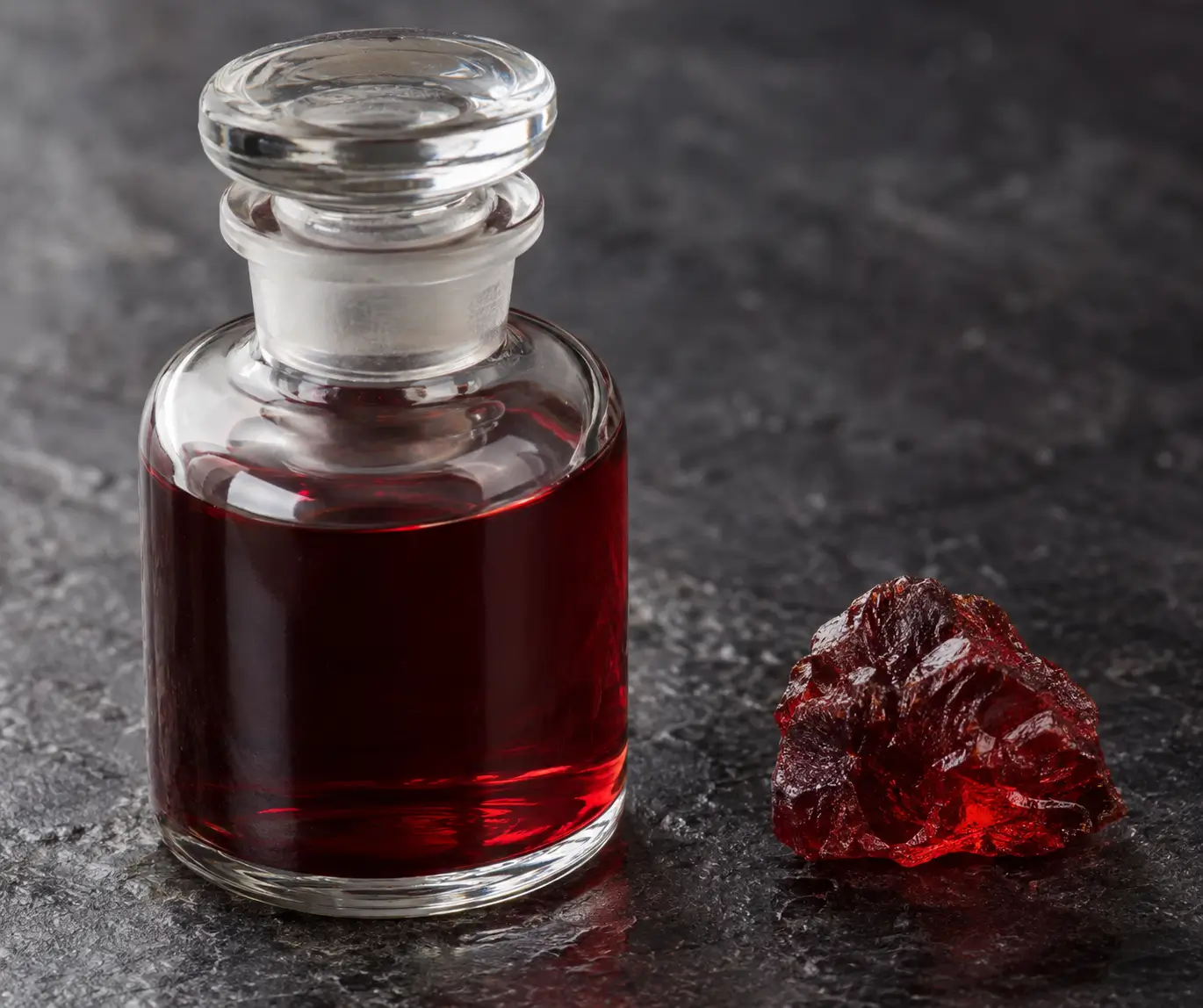
“Dragon’s blood ink” is not literal blood or a single, universally defined substance. Dragon’s blood is a common, non-specific name for red plant resins associated with several botanical sources. Historically, some of these resins served as pigments, but a traditional colorant is not the same as a finished ink.
The practical distinction is simple:
> Dragon’s blood names a family of historically significant red plant resins. Dragon’s blood ink is a finished product whose identity depends on its disclosed formulation.
When evaluating an ink or recipe, keep three questions separate: What historical material does the name reference? What does this product actually contain? What meaning does it hold within a tradition or personal practice? The label alone cannot answer all three.
What “Dragon’s Blood” Means
Dragon’s blood is neither literal blood nor one uniquely defined botanical substance. A peer-reviewed conservation study describes it as a common but non-specific name for red resins obtained from several plants.
Kew’s medicinal plant names service associates the name with accepted taxa including Calamus draco, Dracaena cinnabari, and Croton lechleri. These are distinct botanical sources, not interchangeable forms of one plant. Their shared common name therefore does not prove that two materials have the same species, geographic origin, or composition.
Whenever a raw material, recipe, or commercial product is called “dragon’s blood,” the name leaves important questions unanswered:
- Which plant, if any, supplied the resin?
- Where did that material originate?
- Is the resin identified beyond its common name?
- Does the finished product contain botanical resin at all?
“Dragon’s blood” can communicate a historical category, trade identity, color association, or symbolic theme. On its own, however, it is too broad to establish an ingredient. A species name, identified resin source, or detailed ingredient statement provides more useful information.
This distinction becomes especially important with commercial ink. The resin may be an ingredient, an inspiration, or simply part of the product’s name. A label that says “dragon’s blood ink” does not by itself establish which meaning applies.
From Botanical Resin to Historical Colorant
The connection between dragon’s blood and red ink begins with its documented use as a coloring material. Cambridge describes dragon’s blood as a red tree-resin pigment used for nearly two millennia. That history explains why the name remains associated with rich red pigments, paints, and inks.
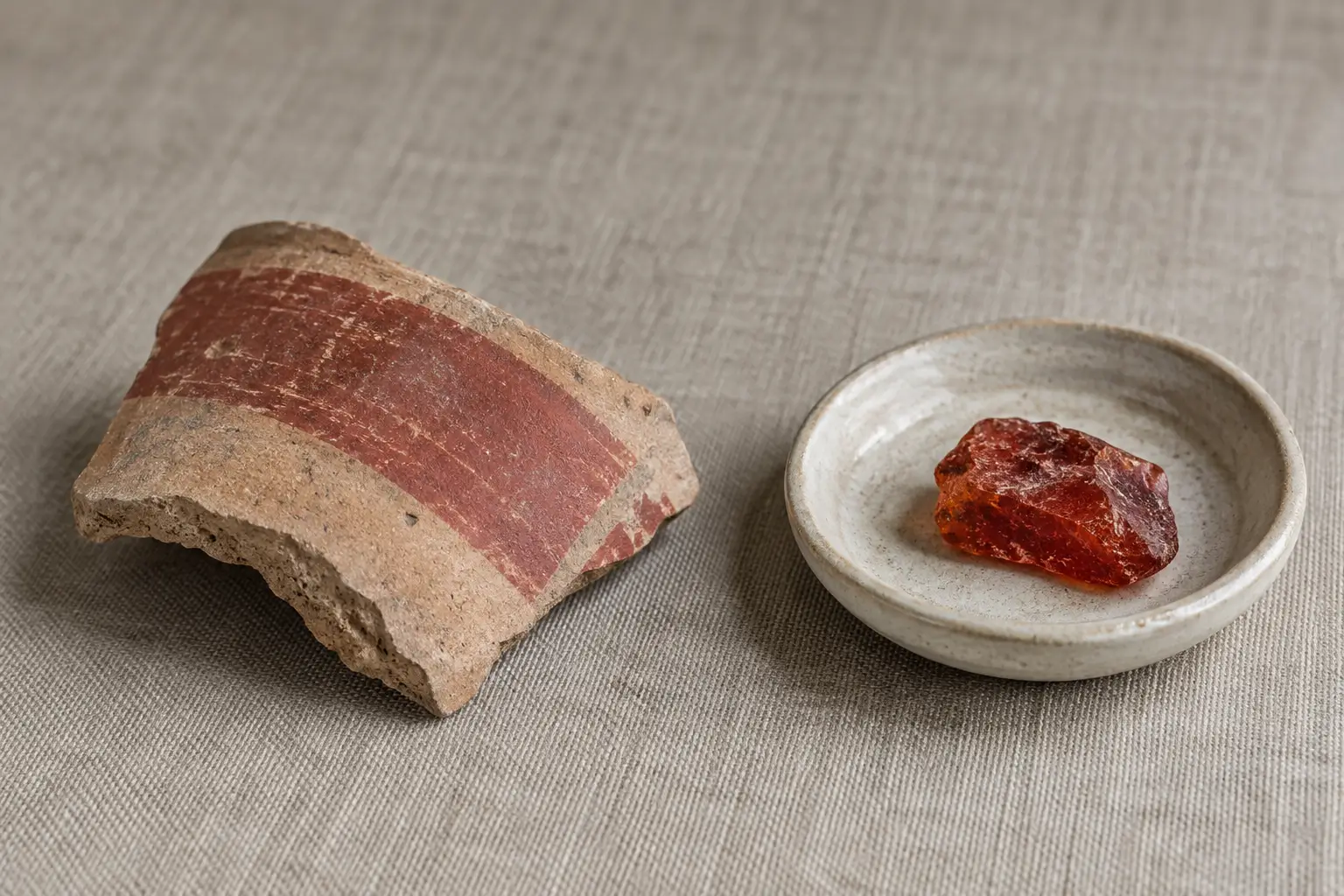
Particular records also show that the shared name covered materials from different plants and regions. The British Museum documents Socotran Dracaena cinnabari resin used as a pottery pigment. This is evidence of one identified resin serving one specific coloring purpose. It does not show that all historical dragon’s blood came from that species or received the same preparation.
The Smithsonian records another historical material: Calamus draco resin imported from Sumatra and Borneo and formed into dragon’s blood sticks. Considered together, the Socotran and Southeast Asian examples demonstrate that materials from distinct plants and geographic origins circulated under the same broad name.
These records establish two related points. First, dragon’s blood has a long documented history as red resin and pigment. Second, that history is not tied to one botanical source.
The evidence should not be extended further than that. Historical pigment use does not reveal the ingredients of an unlabeled modern bottle. Nor does it establish how a present-day product will flow, dry, adhere, age, or interact with a pen, nib, brush, paper, or other surface. The cited records concern identified historical resins and uses, not the composition or performance of every contemporary product sold under the name.
A traditional material can influence a product’s name, color, symbolism, or presentation without being present in its formula. Continuity of language is not necessarily continuity of ingredients.
Why a Red Resin Is Not Automatically an Ink
A botanical resin, a prepared colorant, and a finished ink are related but distinct.
At the source-material level, dragon’s blood refers broadly to red plant resins associated with several taxa. When one of those resins is prepared and used to supply color, it functions as a pigment or colorant. Historical evidence includes the long use of dragon’s blood as a tree-resin pigment and the documented use of Dracaena cinnabari resin on pottery.
An ink is a complete formulation. In addition to its colorant, it may contain a carrier, binder, and other ingredients that affect consistency, drying, adhesion, preservation, and intended application. Calling a product “dragon’s blood ink” does not disclose those components. It also does not establish whether the color comes from traditional botanical resin or from something else.
The name alone leaves all of the following unresolved:
- whether botanical resin is present;
- which species supplied any resin;
- which carriers, binders, or additives are included;
- whether additional or alternative colorants are used;
- how the ink behaves during writing;
- what handling precautions apply; and
- which tools and surfaces are compatible with it.
The supplied research does not answer these questions for a particular commercial ink or homemade recipe. It establishes the broad botanical meaning of dragon’s blood and documents selected historical uses as pigment. It does not supply a universal recipe for dragon’s blood ink.
Historical use also cannot prove that a contemporary ink contains Calamus draco, Dracaena cinnabari, Croton lechleri, or any other botanical material. The museum records describe specific objects and resins, not every current product that borrows the name.
Performance likewise depends on the finished formula rather than on the historical reputation of its possible colorant. Evidence that a resin once served as a pigment does not establish that a modern preparation is safe or suitable for a fountain pen, dip pen, brush, technical pen, skin, or any particular surface.
Instead of asking only whether an ink is “genuine,” ask more precise questions:
- What does the maker or recipe claim it contains?
- Is a botanical species or resin source identified?
- Does “dragon’s blood” describe an ingredient, a color, or a theme?
- What uses and tools does the product documentation specify?
These questions separate the history of the name from the contents of the bottle.
How to Interpret a Modern Dragon’s Blood Ink
Botanical source is a meaningful compositional detail. Analytical research using gas chromatography–mass spectrometry has distinguished dragon’s blood resins from Dracaena and Daemonorops species. Materials grouped under the same common name can therefore have identifiable differences in origin; the source is not merely a naming technicality.
To evaluate a modern ink or recipe, begin with product-specific disclosures. Look for:
- an ingredient list;
- a named botanical species;
- the stated source of any resin;
- an explanation of what “dragon’s blood” means in that product;
- recipe details identifying the colorant, carrier, binder, and additives; and
- directions for intended use, handling, storage, and compatible tools.
A species name such as Calamus draco, Dracaena cinnabari, or Croton lechleri is more precise than the common name alone. Even so, identifying a species does not disclose the complete ink formula. “Contains dragon’s blood resin” is more informative when the resin source and the other significant components are also stated.
When disclosures are vague or absent, do not replace missing information with certainty. A product called dragon’s blood ink might contain botanical resin. It might use a different red colorant, invoke a fragrance or symbolic association, or rely on an otherwise undisclosed formulation. The cited evidence does not allow a reader to choose among those possibilities without information about the specific product.
Ambiguous labeling does not prove that an ink is botanical or non-botanical, traditional or modern, suitable or unsuitable. It means only that its composition has not been established from the label.
Use the ink according to its disclosed formulation and product-specific directions. The research cited here does not establish the safety, writing behavior, or tool compatibility of any particular product or recipe. Historical pigment records cannot substitute for current handling instructions.
For calligraphy, this means checking whether the maker explicitly approves the ink for the intended pen, nib, brush, and surface. If compatibility is not stated, the historical use of dragon’s blood as a pigment is not evidence that the product will work in a particular tool.
For spiritual practice, material composition and spiritual meaning are also separate questions. A tradition or practitioner may associate dragon’s blood with a particular intention, ritual role, or symbolism. That significance can guide personal practice, but it is not a guaranteed physical property, medical benefit, or magical effect. A product’s botanical authenticity does not establish a spiritual result, and a symbolic use does not establish botanical content.
The clearest interpretation keeps three layers distinct:
- Historical identity: Dragon’s blood is a long-used name for red plant resins and pigments from multiple botanical sources.
- Modern composition: The ingredient list, identified resin source, and complete formulation determine what a particular ink contains.
- Spiritual meaning: Ritual or symbolic significance depends on tradition and personal practice rather than being guaranteed by the label.
Dragon’s blood ink is therefore not one standardized substance. It is a modern product name connected to a diverse group of historical red resins. Check the ingredients and resin source, distinguish the traditional colorant from the finished formulation, and use the product according to what its documentation actually supports.