
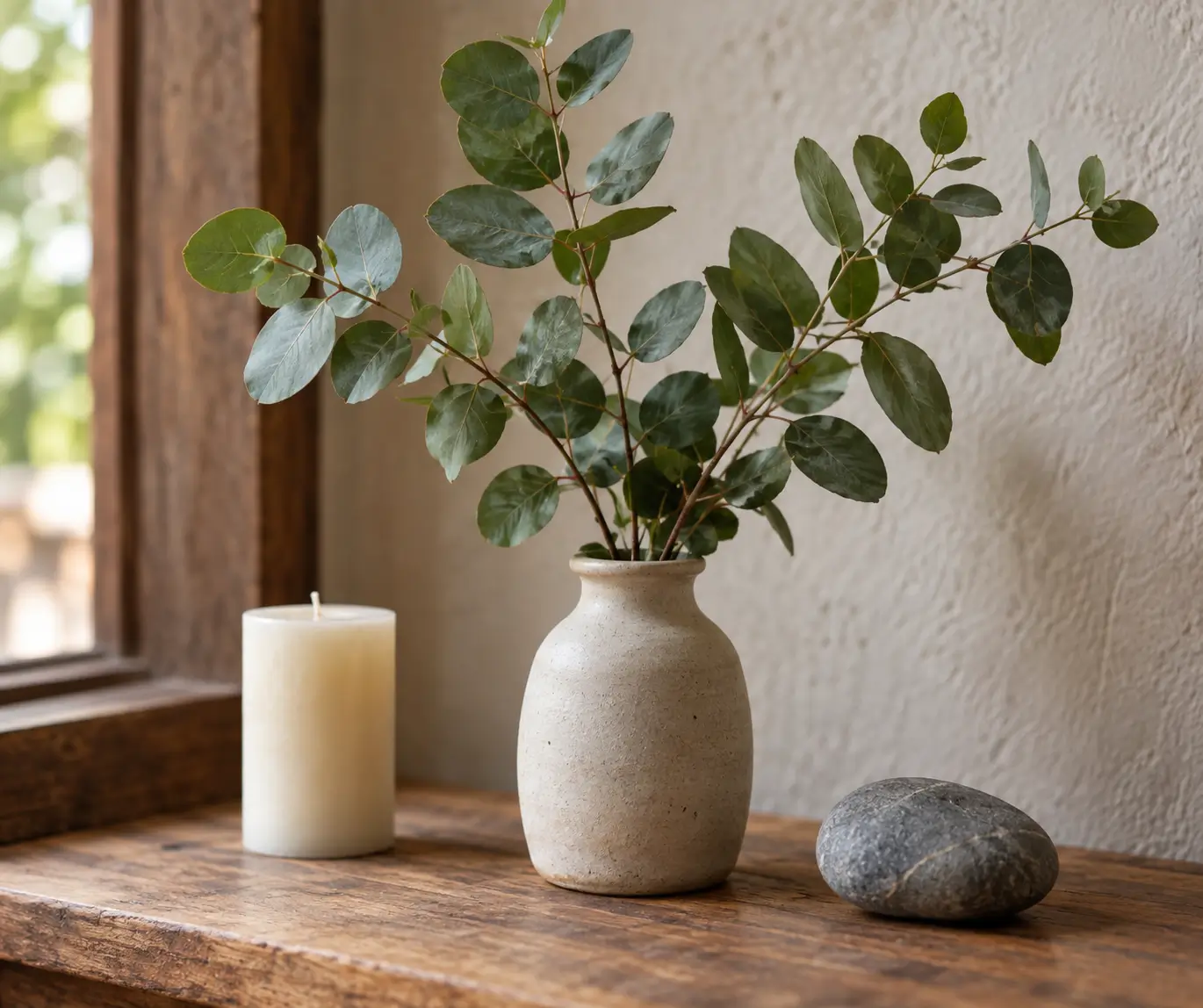
A useful way to approach eucalyptus in ritual work is to separate four layers: what the plant is, how it is used materially, what it symbolizes within a practice, and what its products can safely do. A correspondence is an association between a material and an intention. It may be spiritually meaningful without being a botanical fact, a universal teaching, or a guaranteed physical effect.
This layered approach keeps several questions from collapsing into one. A fact about classification does not prove a correspondence; a traditional or personal correspondence does not prove a medical effect; and an appealing label does not establish safe handling. Keeping those questions separate allows ritual meaning to remain meaningful without asking it to function as scientific evidence.
What “Eucalyptus” Identifies
Eucalyptus is an accepted genus in the myrtle family, Myrtaceae. The name therefore identifies a group of plants, not one uniform species, substance, or ritual product. Kew gives the genus a broad native range extending from the Philippines to Australia.
This distinction matters when an altar supply, dried leaf bundle, fragrance, or bottle of oil is labeled only as “eucalyptus.” The broad name does not necessarily reveal which species is present, how the material was prepared, or whether the product contains identifiable plant material. The supplied evidence does not support treating every member of the genus as identical in appearance, aroma, composition, or use.
Because the genus contains multiple species, the word alone is a starting point rather than a complete identification. For ritual planning, that means readers should avoid moving directly from the general name to assumptions about a specific object. First identify whether the item is botanical material, a fragrance product, or an oil; then read the available label.
Kew records eucalyptus species as being planted for timber, firewood, oil production, and ornament. These are documented material uses. They provide context for understanding how people interact with the plants, but they do not prove that eucalyptus has a fixed spiritual purpose.
That boundary is essential: botanical identity describes a plant, not its magickal meaning. Plant family, native range, and practical cultivation belong to botanical and material documentation. A correspondence such as cleansing, protection, renewal, or strength belongs to a spiritual interpretation unless appropriate evidence connects it to a particular tradition.
The supplied sources establish botanical identity and practical cultivation, but they do not establish a universal system of eucalyptus correspondences. It is therefore more accurate to say, “I associate eucalyptus with this intention,” than to claim that eucalyptus inherently carries the same meaning in every practice.
How Eucalyptus Acquires Symbolic Meaning
Symbolic meaning often begins with attention. A practitioner notices a plant’s appearance, aroma, growth, practical use, or personal emotional associations and connects that observation with a ritual intention. The connection may be coherent and meaningful, but it does not become a scientific property of the plant.
For example, someone might associate a pronounced aroma with alertness or with the transition from ordinary time into ritual space. Another person might draw symbolism from eucalyptus being cultivated for ornament, timber, firewood, or oil. These observations can inspire correspondences, but the resulting meaning belongs to an interpretive framework.
Two kinds of correspondence should be kept distinct:
- A personal association explains what a material represents to an individual and why.
- A tradition-based correspondence reports a teaching documented within a particular spiritual or cultural tradition.
The first requires honesty about personal interpretation. The second requires suitable historical or cultural evidence. The supplied evidence does not document cleansing, protection, healing, or any other magickal use as universal, scientifically verified, or established within a named tradition. Familiarity in contemporary spiritual writing is not enough to justify attributing a belief to a culture.
This boundary does not diminish personal symbolism. Spiritual significance may be individual, communal, inherited, or tradition-specific. It simply answers a different question from botany. Botanical information describes what the plant is; a correspondence expresses how someone understands or works with it.
To define a personal correspondence, complete a sentence such as:
> In my practice, eucalyptus represents ______ because I associate its ______ with ______.
Naming both the meaning and the reason makes the interpretation transparent. It also leaves room for the association to change. If the material later feels distracting, unpleasant, or unsuitable, there is no need to preserve a correspondence merely because a book, website, or product description presented it as fixed.
A simple way to test the wording is to ask whether another practitioner could disagree without being botanically wrong. If so, the statement is probably interpretive. “Eucalyptus is a genus in Myrtaceae” is a botanical claim. “Eucalyptus represents renewal in my practice” is a personal correspondence. Keeping the grammar explicit—“I associate,” “my tradition teaches,” or “this source documents”—helps reveal the evidence layer.
When encountering a claim that eucalyptus “is for” a particular purpose, consider what kind of statement is being made. It may be botanical information, a documented teaching from a defined tradition, an author’s personal system, or commercial language. These categories are not interchangeable.
This approach also supports respectful practice. You can state what eucalyptus means to you without assigning that belief to a named people or tradition for which you have no evidence. If you do follow a specific tradition, its own teachings and sources should guide how the plant is understood.
Plant Material, Aroma, and Essential Oil Are Different Forms
“Eucalyptus” can refer to materially different things. Physical plant material, a eucalyptus-scented product, and concentrated eucalyptus essential oil are not interchangeable merely because they share a name or aroma.
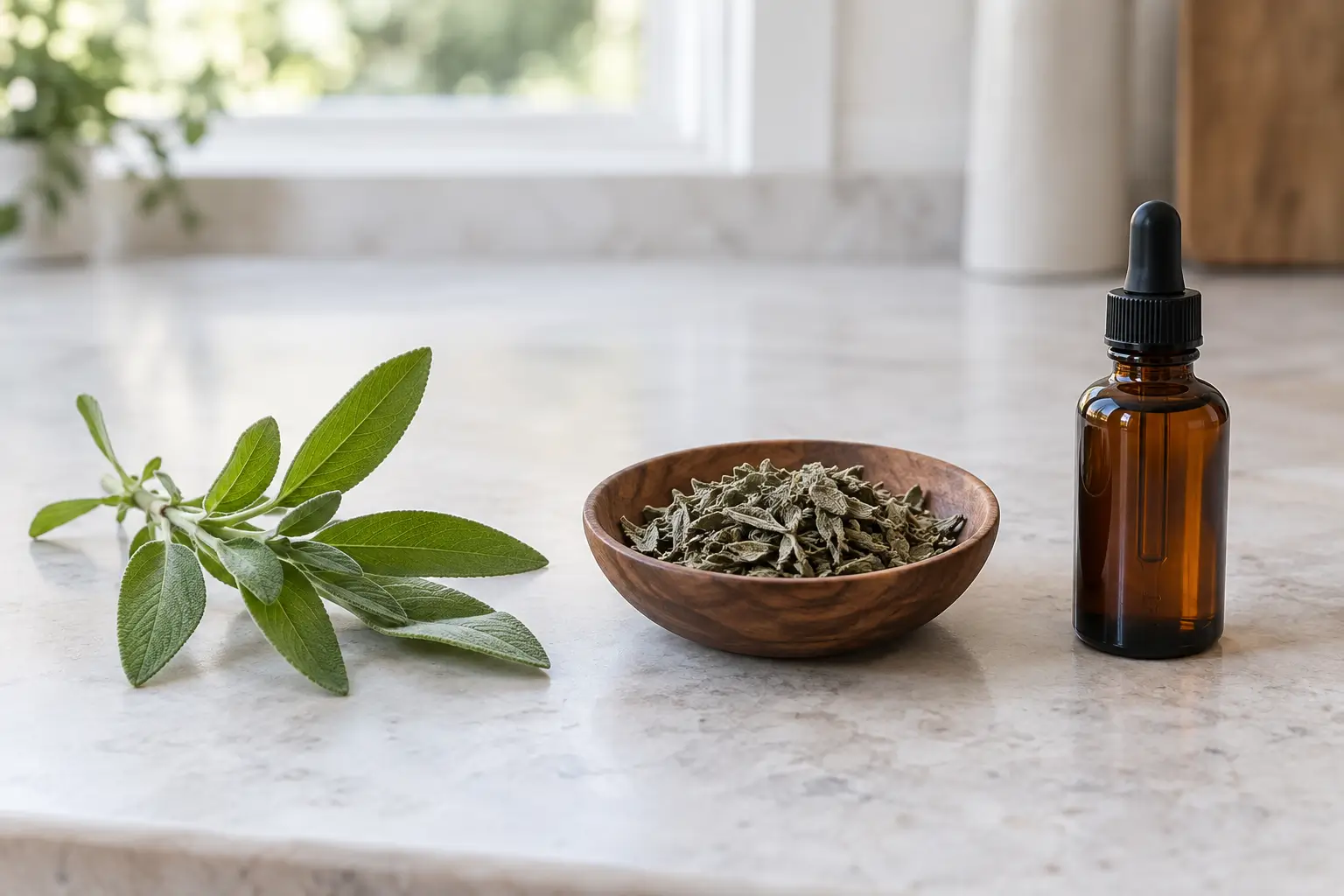
Physical plant material may include identifiable leaves or other botanical matter. A eucalyptus-scented product may contain eucalyptus-derived ingredients, added fragrance, a mixture, or something else, depending on its label. Essential oil is a concentrated product with handling concerns that do not apply in the same way to a picture, written symbol, or intact decorative material.
A product label is therefore part of an informed ritual choice. It should identify what the item contains and how it is intended to be used. Broad terms such as “natural,” “traditional,” or “ritual-grade” do not establish the species, ingredients, concentration, or appropriate handling. Nor do they make a product suitable for swallowing or skin contact.
Species and preparation still matter when the intended use is symbolic. Eucalyptus is a genus rather than one uniform substance. The available evidence does not justify assuming that every eucalyptus species, fragrance, oil, dried material, or manufactured preparation has identical qualities.
Choose the least intensive form that can fulfill the ritual purpose. If the goal is visual symbolism, a clearly identified decorative form may be enough. If no physical plant is needed, a drawing, written name, or other representation can carry the intended meaning. If aroma is important, select a clearly labeled product and use it only as directed.
When comparing forms, ask what sensory element the ritual actually requires. A visual altar may need only an image or labeled plant material; an aromatic practice requires a product intended for that use. This keeps selection tied to function rather than to the assumption that stronger, more concentrated, or more expensive means more authentic.
The most concentrated form is not automatically the most spiritually effective. Chemical concentration and ritual significance are separate concepts. A simple representation may hold greater personal meaning than a concentrated oil, while also being easier to identify and handle appropriately.
Keeping the forms distinct also prevents symbolic language from turning into a health claim. Displaying eucalyptus, appreciating an aroma, and treating a medical condition are different activities. A person may describe a ritual as spiritually “clearing,” but that description should not imply that eucalyptus clears an infection, prevents illness, or produces another guaranteed physical result.
Practical Boundaries for Ritual Use
There is no strong evidence that eucalyptus essential oil prevents or treats colds. Ritual use, fragrance, and personal symbolism should not be presented as medical care.
A practitioner may say that an aroma helps mark a transition, focus attention, or symbolize renewal within a personal ritual. Those are statements about intention or individual experience. Saying that eucalyptus prevents infection, cures a cold, or provides a proven treatment would cross into a health claim unsupported by the supplied evidence.
Eucalyptus oil also requires stricter handling boundaries than a drawing or decorative plant material. Kew warns that eucalyptus oil can cause serious adverse effects if ingested and may cause contact dermatitis. Descriptions such as “natural,” “traditional,” or “ritual-grade” do not remove those risks.
For altar or ritual work, favor a clearly labeled, non-ingestive form that suits the intended purpose. Read and follow all product warnings and intended-use instructions. A spiritual designation is not permission to swallow a product, and an item intended for fragrance or display should not be assumed suitable for the skin.
Avoid skin contact when a product is not labeled for it. If contact causes irritation, discontinue contact. The available sources establish limited boundaries—serious adverse effects from ingestion, possible contact dermatitis, and a lack of strong evidence for preventing or treating colds. They do not support dosing advice, medical protocols, or claims that a particular preparation makes ingestion safe.
One useful final check is to describe the intended action in plain language: display, smell as directed, or use symbolically. If the action depends on swallowing the oil, putting an unsuitable product on skin, or claiming prevention or treatment, choose a different form or remove the health claim. This check does not replace the label; it reinforces it.
Before using an item, identify what it actually is and why it belongs in the ritual. Its role might be visual, aromatic, or symbolic. State whether its meaning is personal or supported by evidence from a particular tradition, and follow the instructions appropriate to that specific product. If the purpose begins to include preventing or treating illness, it has moved beyond the evidence for ritual or aromatic use.
A sound choice matches personal symbolism while identifying the material honestly. Choose a non-ingestive form suited to the purpose, follow its warnings, and present its correspondence as personal or tradition-specific rather than universal. Within those boundaries, eucalyptus can hold genuine ritual significance without turning spiritual intention into a promise of physical effects.