
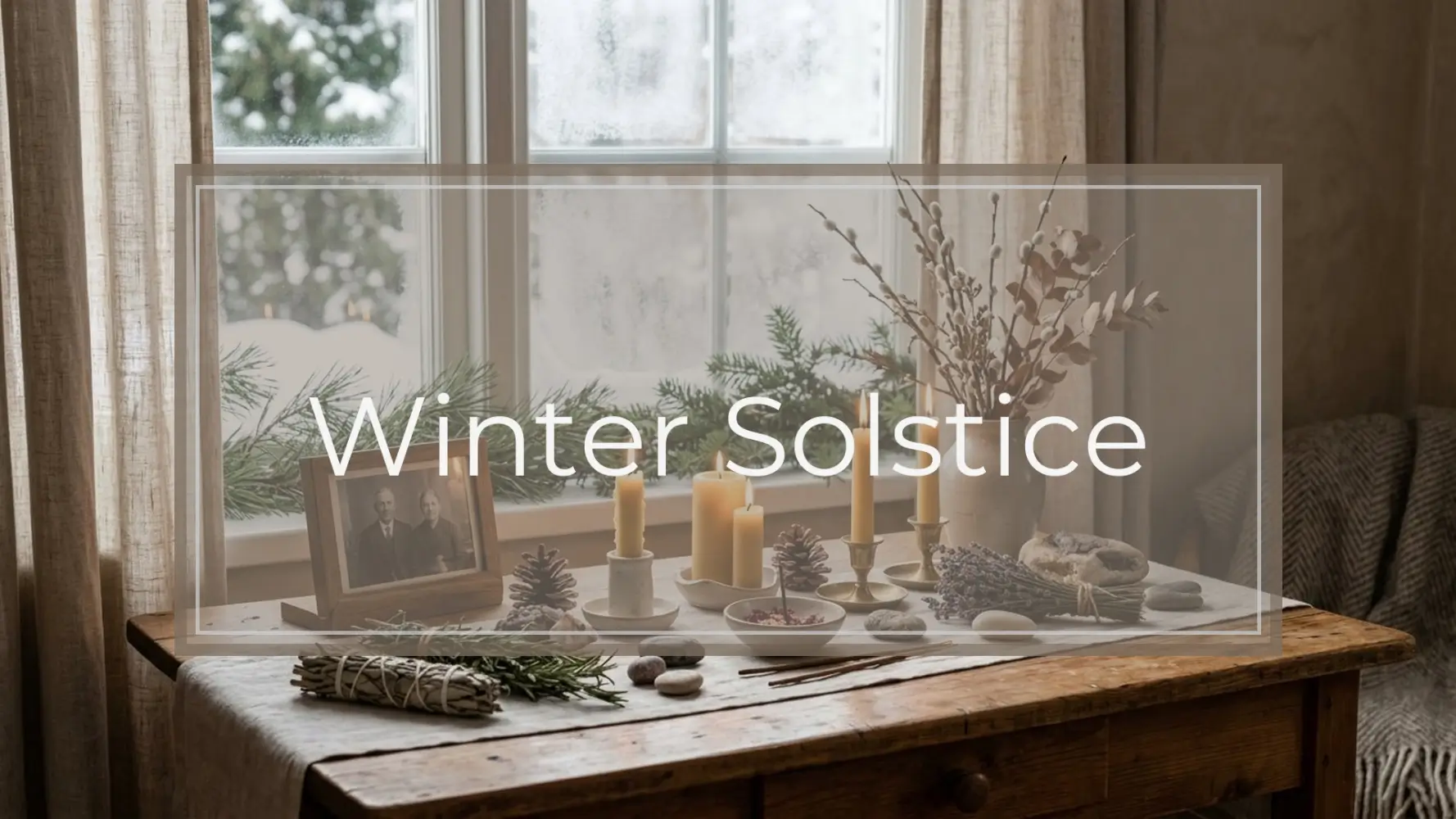
The winter solstice is the shortest day and longest night of the year. In the Northern Hemisphere, it usually falls around December 21 or 22 and marks the turning point when daylight slowly begins to return. People observe the winter solstice with candles, evergreen decorations, quiet reflection, warm food, storytelling, and seasonal rituals that honor both darkness and the returning light.
For those who keep an ancestor altar, the winter solstice can be a meaningful time to remember the people who came before you, give thanks for the year’s endurance, and create a gentle ritual of rest and renewal.
Quick answer: The winter solstice is the shortest day and longest night of the year, marking the seasonal turning point when daylight begins to return. Many people observe it with candles, evergreen decorations, reflection, rest, storytelling, offerings, and ancestor altar practices that honor the dark season while welcoming the light.
This guide explains what the winter solstice means, why it matters spiritually and seasonally, common symbols, and simple ways to create a winter solstice ancestor altar at home.
What Is the Winter Solstice?

The winter solstice is an astronomical event that happens when one of Earth’s poles is tilted farthest away from the Sun. In the Northern Hemisphere, this creates the shortest day and longest night of the year. In the Southern Hemisphere, the timing is reversed: the winter solstice usually occurs around June 20 or 21.
In the Northern Hemisphere, the winter solstice typically falls on December 21 or 22, though the exact date can shift slightly depending on the year and time zone. It is not simply a cold-weather holiday or the “middle of winter” in a weather sense. It is a solar turning point caused by Earth’s axial tilt and orbit around the Sun.
After the winter solstice, daylight begins to increase little by little. The change is gradual, but symbolically powerful. For many people, this makes the solstice a natural moment to pause, look inward, and acknowledge that even in the longest darkness, the light is returning.
Common winter solstice themes include:
- Rest after a long year
- Reflection and memory
- Renewal and quiet hope
- Honoring the dark season
- Welcoming the gradual return of daylight
- Gathering with family, friends, or community
- Remembering ancestors and beloved dead
Many cultures and spiritual traditions have honored this turning point in different ways. Some practices are religious, some are folk customs, and some are personal or secular. There is no single universal winter solstice ritual. A candle in a window, a shared meal, a walk at sunset, or a small offering on an ancestor altar can all be meaningful ways to mark the season.
For ancestor altar practice, the winter solstice invites a simple question: What helped my people endure the dark season, and what wisdom can I carry forward?
Why the Winter Solstice Matters Spiritually and Seasonally
The winter solstice matters because it is a natural pause point. The year has nearly completed its cycle, the nights are long, and the outer world often becomes quieter. Even in places without snow or harsh winter weather, the solstice can still feel like a threshold: one season deepens, another begins to turn.
Spiritually, many people use this time for reflection rather than constant activity. The darkness of the solstice does not have to be treated as negative. Darkness can also mean rest, sleep, memory, mystery, and inner listening. Seeds wait in darkness. People rest in darkness. Stories are often told in the dark. Ancestor remembrance also belongs naturally to this time because memory often rises when the world slows down.
This is one reason candles, lanterns, and hearth fires appear in many winter observances. A flame offers warmth, visibility, and focus. Lighting a candle at the winter solstice can be a way of saying, “I acknowledge this long night, and I welcome the light that returns.”
Evergreens are another common symbol. Trees and plants that remain green through winter can represent endurance, continuity, and life held quietly through cold months. Pine, cedar, fir, rosemary, and holly may appear in seasonal decorations, wreaths, garlands, or altar arrangements. Their meaning varies by culture and household, but many people associate them with resilience.
Warm foods and shared meals are also deeply connected to the season. Soup, bread, tea, cider, roasted vegetables, preserved fruit, and family recipes all speak to winter survival. For our ancestors, winter often required preparation, storage, cooperation, and careful use of resources. Food was not only nourishment; it was memory, labor, and care.
When you honor ancestors at the winter solstice, you are not required to perform anything elaborate. You might remember the people who preserved recipes, repaired homes, kept children warm, told stories, crossed difficult distances, survived scarcity, or made beauty in hard times. You may also honor chosen ancestors, cultural elders, spiritual teachers, land ancestors, or beloved dead who shaped your life.
The solstice does not promise instant healing, prosperity, or transformation. Its power is quieter than that. It offers a moment to stop, notice the dark, name what has sustained you, and turn gently toward the returning light.
Winter Solstice Symbols and Their Meanings
Winter solstice symbols are often simple: light, greenery, warmth, food, and memory. Their meanings can vary widely depending on culture, religion, region, and personal practice. Use the table below as a practical guide, not a rigid rulebook.
If you keep an ancestor altar, choose symbols that feel respectful and manageable in your home. A single candle and a small seasonal offering may be enough.
| Symbol | Common Meaning | Simple Use |
|---|---|---|
| Candles or lanterns | Returning light, hope, focus, remembrance | Light a candle near ancestor photos, or use an LED candle for safety |
| Evergreens | Endurance, life through winter, continuity | Add pine, cedar, fir, or rosemary to a mantel, wreath, or altar |
| Pinecones | Seeds, protection of future growth, winter forest | Place a clean pinecone on the altar or in a seasonal bowl |
| Dried oranges | Sun imagery, sweetness, preserved warmth | Make a garland, add slices to decor, or place one near a candle |
| Cinnamon | Warmth, comfort, seasonal scent | Add a cinnamon stick to a simmer pot, tea tray, or offering bowl |
| Rosemary | Memory, remembrance, resilience | Place a sprig near photos or names of ancestors |
| Holly | Winter vitality, bright color, seasonal protection symbolism in some traditions | Use carefully as decoration, keeping berries away from pets and children |
| Bells | Clearing attention, calling the household together, marking a moment | Ring a small bell before a family remembrance or candle lighting |
| Sun imagery | Return of daylight, solar turning point | Use a sun ornament, gold cloth, dried orange, or simple drawing |
| Warm drinks | Comfort, hospitality, shared care | Offer tea, cider, cocoa, or coffee in honor of a loved one |
| Family photographs or heirlooms | Memory, lineage, relationship, gratitude | Place photos, names, jewelry, tools, letters, or small inherited objects on the altar |
Safety matters, especially with seasonal decorations. Keep open flames away from dried greenery, paper, fabric, curtains, and garlands. Never leave candles unattended. If you have pets, children, or a shared living space, LED candles are a good option.
Be mindful of allergies and plant safety. Some evergreens, berries, and herbs can irritate skin or be toxic if eaten by pets or children. If you gather natural materials outdoors, take only what has fallen when possible, avoid protected areas, and choose ethically sourced greenery.
For ancestor altar use, the most important symbol is not the most beautiful or expensive one. It is the one that carries honest meaning. A cup of tea for a grandmother, a small tool for a grandfather, a recipe card, a name written on paper, or a candle lit in silence can hold more meaning than an elaborate display.
How to Create a Simple Winter Solstice Ancestor Altar
A winter solstice ancestor altar does not need to be large, costly, or formal. It can be a small surface set aside for remembrance during the longest night of the year. The purpose is to create a place where memory, gratitude, and seasonal reflection can come together.
1. Choose a clean, quiet surface
Begin with a place that feels steady and respectful. This might be:
- A shelf
- A small table
- A mantel
- A windowsill
- A tray
- A bedside surface
- A corner of an existing altar
Clean the surface first. Wipe away dust, remove clutter, and make the space feel intentional. You do not need special tools. The act of cleaning can become the first part of the ritual: making room for memory.
If you live in a small space, use a tray or box that can be set up temporarily and stored afterward. If privacy is important, your altar can be discreet.
2. Add a cloth or grounding layer
A cloth helps define the space. Choose colors that match your solstice feeling: deep blue, black, white, green, red, gold, silver, or brown. You might use a scarf, napkin, handkerchief, piece of fabric, or inherited textile.
This layer can represent the winter earth, the night sky, the hearth, or simply the care you are bringing to the practice.
3. Place ancestor items
Add items that represent the ancestors or beloved dead you want to honor. These may include:
- Photographs
- Written names
- Family records
- Letters
- Jewelry
- Tools
- Recipe cards
- Religious objects
- Small heirlooms
- Objects connected to chosen ancestors or teachers
If you do not have photos, write names on paper. If you do not know names, you can write phrases such as “my well ancestors,” “those who came before me,” “the beloved dead,” or “the ones whose strength helped me live.”
Not everyone has a safe or simple relationship with biological ancestors. You are allowed to be discerning. You may honor chosen ancestors, adoptive family, spiritual elders, queer ancestors, cultural ancestors, land ancestors, community caretakers, or beloved dead who offered love and guidance. Ancestor practice should not require you to ignore harm or force closeness where it does not feel safe.
4. Add winter solstice symbols
Choose a few seasonal items from the table above. Keep it simple. You might add:
- One candle or LED candle
- A sprig of evergreen
- A pinecone
- A dried orange slice
- A bowl of water
- A cup of tea
- A piece of bread
- A small sun symbol
- Rosemary for remembrance
A bowl of water can represent life, cleansing, emotion, and continuity. A candle can represent returning light. Evergreen can represent endurance. Food or drink can represent hospitality.
5. Make a small offering
Offerings do not need to be dramatic. They are gestures of respect. For winter solstice, consider:
- Tea, coffee, cider, or cocoa
- A small piece of bread
- Soup in a small bowl
- Fruit
- A favorite family recipe
- A seasonal sweet
- Fresh water
- A handwritten note of thanks
If food offerings are not practical in your home, offer a song, prayer, poem, moment of silence, or act of care. You might donate food, call an elder, cook a family recipe, or repair something in honor of those who endured winter before you.
6. Light the candle and speak a few words
When the altar is arranged, light the candle or turn on the LED candle. Take a breath. Speak naturally.
You might say:
“On this winter solstice, I remember those who came before me. I honor the long night, the rest it offers, and the light that returns. May I carry forward what is wise, loving, and strong.”
Use your own words if that feels better. Silence is also enough.
7. Sit, listen, and close gently
Sit for a few minutes. You may pray, meditate, journal, cry, remember, or simply breathe. There is no need to force a special feeling.
Afterward, close the ritual by thanking the ancestors or beloved dead you named. Extinguish the candle safely. If you leave the altar up, refresh water daily or every few days and remove food before it spoils. If the altar was temporary, take it down with care and return items to their places.
Some people keep a winter altar through the season. Others set it up only for solstice night. Both choices are valid.
Winter Solstice Ritual Ideas You Can Do at Home
You can observe the winter solstice with a full altar, a family meal, a quiet walk, or one candle on a table. The best ritual is one you can actually do with attention and care.
Candle-lighting reflection ritual
This simple ritual works for spiritual, secular, pagan, interfaith, or personal practice.
- Place one candle or LED candle in a safe spot.
- Sit quietly and take three slow breaths.
- Name three things that helped you endure the year.
- Name one person, ancestor, elder, or beloved dead you want to remember.
- Light the candle.
- Say: “I honor the long night and welcome the returning light.”
- Sit in silence for a few minutes.
- Extinguish the candle safely.
You can do this alone or with others. If you are with family, each person can name something they are grateful for or someone they remember.
Journaling ritual for release and renewal
The winter solstice is a good time to write because it naturally invites reflection. Use a notebook, loose paper, or a digital document.
Try these prompts:
- What am I ready to lay down from this year?
- What did I survive, complete, or learn?
- What do I want to carry into the returning light?
- Which ancestral strengths supported me?
- What kind of rest do I need now?
- What small light can I tend in the coming season?
You do not need perfect answers. Let the writing be honest. If you want a symbolic closing, fold the paper and place it near your altar overnight, or keep one sentence visible as a reminder.
Warm meal or drink offering
Food is one of the most accessible winter solstice rituals. Prepare something warm and simple: soup, stew, bread, tea, cider, coffee, cocoa, or a family recipe.
Before eating, set aside a small portion or pour a small cup as an offering. You might place it on the altar briefly or simply hold it and speak a dedication.
For example:
“For those who cooked, gathered, preserved, shared, and kept others fed, I remember you.”
Then share the meal. If you are eating alone, you can still make the meal feel intentional by lighting a candle, playing meaningful music, or reading a family recipe aloud.
Sunrise, sunset, or night walk
Because the winter solstice is tied to the Sun’s turning, watching sunrise or sunset can be a powerful observance. If the weather allows, step outside for a few minutes. Notice the light, air, trees, ground, and sky.
You might:
- Watch the sunset on solstice evening
- Wake early to greet the sunrise after the longest night
- Take a slow walk and gather only fallen natural items
- Stand under the night sky in silence
- Bring a pinecone, leaf, or stone back to your altar
Keep the practice safe. Dress warmly, stay aware of your surroundings, and avoid taking plants from private, protected, or fragile areas.
Family or group remembrance
The solstice can also be shared. A family or group ritual does not need to be formal.
Try one of these:
- Light candles together and name loved ones who have died.
- Tell stories about winter memories, family recipes, or elders.
- Make dried orange garlands while sharing memories.
- Cook a recipe connected to your family, region, or chosen community.
- Invite each person to say what they are releasing and what they are welcoming.
For children, keep it tangible: lighting an LED candle, hanging orange slices, ringing a bell, stirring soup, or drawing suns can help them participate without making the ritual too serious or frightening.
The goal is not to perform a perfect ceremony. The goal is to mark the turning of the year with attention, gratitude, and care.
Respectful Ways to Personalize Your Winter Solstice Practice
Winter solstice traditions are diverse. Some are connected to specific religions, cultures, lineages, or closed practices. Others are seasonal customs shared across many households. Personalizing your practice respectfully means paying attention to context.
A good place to begin is your own life. Ask:
- What winter memories do I already have?
- What foods, songs, stories, or decorations were part of my household?
- What did my region or climate teach me about winter?
- Which elders, relatives, or community members shaped my sense of the season?
- What practices feel sincere rather than borrowed for appearance?
If you come from a mixed, adopted, disconnected, or unknown lineage, you can still build meaningful practice. Start with what is available: the weather where you live, the land you live on, the foods that comfort you, the names you know, the teachers who guided you, and the dead you remember with love.
It is also fine to keep the winter solstice very simple. One candle, one name, one prayer, one moment of silence. A small practice done with sincerity is often more sustainable than an elaborate ritual you feel pressured to maintain.
When learning from traditions outside your own background, take care. Learn the history and context. Avoid presenting a specific culture’s sacred customs as universal. Be especially cautious with closed or initiatory practices, ceremonies that require community permission, or sacred objects with specific religious roles. Appreciation includes humility, not just aesthetics.
You can adapt your solstice practice based on your real life:
- Climate: In a warm region, focus on light, sunset, seasonal foods, or local evergreens rather than snowy imagery.
- Household size: Solo practice can be quiet and brief; family practice can include stories, crafts, and shared food.
- Religious background: You can frame the solstice as spiritual, secular, interfaith, pagan, Christian-adjacent, or simply seasonal.
- Grief stage: If grief is fresh, choose gentleness. Light a candle, say a name, and stop there if that is enough.
- Available space: A tray, windowsill, or small bowl can serve as a temporary altar.
Seasonal holidays can intensify grief. The long night may bring up longing, loneliness, or complicated family memories. If that happens, let your practice be tender rather than demanding. You do not have to honor everyone. You do not have to feel peaceful. You do not have to make the altar beautiful.
Observe the turning of the year in a way that feels grounded, safe, and sincere. The winter solstice can be a quiet invitation: rest in the dark, remember what has carried you, and welcome the light at a human pace.
FAQ
When is the winter solstice?
In the Northern Hemisphere, the winter solstice usually falls on December 21 or 22. In the Southern Hemisphere, it usually occurs around June 20 or 21. The exact date and time can vary slightly by year and time zone.
Is the winter solstice the same as Yule?
Not exactly. The winter solstice is an astronomical event: the shortest day and longest night of the year. Yule is a seasonal festival or holiday with historical, cultural, and modern pagan associations. Some people celebrate Yule on or around the winter solstice, but the terms are not identical.
What should I put on a winter solstice altar?
A simple winter solstice altar may include a cloth, candle or LED candle, bowl of water, evergreen sprig, pinecone, dried orange, rosemary, ancestor photos, written names, heirlooms, and a small food or drink offering. Choose items that feel meaningful, safe, and manageable.
How do you honor ancestors on the winter solstice?
You can honor ancestors by lighting a candle, saying their names, placing photos or heirlooms on an altar, offering water or warm food, cooking a family recipe, telling stories, or sitting in silence. You may also honor chosen ancestors, elders, teachers, or beloved dead.
Can I celebrate the winter solstice if I am not pagan?
Yes. The winter solstice is an astronomical and seasonal event, so many people observe it in secular, spiritual, interfaith, or personal ways. You can mark it with candles, reflection, nature observation, shared food, or quiet remembrance without identifying as pagan.
What colors are associated with the winter solstice?
Common winter solstice colors include deep blue, black, white, silver, gold, green, red, and brown. These colors often suggest night, snow, stars, sunlight, evergreens, warmth, and earth. Use colors that match your household, climate, spiritual background, or altar style.