The Moon is “in” a zodiac sign based on its current position in the sky, and astrologers often interpret that sign as the emotional tone of the moment. Because the Moon moves quickly, it changes zodiac signs about every two to three days, so the answer to “what sign is the Moon in?” changes often.
To find today’s Moon sign, check a current Moon sign calendar, astrology app, online ephemeris, or almanac-style astrology source. If you are looking for your birth Moon sign, you will usually need your birth date, exact birth time, and birthplace for the most accurate result.
In astrology, the Moon sign may symbolize emotions, instincts, needs, memory, comfort, and private inner life. An Aries Moon may feel direct and energetic, a Cancer Moon may feel sensitive and protective, and a Capricorn Moon may feel practical and restrained. These meanings are best treated as symbolic guidance for reflection, timing, and emotional awareness—not as guaranteed predictions.
This guide explains how to check the current Moon sign, what each Moon sign may mean, and how to tell the difference between today’s Moon sign, your natal Moon sign, and the visible Moon phase.
How to Know What Sign the Moon Is In Right Now
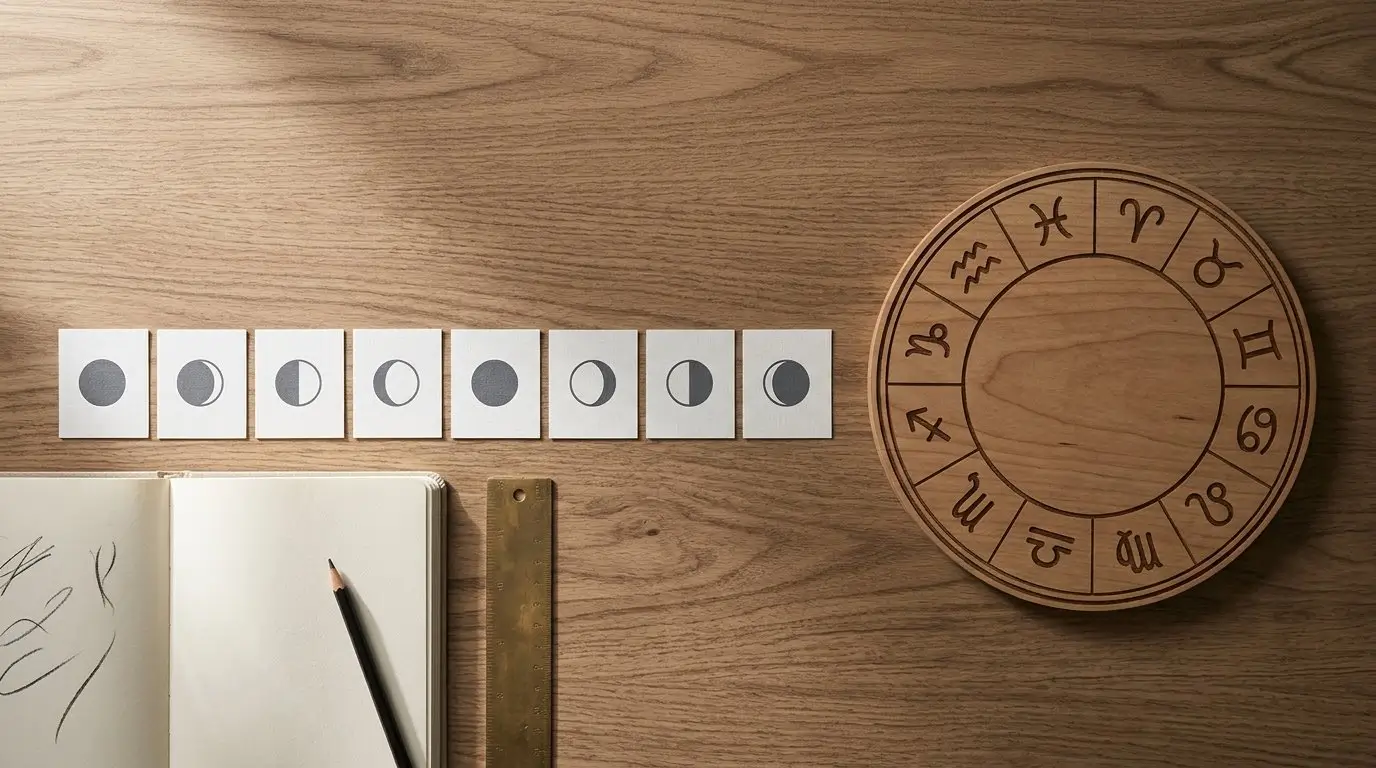
The Moon’s sign is its current zodiac position. It is not the same thing as the visible Moon phase.
For example, the Moon may be waxing crescent, full, or waning gibbous by phase, while also being in Taurus, Libra, Pisces, or another zodiac sign. The phase describes how much of the Moon appears lit from Earth. The sign describes where the Moon is placed in the zodiac from an astrological point of view.
Because the Moon travels quickly, it changes signs roughly every two to three days. That means a Moon sign description you read on Monday may not apply by Thursday.
The easiest ways to check the current Moon sign are:
- A Moon sign calendar
- An astrology app
- An online ephemeris
- A daily astrology planner or almanac
- A reputable astrology website with current planetary positions
If you only want the current Moon sign, your location usually matters less than it does for a full birth chart, though exact timing can still matter around sign changes. If the Moon is changing signs today, different sources may show slightly different timing depending on time zone.
If you want your birth Moon sign, accuracy matters more. The natal Moon sign is based on where the Moon was at the exact time and place you were born. Since the Moon can change signs within a single day, a birth date alone may not always be enough.
A helpful distinction is:
- Current Moon sign: where the Moon is today or at a chosen moment
- Natal Moon sign: where the Moon was when you were born
Astrology uses both symbolically. The current Moon sign may describe a temporary mood or theme. The natal Moon sign is often interpreted as part of your personal emotional pattern.
What the Moon Sign Means in Astrology
A Moon sign is the zodiac sign occupied by the Moon at a specific moment. In astrology, the Moon is commonly associated with the inner life: feelings, instincts, emotional habits, memory, comfort, and the ways people respond before they have time to think things through.
Astrologers often describe the Moon as connected to:
- Emotional needs
- Reactions and instincts
- Family patterns and early conditioning
- Comfort, safety, and belonging
- Memory and nostalgia
- Intuition and reflection
- Private moods and inner rhythms
This is different from the Sun sign, which is often interpreted as identity, vitality, purpose, or life direction. If the Sun is the part of you that grows toward visibility, the Moon is the part that seeks safety, nourishment, and emotional truth.
The Moon sign is also different from the Rising sign. The Rising sign, or Ascendant, is often interpreted as outward style, first impression, and the way you meet the world. The Moon sign is more private. It may show what you need after the social mask comes off.
For example, someone may have a bold Leo Sun, a polished Libra Rising, and a cautious Capricorn Moon. In that case, their public personality may appear warm and socially graceful, while their emotional life may be more reserved, responsible, or protective.
The Moon also carries symbolic links to cycles, night, reflection, tides, dreams, and intuition. In many spiritual and folk traditions, the Moon is associated with ancestry, family memory, seasonal observance, and the unseen rhythms of daily life. For people who tend ancestor altars or mark seasonal transitions, the Moon’s sign can become one more reflective timing tool.
Still, Moon sign meanings should not be treated as fixed facts or unavoidable outcomes. They are interpretive symbols. A Moon sign can suggest questions to ask, patterns to notice, or qualities to work with, but it does not remove personal choice or define a person completely.
Moon Sign Meanings for All 12 Zodiac Signs
Use this table as a quick reference for the current Moon sign or your birth Moon sign. The “emotional tone” describes how astrologers often interpret the Moon in that sign. The “helpful focus” offers a constructive way to work with that symbolism.
| Moon Sign | Emotional Tone | Helpful Focus |
|---|---|---|
| Aries Moon | Direct, restless, courageous, reactive | Take action, but pause before impulsive choices. |
| Taurus Moon | Grounded, steady, sensual, comfort-seeking | Build patience, tend resources, enjoy simple comforts. |
| Gemini Moon | Curious, talkative, mentally active | Communicate, ask questions, stay flexible. |
| Cancer Moon | Sensitive, protective, nostalgic, nurturing | Focus on home, care, and emotional honesty. |
| Leo Moon | Expressive, warm, dramatic, affectionate | Create, share appreciation, practice confident generosity. |
| Virgo Moon | Practical, analytical, service-minded | Improve routines without falling into perfectionism. |
| Libra Moon | Social, diplomatic, harmony-seeking | Balance relationships, beauty, fairness, and peace. |
| Scorpio Moon | Intense, private, transformative | Honor emotional truth, boundaries, and depth. |
| Sagittarius Moon | Adventurous, optimistic, philosophical | Seek learning, freedom, humor, and perspective. |
| Capricorn Moon | Disciplined, reserved, responsible | Create structure, clarify goals, practice emotional maturity. |
| Aquarius Moon | Detached, inventive, community-minded | Explore ideas, friendships, and wider perspective. |
| Pisces Moon | Dreamy, compassionate, porous, imaginative | Rest, create, trust intuition, and keep emotional boundaries. |
These meanings can apply in two main ways.
When describing the current Moon sign, they may point to the general emotional weather of a day or two. For example, a Gemini Moon may support conversation, messages, study, or flexible planning.
When describing a natal Moon sign, they may point to emotional needs or instinctive patterns. A Taurus natal Moon may seek steadiness and physical comfort, while a Sagittarius natal Moon may feel restored by freedom, learning, and spaciousness.
No Moon sign is “better” than another. Each has strengths, challenges, and constructive expressions.
How the Current Moon Sign Can Shape the Mood of the Day
Astrologers often use the current Moon sign to describe the emotional weather of the moment. Since the Moon changes signs every few days, its symbolism is temporary. It may help you name the tone of a day, choose a focus, or reflect on why certain themes feel more noticeable.
A simple way to understand this is by element:
-
Fire Moons: Aries, Leo, Sagittarius
These may feel more active, expressive, bold, or impatient. They can support initiative, creativity, movement, and confidence. -
Earth Moons: Taurus, Virgo, Capricorn
These may feel more practical, grounded, or task-oriented. They can support organizing, planning, budgeting, cooking, cleaning, and body-based care. -
Air Moons: Gemini, Libra, Aquarius
These may feel more social, mental, or conversational. They can support writing, planning, discussion, friendship, and idea-sharing. -
Water Moons: Cancer, Scorpio, Pisces
These may feel more emotional, intuitive, private, or reflective. They can support journaling, rest, grief work, dream attention, and honest emotional processing.
The Moon sign is not the only factor astrologers consider. Moon phase, planetary aspects, eclipses, and the rest of a chart can all add nuance. A Full Moon in Aries may feel different from a waning Moon in Aries, for example. But you do not need to master every detail to use the Moon sign as a simple reflective tool.
Practical uses include:
- Journaling about the emotional tone of the day
- Planning rest, action, conversation, or practical tasks
- Choosing a simple ritual focus
- Noticing repeated emotional patterns
- Tending an ancestor altar with seasonal or lunar awareness
- Reflecting on family memory, gratitude, or release
The current Moon sign does not force behavior. A Scorpio Moon does not guarantee conflict. A Leo Moon does not require performance. A Capricorn Moon does not make everyone cold or detached. These are symbolic invitations, not commands.
Current Moon Sign vs. Birth Moon Sign: Why Both Matter
The phrase “Moon sign” can mean two different things depending on context.
The current Moon sign is where the Moon is today, tonight, or at any chosen moment. It is temporary and shared. Everyone is living under the same current Moon sign, though people may experience it differently.
The birth Moon sign, also called the natal Moon sign, is where the Moon was at the exact time and place you were born. In astrology, this is considered personal. It is part of your birth chart and is often interpreted as a symbol of emotional needs, attachment patterns, instincts, comfort, memory, and private responses.
For example, if the current Moon is in Virgo, the day may feel more detail-oriented, practical, or focused on improvement. People may be drawn toward lists, routines, cleanup, or problem-solving.
But if someone has a Virgo natal Moon, that symbolism is considered part of their personal emotional pattern. They may seek order when stressed, feel soothed by usefulness, or process feelings by analyzing details. This does not mean they are always critical or anxious. It simply offers one symbolic lens.
The same distinction applies to every sign:
- A current Cancer Moon may make home, family, or memory feel more noticeable for a day or two.
- A natal Cancer Moon may suggest a lifelong need for emotional safety, belonging, and care.
- A current Aquarius Moon may support perspective and detachment.
- A natal Aquarius Moon may suggest emotional comfort through ideas, friendship, or independence.
If you are calculating your natal Moon sign, use your exact birth time if possible. The Moon can change signs on the same date, so two people born on the same day may have different Moon signs.
Common Misconceptions About Moon Signs
Moon signs are popular, but they are also easy to misunderstand. Here are some of the most common points of confusion.
The Moon sign is not the same as the Moon phase
The Moon phase describes the Moon’s visible light: new, crescent, quarter, gibbous, full, and so on. The Moon sign describes the Moon’s zodiac position.
You can have a Full Moon in Aries, a Full Moon in Taurus, or a Full Moon in Pisces. The phase and sign work together in astrology, but they are not the same thing.
Not everyone feels the current Moon sign in the same way
The current Moon sign is collective, but experience is personal. Your birth chart, current life situation, stress level, culture, beliefs, and emotional habits all shape how you interpret a day.
For one person, a Capricorn Moon may feel productive and grounding. For another, it may feel heavy or overly serious. Both experiences can be valid.
Moon signs do not predict exact events
Moon signs are better understood as symbolic themes than as event predictors. A Scorpio Moon does not mean a crisis will happen. A Libra Moon does not guarantee relationship harmony. A Sagittarius Moon does not promise travel or good news.
A more balanced approach is to ask, “What quality is being highlighted?” rather than “What will definitely happen?”
Your Sun sign is not the whole chart
Many people first learn astrology through their Sun sign. The Sun sign is important in astrology, but it is only one part of a chart.
The Moon sign adds emotional nuance. The Rising sign adds context about expression and orientation. Other placements may describe communication, desire, responsibility, growth, and more. This is why two people with the same Sun sign can feel very different.
A difficult-sounding Moon sign is not bad
Some Moon signs are described with intense words: Scorpio may be called deep, Capricorn reserved, Aries reactive, or Pisces porous. These descriptions can sound negative if taken too literally.
Every sign has gifts and challenges. A Scorpio Moon can symbolize emotional honesty, loyalty, depth, and the courage to face what others avoid. It does not automatically mean drama or crisis. A Capricorn Moon can symbolize steadiness and maturity, not emotional coldness.
The most useful Moon sign interpretation is balanced. It names both the strength and the shadow without using fear-based language.
FAQ
How often does the Moon change zodiac signs?
The Moon changes zodiac signs about every two to three days. Exact timing varies, so check a current Moon sign calendar, astrology app, or ephemeris if you need the sign for a specific date and time.
Is the Moon sign the same as the Moon phase?
No. The Moon sign is the Moon’s zodiac position, such as Taurus or Scorpio. The Moon phase is its visible light pattern, such as new, waxing, full, or waning.
Do I need my birth time to find my Moon sign?
Usually, yes, if you want the most accurate natal Moon sign. The Moon can change signs within one day, so birth date alone may be uncertain if you were born near a sign change.
Which Moon sign is the most emotional?
Water Moon signs—Cancer, Scorpio, and Pisces—are often described as especially emotional or intuitive. But every Moon sign has feelings; they simply express, process, and protect emotions in different ways.
Can the current Moon sign affect my mood?
Astrologers often interpret the current Moon sign as part of the day’s emotional tone. It may offer a useful reflection point, but it does not control your mood or override personal choice, context, or lived experience.