

Visualization, in the context of shamanic journeying, is a focused inner practice where a person enters a receptive state and follows images, sensations, sounds, or symbols that arise. Practitioners often understand these experiences as contact with spirit helpers, ancestors, land spirits, or deeper layers of wisdom. From a grounded perspective, what is factual is that rhythm, attention, ritual setting, and imagination can shift consciousness and produce meaningful experiences. What is interpretive is whether those experiences come from spirits, the subconscious, ancestral memory, or sacred relationship. Saying it is “not just in your head” does not have to mean every image is literal. It means the experience can carry guidance, emotional truth, and spiritual significance beyond ordinary daydreaming.
What Is Shamanic Journeying?
Shamanic journeying is an intentional spiritual practice that uses focused attention, rhythm, and ritual structure to enter an altered or liminal state. In many traditions, the journeyer seeks guidance, healing insight, protection, or relationship with helping spirits and ancestors.
When the intention is release and repair, a shamanic journey for forgiveness and healing offers a more specific path through that same kind of guided inner work.
It differs from casual daydreaming because it has a purpose, a beginning and ending, and often a repeated method. A person may begin with a question, listen to drumming or rattling, imagine entering a sacred landscape, and return with impressions to reflect on. The images are not treated as random entertainment. They are approached as symbolic, relational, and potentially instructive.
Why People Say It Is “Not Just in Your Head”
When practitioners say shamanic journeying is not just in your head, they are usually pointing to the depth and effect of the experience. A journey may bring a message that feels unexpected, a symbol that later proves personally meaningful, or a sense of being held by ancestors during grief.
This does not require claiming that every vision is objectively verifiable. The phrase can be understood more carefully: the experience may happen through the mind, but it is not necessarily limited to fantasy. Like prayer, dreamwork, or ritual at an ancestor altar, its value may be emotional, spiritual, relational, and transformative. Many people judge the reality of a journey by its fruits: humility, clarity, healing, responsibility, and right action.
Visualization Vs. Shamanic Journeying: Are They the Same?
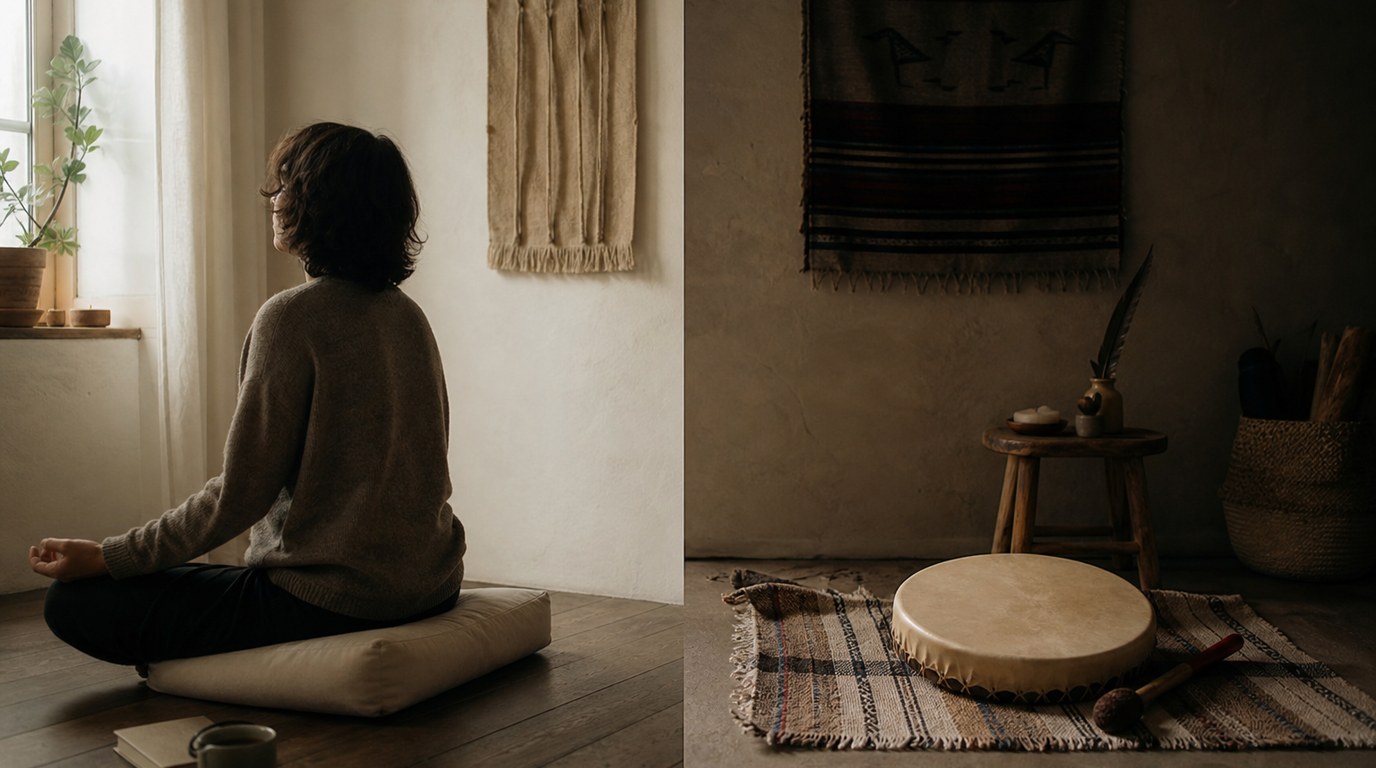
Visualization and shamanic journeying overlap, but they are not always identical. Visualization often means intentionally creating mental images, such as picturing light around the body or imagining a peaceful place. Shamanic journeying may begin with visualization, but many practitioners describe it as becoming more receptive than directive.
In other words, visualization may be “I imagine this.” Journeying may become “I follow what appears.” Some people use the terms interchangeably, especially in modern spiritual settings. Others reserve “shamanic journeying” for practices rooted in specific ritual forms, spirit relationships, or lineage-based traditions.
Supporting Context: Altered States, Rhythm, and Ritual
A grounded explanation begins with altered states. Repetitive rhythm, breath, darkness, chanting, drumming, rattling, and stillness can affect attention and perception. These conditions may make imagery more vivid and help the ordinary analytical mind soften.
Ritual also matters. A clear opening, stated intention, protective prayer, and closing action help create a container. This is one reason journeying can feel different from imagination alone. The person is not simply drifting; they are entering sacred time.
For those who keep an ancestor altar, journeying may be paired with offerings, candlelight, water, or prayer. The altar becomes a place of respect and orientation, not a prop to force results.
What Might Happen During a Journey?
Experiences vary widely. One person may see a forest path, an animal, a river, or a doorway. Another may not “see” anything but may feel warmth, pressure, emotion, or a sudden knowing. Some hear words internally; others receive symbols, songs, colors, or memories.
Ancestor-related journeys may include an elder figure, a family home, a name, a recipe, a plant, or an instruction to repair a relationship. These should be treated with care. A symbol may be spiritually meaningful without being taken as literal proof. The best approach is to record it, reflect, and look for wise, ethical integration.
Common Misconceptions About Shamanic Journeying
One misconception is that journeying must be visually dramatic. In reality, many people receive subtle impressions. Feeling, sensing, remembering, or knowing can be part of the experience.
Another misconception is that every journey message is automatically sacred truth. Discernment is essential. Personal wounds, fears, hopes, and cultural expectations can shape what appears.
A third misconception is that anyone can freely borrow any shamanic method without context. Many journey practices come from living Indigenous and traditional cultures. Respect means learning carefully, avoiding false claims of lineage, and not treating sacred customs as aesthetic accessories.
Finally, journeying is sometimes mistaken for escapism. Healthy practice should support grounded living, not replace therapy, medical care, accountability, or practical action.
How to Frame Claims Carefully

It is helpful to separate fact from interpretation. Fact: people can enter altered states through rhythm, ritual, and focused attention. Fact: these states can produce vivid imagery, emotion, insight, and lasting meaning. Interpretation: the source of the experience may be ancestors, spirits, the unconscious, divine guidance, or a combination.
A respectful spiritual approach does not need to flatten mystery into psychology, but it also does not need to overstate what cannot be proven. Instead of saying, “My ancestor definitely told me this,” you might say, “I received this as an ancestral message, and I am discerning it carefully.”
A Simple, Respectful Way to Approach a Journey
Begin with humility. Choose a quiet place, set a clear intention, and avoid journeying when intoxicated, highly distressed, or unable to ground yourself. If you work with an ancestor altar, you might refresh the water, light a candle safely, and offer a brief prayer of respect.
Ask one simple question, such as, “What do I need to understand for my healing?” Listen to steady drumming or sit in silence. Notice what arises without forcing it. When finished, thank any helpers, close the practice, and return fully to the room.
How to Discern and Integrate What You Receive
Write down the journey soon afterward. Mark the difference between what you saw, what you felt, and what you think it means. Look for patterns over time rather than making major decisions from one experience.
Good integration is practical. If the message was about forgiveness, rest, protection, or family repair, ask what small ethical action follows. If a journey increases fear, obsession, or grandiosity, pause and seek grounded support.
So, Is It Real?
Shamanic journeying is real as an experience, real in its effects, and real in the devotion many practitioners bring to it. Whether its images are understood as spirits, ancestors, symbols, or deep psyche depends on tradition and belief.
The wisest answer is balanced: it may happen through the inner senses, but that does not make it meaningless. Treat it with respect, discernment, and humility.
FAQ
Is Shamanic Journeying the Same as Meditation?
Not exactly. Both can involve altered attention, stillness, and inward focus. Meditation often emphasizes awareness, presence, or concentration. Shamanic journeying usually has a specific intention, symbolic movement, and relationship with helping spirits, ancestors, or sacred landscapes, depending on the tradition.
Do I Have to Believe in Spirits for Shamanic Journeying to Be Useful?
No. Some people approach journeying spiritually, while others understand it as symbolic imagination, dreamlike inquiry, or deep intuition. Belief can shape the experience, but usefulness often comes from reflection, emotional honesty, and how wisely you integrate what arises.
What If I Do Not See Anything During a Journey?
Seeing is only one way to receive. You may feel sensations, hear inner words, remember something, sense a presence, or simply feel calm. If nothing happens, that is not failure. Shorter sessions, clearer questions, and less pressure often help.
Can Shamanic Journeying Connect Me with My Ancestors?
Many practitioners believe it can, especially when approached with respect, offerings, and discernment. Ancestor-related imagery may include people, places, objects, songs, or feelings. Treat what you receive as meaningful material to reflect on, not automatic proof or a command beyond question.
Is Shamanic Journeying Safe?
For many people, gentle journeying is safe when practiced sober, grounded, and respectfully. It may not be appropriate during acute crisis, psychosis, severe dissociation, or overwhelming fear. If you have mental health concerns, work with qualified support and keep practices simple and stabilizing.