
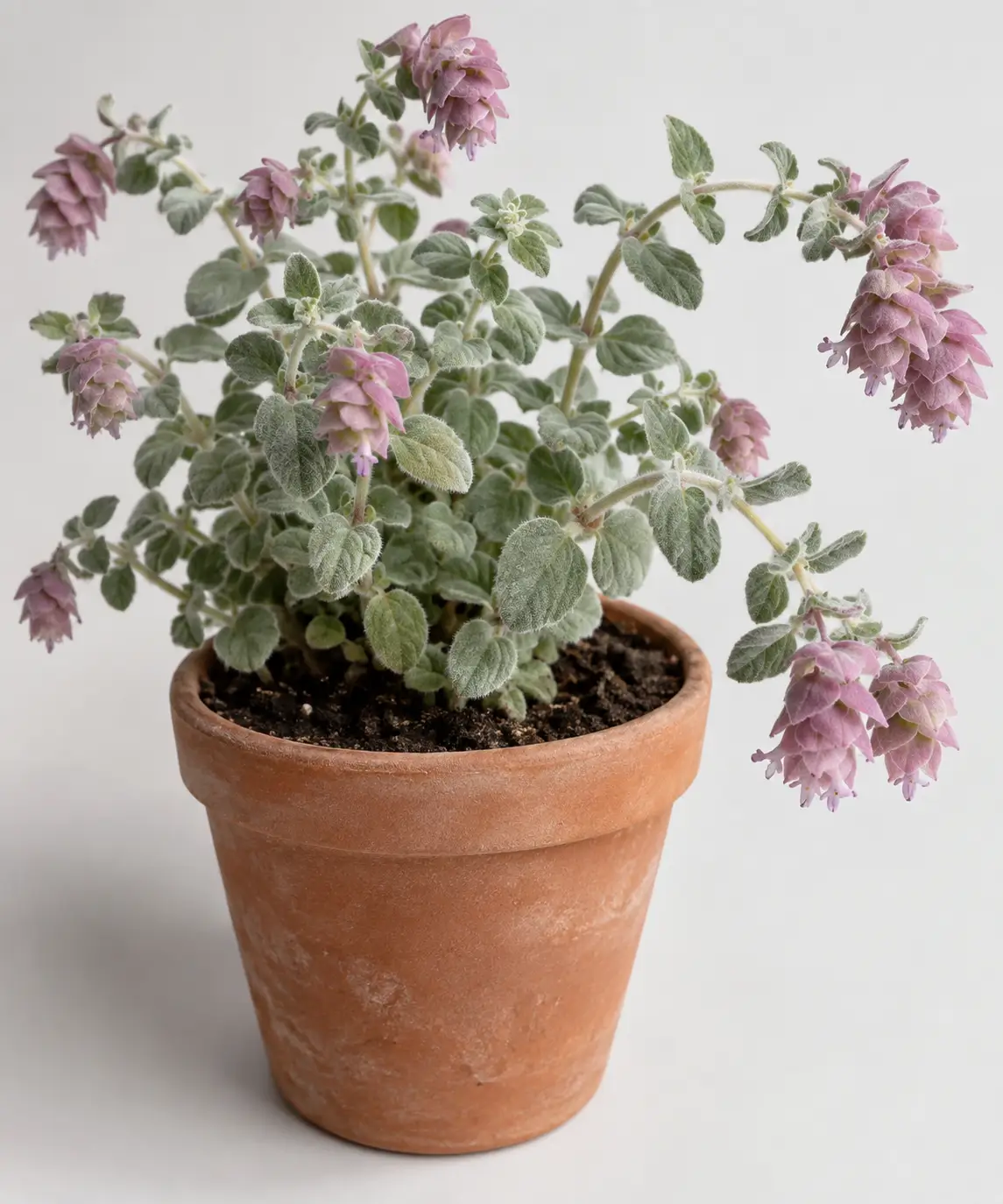
Dittany of Crete is Origanum dictamnus L., a mint-family plant native to Crete. The scientific name matters because “dittany” has not always named the same plant. If you encounter it on an occult herb list, the name alone cannot tell you which species the writer—or a seller—means.
Its reputation has several layers. Ancient accounts and literature help explain why dittany carries associations with extraordinary healing; a contemporary practitioner describes a spirit-focused association. Those sources document stories and interpretations, not demonstrated physical or supernatural effects. Identifying the plant, understanding its reputation, assessing medicinal evidence and judging the source of material are separate tasks. Keeping them separate makes it possible to take the tradition seriously without asking a story or a product label to prove more than it can.
What Dittany of Crete Names
Kew accepts Origanum dictamnus L. as the botanical name for dittany of Crete, places it in Lamiaceae—the mint family—and gives Crete as its native range. That gives a reader a precise reference point, whether the name first appears in a historical discussion, a spiritual context or a listing for dried plant material.
Common names are less precise. The Metropolitan Museum of Art distinguishes Origanum dictamnus from white dittany, which is botanically unrelated. The Met also notes that more than one plant was historically called dictamnus. Theophrastus mentions another plant sharing the name. An old reference to “dittany” therefore needs its context; the word alone cannot settle which plant an author had in mind. Nor should a present-day packet marked “dittany” be assumed to contain the Cretan species.
An “oregano” label is not enough either. Origanum is part of this species’ scientific name, but the broad word “oregano” does not identify Origanum dictamnus. The useful distinction is between a name that suggests a connection and a full botanical name that specifies the plant being claimed. Even the full name on a label remains a seller’s identification claim, rather than independent confirmation of what is inside.
These naming questions come first because the later questions depend on them. A historical account can show what was said about a plant; a modern practitioner can describe what it means in their practice; medical evidence addresses tested effects; sourcing information concerns particular material. None of those answers, by itself, identifies an otherwise ambiguous listing.
How the Ancient Reputation Took Shape
Theophrastus records a story linking dittany with goats wounded by arrows. The value of the passage here is that it preserves an ancient claim: people associated dittany with an extraordinary response to injury. It is not an observed demonstration that the plant heals wounds. Theophrastus also says another plant shares the name, a reminder that identifying every historical “dittany” as the modern Cretan species would go beyond what the name alone establishes.
Dittany’s reputation also took shape in literature. As the Met discusses, Virgil includes it in the scene in which Venus tends the wounded Aeneas. The setting matters: this is a memorable portrayal of care and recovery within a literary work. It can tell us something about the role dittany played in the story and the associations readers might carry away from it. It cannot test what a plant does outside that story.
The two accounts are useful for different reasons. Theophrastus preserves a reported story about animals and arrows; Virgil’s scene, discussed by the Met, is a literary portrayal. Reading them as sources for dittany’s inherited reputation does not require treating either as proof of a physical effect. Nor does an extraordinary event in a story establish a supernatural property of the plant. Their contribution is explanatory: they help show why dittany could become more than a botanical name in later lists and interpretations.
The naming uncertainty sets a limit on that explanation. This article has a clear botanical subject, Origanum dictamnus, but historical uses of “dittany” were not uniform. The ancient reputation helps explain the name’s appeal; it cannot identify material offered under that name today.
What a Modern Occult Association Represents
Otherworld Apothecary, in a contemporary practitioner account, describes using dittany in spirit-focused incense blends. That is a specific account of how one practitioner associates the plant with spiritual work. It documents an interpretation and a practice, not a guaranteed result or an effect established by the ancient sources.
It also should not be presented as an ancient rule or a universal occult consensus. Theophrastus’s reported goat story and the Virgil scene discussed by the Met account for different parts of dittany’s older reputation; neither makes this particular spirit-focused association a position shared across traditions. Naming the modern source lets a reader see whose interpretation is being described instead of treating “occult use” as though it had a single, timeless meaning.
A reader may find that association meaningful in their own symbolic practice, or may decide it does not fit their tradition or circumstances. In either case, personal meaning is an interpretation someone brings to the plant, not a property a listing can promise. Understanding the association does not require adopting the practitioner’s practice or assuming a spiritual outcome.
Where the Medicinal Evidence Stops
The European Medicines Agency (EMA) identifies the relevant herbal material as the aerial parts of Origanum dictamnus. Its discussion is therefore tied to a named species and specified plant material, not to everything that might be sold or described as “dittany.”
EMA’s conclusions concern traditional use, and EMA says they lack sufficient clinical-trial evidence. Traditional-use documentation records a different kind of basis for a conclusion than adequate clinical trials would provide. It should not be rewritten as clinical proof because the plant has an old reputation or because a regulatory summary discusses it. The ancient stories, too, remain evidence of what was reported or portrayed, not medical findings.
That does not mean EMA ignored evidence beyond old stories. Its assessment also considered documented longstanding use and published experimental studies that supported the plausibility of the traditional uses. Plausibility and a history of use are meaningful parts of that regulatory category, but they remain different from sufficient evidence from clinical trials. The distinction matters whenever a historical wound legend is presented beside a modern medicinal summary.
EMA also says its summary is not practical use advice. Its value here is to mark an evidence boundary: a traditional-use record does not supply an individual treatment plan or a safety assurance. Likewise, an occult association does not establish a tested health effect.
What the Conservation Record Means for Sourcing
Conservation categories need dates. IUCN’s 2026 account says the current Red List assessment for dittany of Crete is Least Concern and notes that earlier assessments placed it in Vulnerable and Near Threatened categories. Kew’s page data still displays Near Threatened. Rather than repeating that Kew field as an undated current status, a reader can state the dated IUCN assessment while acknowledging the differing category still visible at Kew.
Its limited natural range and its current assessment answer different questions. IUCN reports the species across 60 to 70 locations on Crete and estimates 220,000 to 530,000 mature individuals. Being native to one island makes the plant distinctive, but does not by itself say that its current extinction-risk category must be threatened. IUCN also says the 2026 Least Concern assessment depends on protections remaining in place and cultivation continuing to meet demand. That conditional context is more useful than calling the plant simply “rare” or “safe.”
IUCN says cultivation has reduced pressure on wild populations. That explains why cultivation matters to the sourcing question: material supplied through cultivation need not depend on collecting plants from the wild. IUCN also warns that renewed wild overcollection could raise future risk. Least Concern describes an assessment of the species; it does not certify that every way of obtaining it is responsible, or that pressure on wild plants cannot return.
For material offered for personal symbolic practice, useful seller disclosures would include the exact botanical name, whether it is described as cultivated or wild-collected, its stated origin, and information about collection practices. The name Origanum dictamnus addresses the ambiguity of “dittany.” A cultivation claim bears on the wild-collection pressure IUCN discusses. An origin statement and collection information help a reader understand what the seller is claiming about a particular batch, rather than relying on the plant’s Cretan native range to infer where that batch came from.
Disclosure is not authentication. A printed species name does not independently verify botanical identity; “cultivated” does not prove how the plants were grown; and an origin or collection statement does not, on its own, establish provenance or responsible collection. The sources establish the accepted name and conservation context, but they do not verify any particular seller’s material. That limitation is a reason to ask specific questions, not to substitute an appealing label for answers.
How to Read an Ambiguous Listing
Suppose a listing says only “dittany.” The first question—which species?—is unanswered, given the name’s history and its use for botanically unrelated white dittany. The listing also leaves cultivation, origin and collection practices undisclosed. Its occult framing may explain why someone is interested in the plant, but it cannot resolve those gaps. A reader cannot make an informed species or sourcing judgment from that description alone.
Now suppose a listing says “Origanum dictamnus, cultivated.” It is more informative: the seller names the species sought and makes a cultivation claim relevant to IUCN’s account of reduced pressure on wild populations. The reader can ask where the material was cultivated, what supports the species identification, and whether the seller can explain the stated provenance. Those questions are possible because the listing says more; its statements are still not independently verified merely by appearing on the label.
The practical decision is to seek meaningful species and provenance disclosure—or leave both uncertain. Dittany’s stories and spiritual associations may shape what the plant means to a reader, but they cannot establish what is in an unverified packet or how it was obtained.