
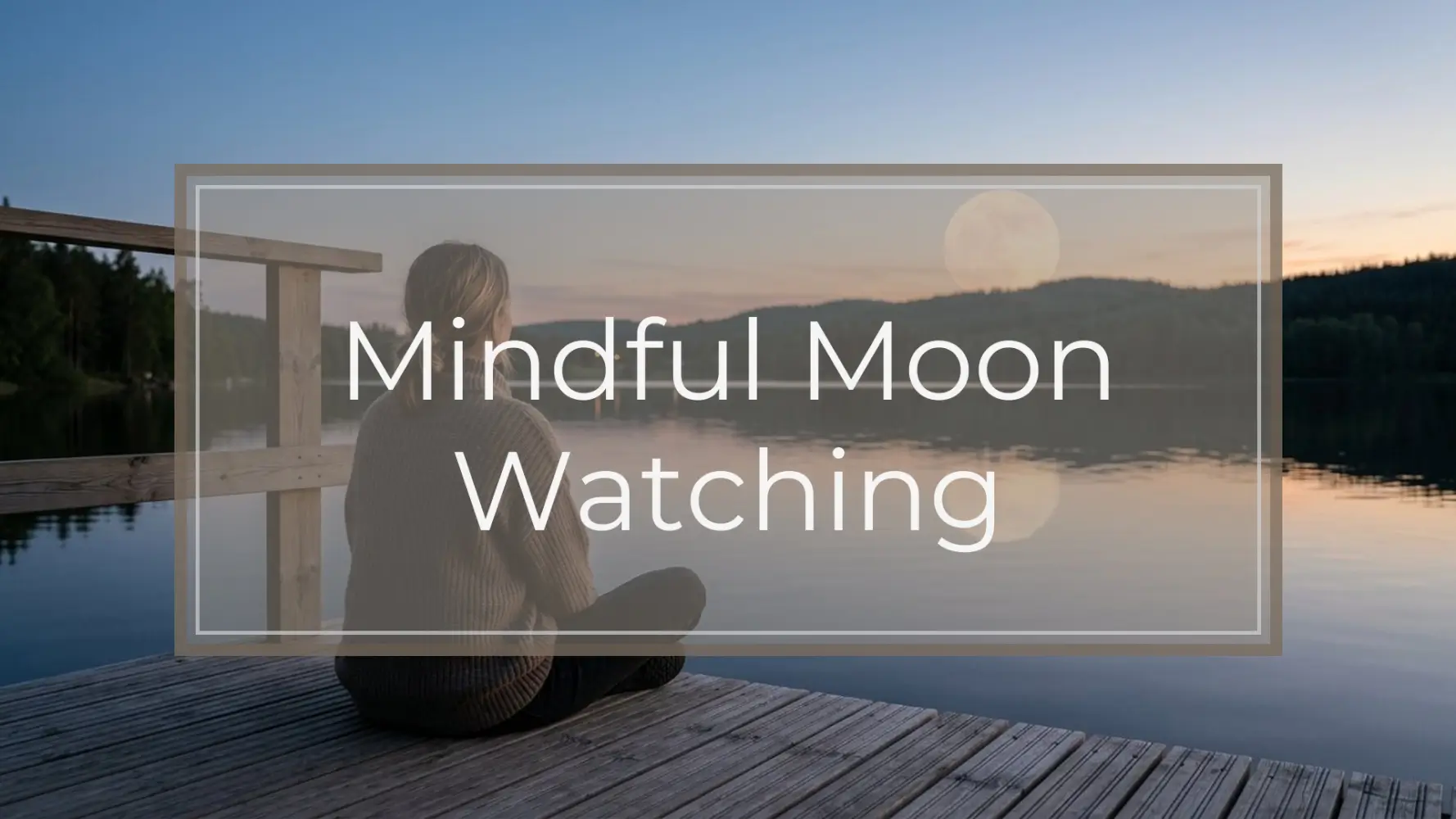
Mindful moon watching is the practice of observing the moon with calm attention, using your senses, breath, and reflection to become more present. To try it, choose a safe viewing spot, settle your body, look at the moon without rushing, notice what you see and feel, and close with a short journal note, gratitude moment, or quiet breath.
This night ritual can be spiritual, reflective, or simply calming. You do not need a perfect sky, a full moon, or special tools. A few intentional minutes at a window, on a balcony, in a yard, or beneath an open sky can be enough.
How to Practice Mindful Moon Watching Tonight
Mindful moon watching means looking at the moon as an object of attention rather than background scenery. Instead of glancing up and moving on, you pause. You notice the moon’s shape, color, brightness, position, and relationship to the clouds, buildings, trees, or stars around it. You also notice what happens inside you as you look.
Here is the simplest version:
- Choose a safe viewing spot. Find the moon from a window, porch, balcony, yard, sidewalk, or open outdoor place.
- Settle your breath and body. Sit or stand comfortably. Let your shoulders soften. Feel your feet, seat, or hands.
- Observe the moon slowly. Look without trying to force a special feeling. Notice what is actually there.
- Notice your inner response. Pay attention to thoughts, memories, emotions, stillness, or restlessness.
- Close intentionally. Write one sentence, offer thanks, or say, “This moment is complete.”
Clouds still count. City skies still count. A short session still counts. Mindful moon watching is not about performing a perfect moon ritual; it is about bringing deliberate attention to a natural rhythm that is already present.
You can approach the practice as mindfulness, ancestor remembrance, spiritual reflection, or a quiet pause at the end of the day. Let it be simple enough that you will actually do it.
What You Need Before You Begin

You do not need special equipment for mindful moon watching. The moon, your attention, and a safe place to stand or sit are the essentials. A few items can make the practice more comfortable:
- A warm layer, shawl, or jacket
- A chair, cushion, or blanket
- A journal and pen
- A warm drink
- A small candle or altar object, used safely
- Optional binoculars
- Optional moon phase app or calendar
Choose your location with care. Good options include a balcony, yard, front step, window, park, rooftop access area, or open sky location where you are allowed to be. Make sure the ground is steady, the area is safe enough to move through, and you remain aware of your surroundings.
Timing can be flexible. You might watch at moonrise, before bed, during an evening walk, or whenever the moon is visible. If you want to plan ahead, check the moonrise time or phase, but do not let planning replace practice. Seeing the moon unexpectedly can be an invitation.
A few cautions matter. Avoid trespassing, unstable ground, isolated places where you feel unsafe, and extreme weather. If you use a candle, keep it away from fabric, plants, wind, pets, and anything flammable. If your eyes feel strained, soften your gaze or look away.
Comfort supports attention. If you are cold, tense, or worried about your location, it will be harder to settle. Choose the simplest safe place available, even if that is indoors by a window.
A Step-by-Step Mindful Moon Watching Ritual
Use this ritual as a flexible sequence. It can take five minutes, fifteen minutes, or longer. The point is not to rush through the steps, but to let each one give your attention somewhere gentle to rest.
1. Arrive and pause
Begin intentionally. Put away your phone if you can, or set it face down after checking the moon’s location. Step outside or come to your window. Sit or stand in a way that feels stable.
Feel your body. Notice your feet on the ground, your back against a chair, or your hands resting together. Let your eyes adjust to the night. You do not have to become perfectly still. Just pause long enough to recognize that you are here.
2. Set a gentle intention
An intention gives the ritual a simple direction. It should feel spacious, not demanding. You might choose one word or phrase, such as:
- Presence
- Gratitude
- Remembrance
- Release
- Curiosity
- Patience
- Listening
For example, say, “Tonight I am here to be present,” or “I am watching with gratitude for those who came before me.” If no intention comes, use curiosity: “Let me notice what I notice.”
3. Look at the moon slowly
Bring your attention to the moon itself. Notice its shape first. Is it a thin curve, a half circle, nearly full, full, or fading? Notice its brightness. Does it look white, silver, gold, orange, or softened by haze?
Look at the surrounding sky. Are clouds crossing the moon? Is the moon sharp-edged or blurred? Are branches, rooftops, or power lines framing it? Is it high overhead or low near the horizon?
Try not to label the scene too quickly as beautiful, ordinary, cloudy, or disappointing. Stay with direct observation. What is the moon actually doing in this moment?
4. Engage the rest of your senses
Mindful moon watching is not only visual. Let your other senses join.
Notice the temperature of the air on your face or hands. Listen for night sounds: traffic, wind, insects, distant voices, animals, or the hum of your home. Notice any scents, such as damp earth, rain, smoke, flowers, pavement, or cool air.
Then notice body sensations. Are your shoulders lifted? Is your jaw tight? Are you relaxed, restless, tired, or alert? You do not need to change everything you notice. Simply include it.
This step helps the practice become embodied rather than purely symbolic. You are not only thinking about the moon; you are experiencing a night moment with your whole self.
5. Breathe with the observation
Let your breathing become part of the watching. You might inhale while noticing the moon’s light, then exhale while softening your body. Keep the rhythm comfortable.
A simple pattern is:
- Inhale and silently say, “Here.”
- Exhale and silently say, “Now.”
Repeat for a few breaths while looking at the moon or surrounding sky. If counting or rhythm feels distracting, skip it. The breath is a support, not a rule.
6. Reflect inwardly
After a few minutes of observation, allow a question to arise. Choose one prompt and sit with it gently:
- What am I noticing tonight?
- What feels full in my life right now?
- What feels hidden or not yet ready to be seen?
- What is beginning?
- What is ready to soften?
- What do I want to remember?
- What can I release from this day?
Do not force a dramatic answer. A single word, image, memory, or feeling is enough. Sometimes the answer is simply, “I am tired,” or “I feel quiet.” That still belongs.
If you practice ancestor remembrance, this can also be a moment to think of loved ones, family lines, or those whose lives made yours possible. You might say a name, hold a memory, or offer gratitude in silence.
7. Close the ritual
End the session clearly, even if it was brief. A clear closing helps the practice feel complete.
You might:
- Write one sentence in a journal
- Say, “Thank you for this moment”
- Touch the earth, floor, or windowsill
- Place a hand on your heart
- Blow out a candle safely
- Take one final look at the moon and step away
A journal note can be simple: “Waxing moon behind thin clouds; I felt restless at first, then calmer.” Over time, these notes become a record of weather, mood, season, and reflection.
Moon Phase Prompts for Mindful Watching
You can practice mindful moon watching during any moon phase. The phase does not need to control your experience or guarantee a specific outcome. Think of these prompts as invitations. Choose what resonates and leave the rest.
If the new moon is not visible, watch the dark sky, sit indoors with the known phase in mind, or use the absence of visible moonlight as the focus.
| Moon Phase | What to Notice | Reflection Prompt | Simple Closing Action |
|---|---|---|---|
| New moon | Darkness, absence, quiet sky, subtle beginnings | What is not visible yet, but may be forming? | Write one intention or word for the coming cycle |
| Waxing crescent | Thin light, delicacy, emergence | What small beginning deserves my attention? | Name one tiny next step |
| First quarter | Half light, half shadow, contrast | Where am I meeting a choice or challenge? | Take one steady breath and affirm your next action |
| Waxing gibbous | Growing brightness, almost-full shape | What is developing that needs patience? | Note one thing you can tend rather than rush |
| Full moon | Brightness, fullness, visibility, strong shadows | What is asking to be seen clearly? | Offer gratitude for one effort, lesson, or completion |
| Waning gibbous | Softening fullness, gradual release | What can I share, integrate, or learn from? | Write one insight from the past week |
| Last quarter | Half light, half shadow, turning point | What am I ready to revise or let go of? | Cross out one unnecessary task or expectation |
| Waning crescent | Faint light, rest, quiet endings | What needs privacy, rest, or gentleness? | Close with silence or an early bedtime intention |
You do not need to memorize these meanings. The moon can be a mirror for reflection without becoming a strict rulebook. If your lived experience does not match the prompt, trust what you notice.
Common Mistakes and Gentle Cautions
One common mistake is trying to make mindful moon watching too perfect. You may imagine a quiet hilltop, a bright full moon, a beautiful journal, and a deep realization. Real practice may look like standing at a kitchen window for four minutes while clouds move across the sky. That is still valid.
Another mistake is expecting a dramatic spiritual experience every time. Some nights feel meaningful. Some feel ordinary. The value is in returning to attention, not in forcing awe, signs, or certainty.
It is also easy to overload the ritual. Apps, candles, crystals, incense, tarot cards, elaborate correspondences, and long prayers can all have a place, but too many tools may pull you away from simple observation. Begin with the moon, your breath, and your senses. Add objects only if they support attention.
Do not ignore safety or comfort. Avoid cold exposure, unsafe areas, unstable ground, or places where you are not allowed to be. If you feel uneasy, move indoors or practice from a window.
Use moon watching as reflection, not as the only basis for major decisions. A ritual can help you listen to yourself, but practical choices still need practical judgment, conversation, planning, and care.
If you feel distracted, emotional, bored, or restless, you are not failing. Notice that experience too. Mindfulness includes the wandering mind, the heavy heart, and the ordinary night.
Troubleshooting and How to Know It Worked
If the sky is cloudy, practice with what is visible. Watch the clouds brighten and dim. Notice the texture of the darkness. If you know the moon phase, use it as a reflection focus even without seeing the moon directly. Cloudy moon watching can be just as attentive as clear-sky watching.
If light pollution makes the sky feel washed out, try viewing when the moon is higher above the horizon, step away from direct streetlights, or use a window with the best angle. A moon phase app can help with timing, but use it briefly, then return to the sky.
If you are distracted, shorten the session. Try three breaths instead of fifteen minutes. Name five things you notice: moon, cloud, air, sound, body. Or write one line: “Tonight I noticed…” The practice does not need to be long to be real.
If you feel no emotional response, let that be enough. Neutral observation is still mindful practice. You are training attention, not auditioning for a mystical experience.
If strong feelings arise, pause and ground through the senses. Feel your feet. Name where you are. Notice one nearby object. Return indoors if that feels better. If distress feels overwhelming or continues beyond the moment, reach out to someone you trust or seek appropriate support.
How do you know mindful moon watching worked? It worked if you spent intentional time noticing the moon, your body, and your thoughts with a little more awareness than before. You do not need a vision, a sign, or a sudden life change.
To deepen the practice, keep a simple moon watching journal. Record the date, phase if you know it, weather, location, mood, and one reflection. Patterns may become visible slowly: how seasons affect you, which times of night feel best, or what themes return in your thoughts.
FAQ
Do I need to watch the moon on a specific phase?
No. Mindful moon watching can be practiced during any phase. Full moons are bright and easy to notice, but crescents, half moons, waning moons, and the dark sky near the new moon can all support reflection.
Can I practice mindful moon watching from a window?
Yes. A window practice is completely valid, especially if the weather is harsh, the area outside feels unsafe, or you have limited mobility. Sit or stand comfortably and treat the window as your viewing place.
How long should a mindful moon watching session last?
Start with five minutes. If you feel settled and want to stay longer, try ten to fifteen minutes. A brief, attentive session is better than a long session spent uncomfortable, distracted, or trying too hard.
What should I write in a moon watching journal?
Write the date, moon phase if you know it, weather, where you watched from, and one sentence about what you noticed or felt. Keep it simple enough that journaling does not become a barrier.
Is mindful moon watching a spiritual ritual or a mindfulness practice?
It can be either or both. Some people use it for spiritual reflection, gratitude, prayer, or ancestor remembrance. Others use it as a quiet mindfulness practice. The core is intentional attention to the moon and your present experience.