
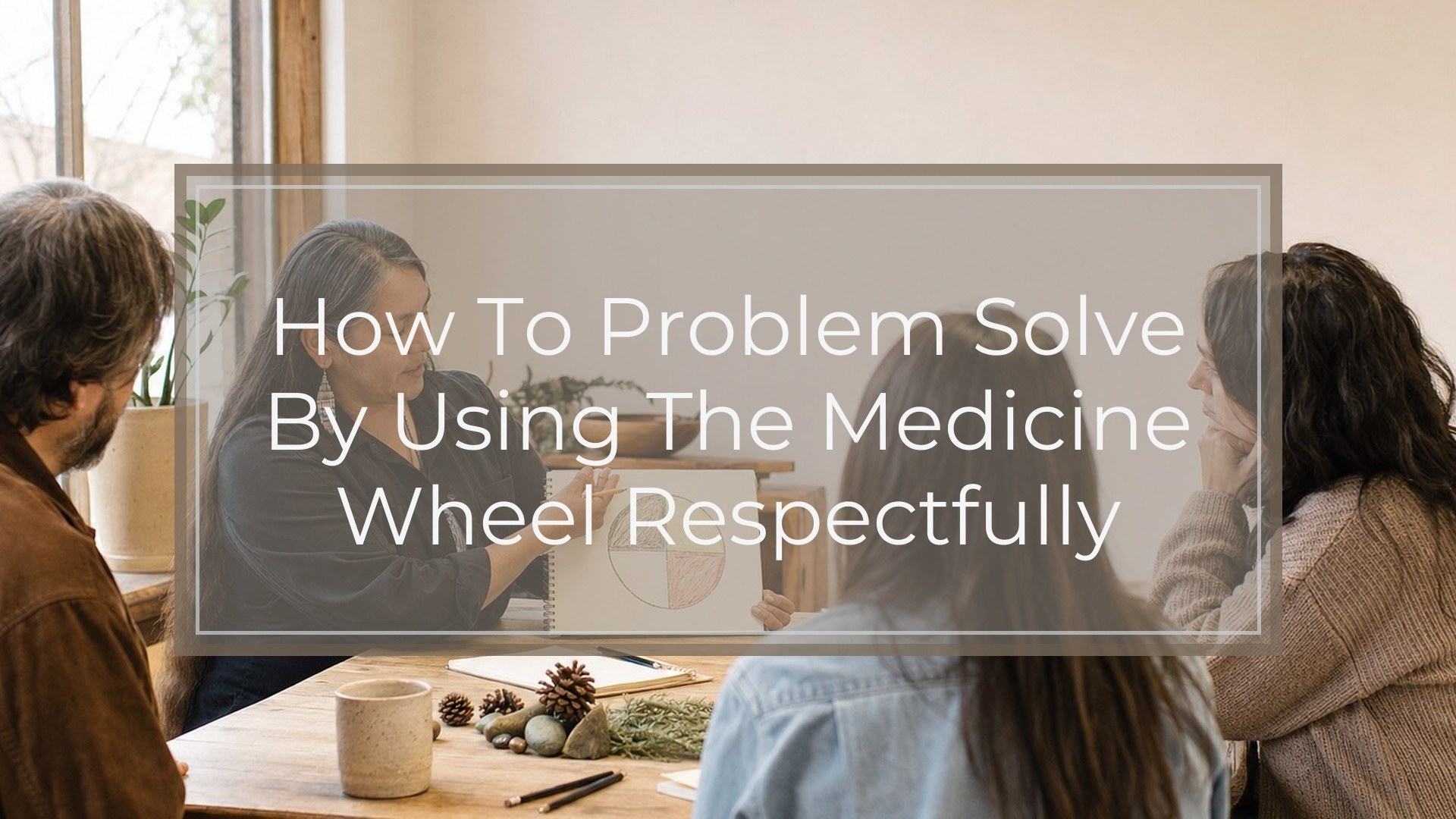
To problem solve by using the Medicine Wheel, bring one clear issue into the center, then move through the four directions as a reflection process: East for clarity, South for feelings and relationships, West for root causes and hidden patterns, and North for wisdom and responsibility. After listening at each direction, return to the center and form one balanced action.
This practice works best when you treat the wheel as sacred reflection, not as a quick trick. It can help you slow down, see what you have missed, involve your body and spirit, and choose a next step that is practical as well as meaningful.
Before You Begin: a Respectful Note on Medicine Wheel Teachings
Medicine Wheel teachings are not all the same. They differ across Indigenous nations, communities, families, elders, and ceremonial traditions. If you have access to appropriate community teaching, learn from those sources first and follow their guidance.
This article offers a simple spiritual reflection method inspired by a four-direction model. It is not a substitute for lineage-based instruction, ceremony, or cultural authority. Approach the wheel with humility. Do not treat it as a decorative trend or a tool to take from living traditions without respect.
What You Need for This Problem-solving Practice
Gather simple materials before you begin:
- A quiet space where you will not be interrupted
- A journal or paper
- A pen
- Four markers for the directions, such as stones, shells, cards, or candles
- A central object, word, or symbol for the problem
- Optional: a candle, water, flowers, or another offering
- Optional: your ancestor altar nearby, if that is part of your practice
You also need inner readiness: enough time, emotional steadiness, and willingness to be honest.
Do not use this practice as your only support for emergencies, abuse, serious medical decisions, severe mental distress, or immediate danger. In those situations, seek qualified help, safety planning, medical care, or trusted support.
Set up the Wheel and Name the Problem

Create a simple Medicine Wheel on the floor, on an altar cloth, on paper, or across a journal page. Mark the four directions: East, South, West, and North. If you do not know the actual directions in your room, you may use symbolic placement on the page.
Place the issue in the center. You can write it as a sentence, choose an object that represents it, or draw a symbol.
Use a clear problem statement, such as:
- “I need to decide whether to change jobs.”
- “I need to repair conflict with my sibling.”
- “I keep repeating the same money pattern.”
Avoid vague statements like “Everything is bad.” Name one problem at a time.
Step 1: Begin in the East for Clarity
Face the East marker, sit beside it, or write under “East” in your journal. The East is often associated with beginnings, light, vision, and clear seeing. Here, your task is to look at the problem without exaggerating it and without avoiding it.
Ask:
- What is actually happening?
- What do I know for sure?
- What am I assuming?
- What information is missing?
- What new perspective is trying to appear?
Write plainly. Separate facts from fears. For example, “My manager criticized one report” is different from “I am going to lose my job.”
End this direction with one clear sentence: “The real issue is ___.”
Step 2: Move to the South for Feelings and Relationships
Move to the South marker. The South can be used here as a place of warmth, emotion, growth, and connection. Let the problem become human. Who is affected? What is being felt? What relationships are involved?
Ask:
- What am I feeling in my body?
- Who else is impacted by this problem?
- Where am I reacting from fear, grief, pride, loyalty, or love?
- What emotional need is asking to be honored?
- What would kindness require here?
Do not rush past anger, sadness, embarrassment, or tenderness. Feelings are not always instructions, but they are information.
Before leaving the South, name one relationship or emotional need that must be included in the solution.
Step 3: Move to the West for Root Causes and Hidden Patterns
Move to the West marker. The West can serve as a place of depth, endings, shadow, memory, and what is hidden beneath the surface. Here, look for patterns rather than blaming yourself or others.
Ask:
- Have I faced this kind of problem before?
- What old wound does this situation touch?
- Is this connected to family history, ancestral memory, or a repeated cycle?
- What truth have I avoided naming?
- What part of the problem is older than this moment?
If ancestor veneration is part of your practice, you may respectfully ask: “Beloved ancestors of wisdom and care, what do I need to understand about this pattern?” Then listen, journal, or sit quietly.
Balance spiritual insight with responsibility. Ancestral guidance should not replace facts, consent, therapy, legal advice, medical care, or your own accountable choices.
Step 4: Move to the North for Wisdom and Responsibility
Move to the North marker. The North can represent wisdom, maturity, structure, protection, and responsibility. In this direction, turn insight into grounded action.
Ask:
- What is the wisest next step?
- What would a trusted elder, guide, or future self advise?
- What responsibility is truly mine?
- What is not mine to carry?
- What boundary, conversation, decision, or practical action is needed?
Be specific. “I will be more confident” is too vague. “I will ask for a meeting on Tuesday and request clear feedback” is usable.
Before leaving the North, choose one grounded action. It may be a boundary, an apology, a plan, a conversation, a decision, or a request for help.
Step 5: Return to the Center and Form a Balanced Solution
Return to the center of the wheel. Look at what each direction gave you:
- East: clear facts and perspective
- South: feelings and relationships
- West: roots, patterns, and hidden causes
- North: wisdom, responsibility, and action
Now form a balanced solution that includes all four. Use this formula:
“Because I see ___, feel or recognize ___, understand ___, I will ___ by ___.”
Example:
“Because I see that I am overwhelmed by unclear work expectations, recognize that I feel anxious and unsupported, and understand that I often stay silent to avoid conflict, I will request a meeting with my manager by Friday and ask for written priorities.”
A balanced solution should feel honest, grounded, and possible.
Step 6: Make an Offering or Closing Action
Close the practice respectfully. You might speak gratitude to the directions, to Spirit, to the earth, or to your ancestors according to your own tradition. If you lit a candle, extinguish it safely. If you keep an ancestor altar, you may leave fresh water, flowers, or a simple prayer of thanks.
Clean up the wheel with care. Do not leave candles burning unattended. If you wrote an action step, place it somewhere visible or copy it into your calendar. Let the closing action mark the shift from reflection into responsibility.
How to Check Whether the Practice Worked
The practice has worked if you leave with more clarity, not more confusion. Check for these signs:
- You can name the problem in one sentence.
- The emotional charge has softened or become easier to hold.
- You have written at least one next step.
- You can explain why the step is balanced.
- Your solution does not ignore the body, emotions, relationships, spirit, or practical consequences.
After 24 hours, ask: “Does this action still feel clear, responsible, and aligned?” If yes, take the next step. If not, revisit the direction that feels unfinished.
Common Mistakes and Troubleshooting
A common mistake is rushing through the directions. If you finish in five minutes and feel unchanged, slow down and repeat one direction.
Another mistake is using the wheel to avoid direct action. Reflection is not a replacement for making the call, setting the boundary, apologizing, seeking help, or changing behavior.
Watch for forcing a spiritual answer. If nothing comes, return to facts, breathe, and wait. Also be careful not to confuse fear with intuition. Fear often feels frantic and circular; intuition is usually quieter, clearer, and less punishing.
Do not ask ancestors to decide everything for you. Ask for guidance, then accept your responsibility.
If the practice brings up panic, trauma, or crisis, pause. Ground yourself, contact a trusted person, or seek professional support. The wheel should help you become more present, not more overwhelmed.
FAQ
Can Anyone Use the Medicine Wheel for Problem Solving?
Anyone can use a four-direction reflection practice with respect, humility, and care. However, Medicine Wheel teachings belong to living Indigenous traditions and are not universal. Learn from appropriate community sources when possible, and avoid claiming authority over teachings you have not received.
Do I Have to Use Specific Colors for the Four Directions?
Not for this simple reflection practice. Directional colors vary by tradition, and it is better not to invent certainty where you do not have teaching. You can use plain labels, stones, paper, or natural objects unless your own tradition gives specific colors.
What Kinds of Problems Can I Bring to the Medicine Wheel?
Bring personal decisions, relationship tensions, repeating patterns, life transitions, creative blocks, or spiritual questions. Do not rely on this practice alone for emergencies, abuse, medical crises, legal danger, or severe mental distress. In those cases, seek qualified real-world support.
How Often Should I Repeat the Medicine Wheel Problem-solving Practice?
Use it when you need deeper reflection, not as a way to obsess over the same issue. For one problem, complete the practice, take the next step, and check back after 24 hours or a few days. Repeat only if new information appears.
Can I Do This Practice at My Ancestor Altar?
Yes, if ancestor veneration is already part of your practice. Keep the altar respectful and uncluttered, make simple offerings, and ask for wisdom rather than asking ancestors to control the outcome. Close with gratitude and follow through with responsible action.