
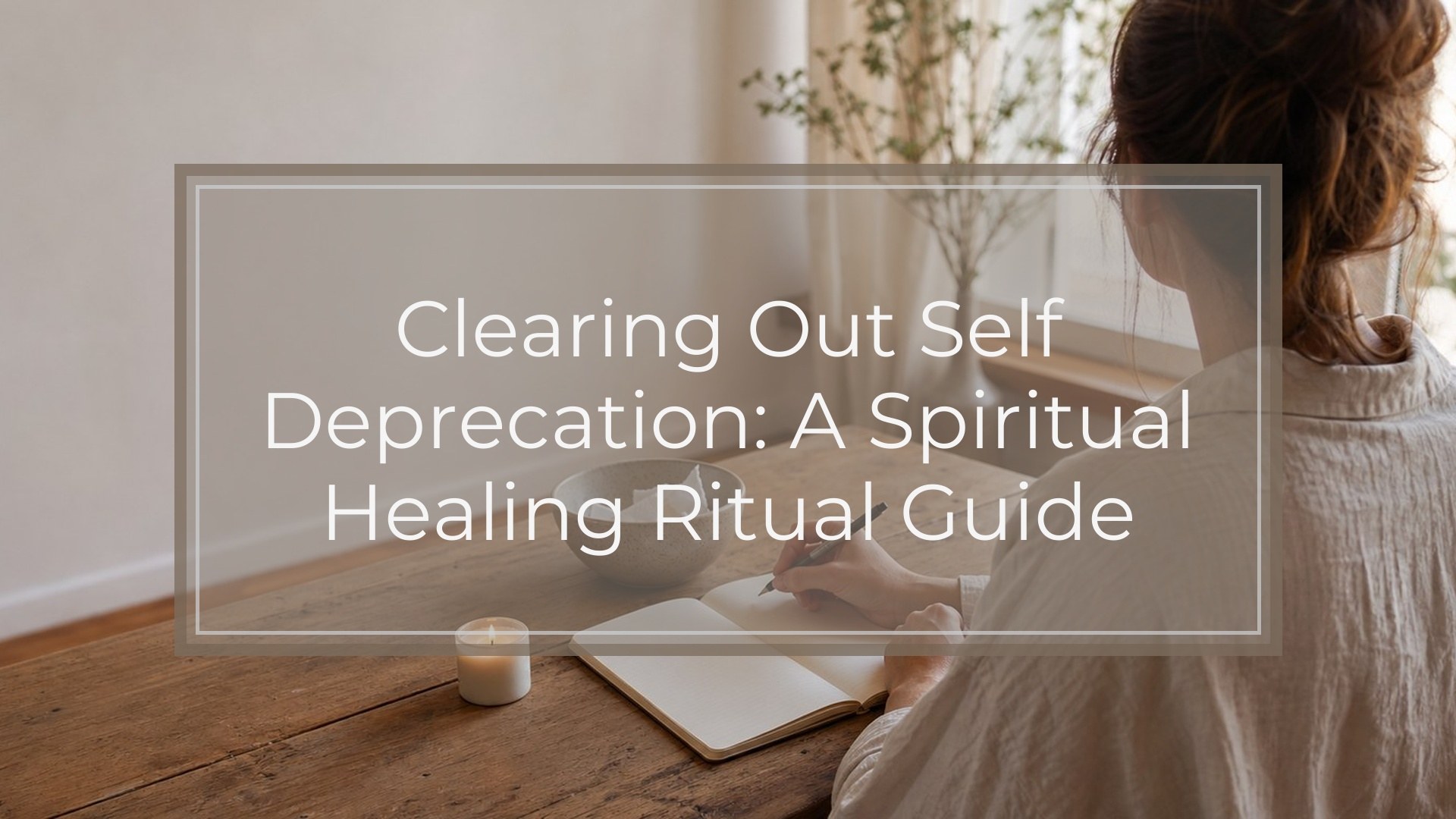
Clearing out self deprecation begins by noticing the exact words you use against yourself, grounding your body, and refusing to treat those words as spiritual truth. In ritual practice, you can write the phrase down, name it as a pattern, release it safely, and replace it with a blessing that feels honest rather than forced. An ancestor altar or quiet sacred space can support the process, but the work should remain gentle, practical, and emotionally safe. The goal is not to pretend you never struggle. The goal is to stop feeding language that diminishes your spirit and to practice speaking to yourself as someone worthy of care, guidance, and protection.
What Self-deprecation Looks Like in Spiritual Healing
Self-deprecation is the habit of turning pain, embarrassment, fear, or old criticism into statements against yourself. It may sound like, “I ruin everything,” “I am not spiritual enough,” “My ancestors must be disappointed,” or “I do not deserve help.”
In spiritual healing, these thoughts can become especially heavy because they may feel like messages, punishments, or signs. Treat them carefully. A self-deprecating thought is not automatically intuition. Often, it is an old wound speaking in a sacred room. This practice helps you slow down, examine the phrase, release its hold, and replace it with language that supports repair.
Prerequisites: What You Need Before You Begin
Choose a time when you have at least 20 quiet minutes and no urgent obligations immediately afterward. You will need paper, a pen, a bowl, a glass of water, and one simple offering such as fresh water, tea, fruit, flowers, or a candle.
If you work with an ancestor altar, make sure the space is clean and respectful. If you do not have an altar, use a small cleared surface.
Important cautions: do not use fire if you feel emotionally overwhelmed, are in an unsafe environment, or cannot supervise it fully. Tearing paper is enough. If self-deprecating thoughts become intense, frightening, or tied to self-harm, pause the ritual and seek support from a trusted person or qualified mental health professional. Spiritual practice can support healing, but it should not replace urgent care.
Step 1: Ground Your Body Before Challenging the Thought

Before you argue with the thought, settle your body. Sit with both feet on the floor. Place one hand on your chest and one hand on your belly. Breathe in for four counts, hold for two, and exhale for six. Repeat this five times.
Then name five things you can see, four things you can feel, three things you can hear, two things you can smell, and one thing you can taste or imagine tasting. This tells your nervous system, “I am here now.”
Do not skip grounding. Self-deprecation often grows stronger when the body is activated, ashamed, or bracing for judgment.
Step 2: Open the Ritual Space or Ancestor Altar Respectfully
If you keep an ancestor altar, approach it with humility. Refresh the water if needed. Light a candle only if it is safe, or simply place your hand near the altar and bow your head.
You might say:
> “Beloved ancestors of wisdom, love, and healing, I ask for support in releasing words that harm my spirit. Only those who come in truth, protection, and alignment with my well-being are welcome here.”
This boundary matters. You are not inviting every ancestral pattern into the room. You are calling on the healed, wise, and loving support that strengthens your dignity.
Step 3: Write the Self-deprecating Phrase Exactly as It Appears
On the paper, write the self-deprecating phrase exactly as it appears in your mind. Do not soften it yet. If the thought says, “I am a failure,” write that. If it says, “I never get anything right,” write that.
Then underneath it, write:
> “This is a thought I have learned. It is not the whole truth of who I am.”
Be specific. The purpose is to move the thought out of the fog and onto the page. Once it is visible, you can work with it. You are not confessing a truth; you are identifying a pattern.
Step 4: Separate the Thought from Your Identity
Look at the phrase and say aloud:
> “This thought is visiting me. It is not my name. It is not my spirit. It is not my destiny.”
Notice where the phrase lands in your body. Does your throat tighten? Does your stomach drop? Does your chest close? Place a hand there and breathe.
Now ask: “Whose voice does this resemble?” It may come from family, school, religion, past relationships, cultural pressure, or old survival strategies. You do not need a perfect answer. You only need enough distance to stop calling the thought “me.”
Step 5: Perform the Release Ritual
Choose one safe release method.
If you are not using fire, tear the paper slowly into small pieces. With each tear, say:
> “I release agreement with this harm.”
Place the pieces in a bowl and cover them with water. Let them sit until the end of the ritual, then dispose of them respectfully in the trash.
If you are using fire, place the paper in a fire-safe bowl or cauldron, away from curtains, pets, children, and loose clothing. Keep water nearby. Burn only a small piece of paper, and never leave it unattended.
As it burns or breaks apart, say:
> “What was learned can be unlearned. What was spoken against me can lose its power. I return this pattern to ash, water, and the keeping of the earth.”
Step 6: Replace the Old Phrase with a Truthful Blessing
Do not leave an empty space where the old phrase lived. Replace it with something believable. A blessing does not need to sound grand. It needs to be true enough that your body can begin to accept it.
If the old phrase was “I ruin everything,” try:
> “I am learning to repair, choose again, and move with care.”
If the old phrase was “I am not worthy,” try:
> “My worth is not cancelled by struggle.”
If the old phrase was “My ancestors are disappointed in me,” try:
> “I welcome ancestral guidance that helps me grow without shame.”
Write your blessing on a clean piece of paper. Read it aloud three times, slowly.
Step 7: Make an Offering to Your Future Self
Now make a small offering not only to your ancestors, but to the future self who will live with kinder inner speech. Place fresh water, tea, fruit, flowers, or another simple offering on the altar or sacred surface.
Say:
> “I offer this in honor of the self I am becoming. May my words become shelter. May my thoughts become honest and kind. May I be corrected without being crushed.”
Leave the offering for an appropriate amount of time according to your tradition or household practice. If it is food or drink, remove it before it spoils. Respect includes tending the space after the ritual.
Result Check: How to Know the Practice Is Working
The practice is working when you notice more space between the thought and your reaction. The self-deprecating phrase may still appear, but you catch it sooner. You may feel less fused with it, less eager to repeat it as truth, or more able to answer it with your blessing.
Other signs include softer body tension, more willingness to try again after mistakes, and less fear when approaching your altar or spiritual practice. Progress is not measured by never having a negative thought. It is measured by no longer building a home for that thought inside your identity.
Common Mistakes and Troubleshooting

One common mistake is choosing a replacement blessing that feels fake. If “I am amazing” makes your body reject the practice, use something steadier, such as “I am learning to treat myself with respect.”
Another mistake is using ritual to suppress emotion. If grief, anger, or shame rises, pause and breathe. You can say, “This feeling is allowed to move through without becoming my identity.”
Be careful with ancestor work if your family line carries harsh judgment, abuse, or spiritual fear. Call only on healed, wise, loving ancestors. You may also work with God, Spirit, guides, saints, nature, or your own higher wisdom instead.
If the same phrase returns, do not assume the ritual failed. Repeated thoughts often need repeated care. Short, consistent practice usually works better than one dramatic ceremony.
A Simple 7-day Practice for Clearing Self-deprecation
For seven days, spend five minutes with your blessing. Place your hand on your heart, breathe slowly, and read the blessing aloud.
Each day, write one sentence that begins with:
> “Today I will speak to myself with more care by…”
Keep it practical. Examples: “not insulting myself after a mistake,” “asking for help,” or “resting without calling myself lazy.”
On the seventh day, refresh your altar or sacred space. Thank your ancestors, guides, or inner wisdom for any support received. Then review your notes and circle one change you can honestly see, even if it is small.
FAQ
What Is the First Step Someone Should Take with Clearing Out Self Deprecation?
The first step is to notice the exact phrase you use against yourself. Write it down without editing it, then ground your body before responding. This keeps the practice concrete and prevents you from trying to fight a vague cloud of shame.
What Can Go Wrong When Following Clearing Out Self Deprecation Advice?
The main risks are moving too fast, using unsafe fire practices, or forcing a positive phrase you do not believe. Emotional overwhelm can also happen. If the process brings up intense distress or thoughts of self-harm, stop and seek immediate support.
How Long Does It Usually Take to Work Through Clearing Out Self Deprecation?
Some people feel lighter after one ritual, but deeper patterns usually need repetition. Try the seven-day practice first, then continue weekly if it helps. The aim is not instant perfection; it is building a new relationship with your inner speech.
How Can a Beginner Tell Whether Clearing Out Self Deprecation Worked?
A beginner can look for small, observable changes: catching the thought sooner, feeling less identified with it, using the replacement blessing, or recovering faster after mistakes. If you have even a little more space and compassion, the practice has begun working.