
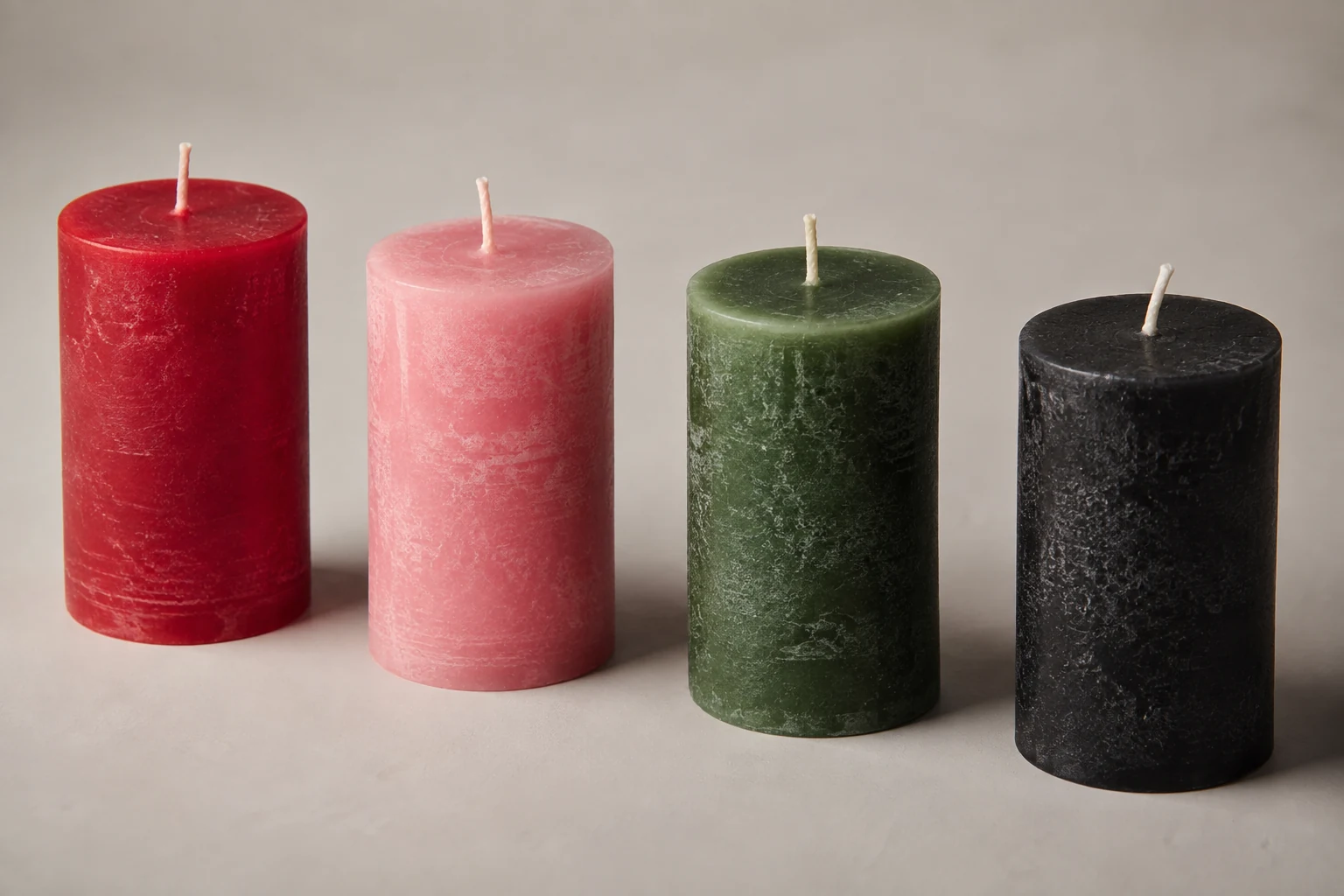
What Candle Colors Mean
In candle practice, an intention is the purpose you bring to an exercise: perhaps reflecting on a friendship or preparing to take a difficult step. A correspondence is a symbolic link between that purpose and something you use, such as a candle color. It gives you a way to represent what you are thinking about; it does not make the color an inherent source of power.
Pagan educator Patti Wigington presents candle-color meanings as typical correspondences used in candle magic. Her guide describes the candle as a tool, rather than something inherently magical. Read the meanings below as one practitioner’s framework for focusing an intention, not as universal rules or promises that lighting a color will produce a result.
Thirteen Candle Colors in One Contemporary Guide
The following are the correspondences in Wigington’s guide. Some entries overlap, and some name difficult experiences rather than desirable outcomes. They are starting points for interpretation, not instructions to feel a particular way about a color.
| Color | Associations in Wigington’s guide |
|---|---|
| Red | Courage, health, sexual love and lust. |
| Pink | Friendship and sweet love. |
| Green | Financial gain, abundance and fertility. |
| Black | Negativity and banishment. |
| White | Purity and truth. |
| Orange | Attraction and encouragement. |
| Gold | Financial gain, business endeavors and solar connections. |
| Yellow | Persuasion and protection. |
| Light blue | Health, patience and understanding. |
| Dark blue | Depression and vulnerability. |
| Purple | Ambition and power. |
| Brown | Earth-related or animal-related workings. |
| Silver | Reflection, intuition and lunar connections. |
A chart is useful because it puts possible symbols side by side. It cannot decide what you mean by love, abundance or protection in a particular situation. Those words need the context of your own intention before a color becomes a useful choice.
How to Read Close or Troubling Associations
Red and pink show why related colors need not be interchangeable. In Wigington’s list, red includes sexual love and lust, while pink points to friendship and sweet love. If your intention concerns showing care to a friend, pink may express it more precisely; if it concerns sexual desire, red may feel closer to the guide’s wording. That is a distinction within this chart, not a fixed rule every practitioner must follow.
Green and gold both include financial gain. Green also carries abundance and fertility; gold adds business endeavors and solar connections. Someone thinking about abundance broadly might choose green, while someone reflecting specifically on a business undertaking might choose gold. Neither choice predicts a financial outcome.
The entries for black and dark blue call for particular care. Wigington links black with negativity and banishment. You might understand banishment as an intention to set aside something you no longer want to give your attention to; it does not make a black candle inherently evil. Her association of dark blue with depression and vulnerability is a symbolic entry in a color chart, not a way to diagnose or treat a mental-health condition.
Why Meanings Can Vary
Wigington’s list documents one contemporary Pagan practitioner framework. It is not an exhaustive account of Pagan traditions, nor a claim that everyone responds to the same colors in the same way. Its purpose here is to make one set of correspondences clear enough to consider, question and adapt.
Research about color associations addresses a different question. A 2020 study surveyed 4,598 people across 30 nations and 22 languages and found both shared patterns and local differences in color–emotion associations within its sample. Participants associated colors with emotion words; the study did not test candle rituals or measure whether an intention came about. Its findings therefore cannot verify that a candle color produces a ritual effect.
Those distinctions leave room for meaning without turning meaning into proof. A color may have a strong association for you because of your experience or the tradition in which you practice. You can take that association seriously as part of your intention while recognizing that it may differ from this guide—or from another person’s interpretation. Neither a practitioner chart nor an emotion-word study establishes an experimentally proven force in the candle itself.
Choosing a Color Without Needing a Collection

Begin with one specific intention, rather than trying to find a color that covers everything at once. For example, “I want to approach a conversation with patience” gives you something clearer to reflect on than “I want things to get better.” Wigington lists patience and understanding with light blue, so that would be one plausible symbol for the conversation. If your emphasis is finding courage to begin it, red would be another. Comparing the entries helps you name which part of the situation you mean to address; it does not reveal a uniquely correct candle.
Your own context can settle a close choice. If a color already carries a relevant meaning in your practice or experience, you need not discard it because it differs from Wigington’s list. You might use the chart to notice the difference: This guide suggests one association, but this other color better represents my intention. That keeps the choice deliberate without treating either association as a guaranteed effect.
Nor do you need thirteen candles. Wigington says many Pagan traditions accept a white candle in place of another color. You could use white while keeping the particular intention in mind, whether or not it appears under white’s own entries of purity and truth. If an open flame is unsuitable, the U.S. Fire Administration offers a battery-operated flameless candle as an alternative. The light is a point of focus; owning a particular color—or using fire—does not determine the value of the intention.
A Modest Exercise That Connects Intention to Action
A personal exercise can stay simple. Choose a color that helps you name your purpose, or use white or a flameless light. Write a short intention on paper and keep the paper away from heat. If you use a lit candle, leave it bare and follow the open-flame conditions below; the exercise does not call for oil, loose herbs or burning the paper.
Then pause briefly with the light as a focus. You might ask yourself what part of the intention is within your control. For the conversation above, that could mean deciding what you need to say clearly, or planning when to invite the other person to talk. The useful next step is something you can actually do after the pause, not something you expect the candle to do for you.
You can adapt the reflection to your circumstances and tradition. A flameless light can mark the same pause if fire would be impractical. You can also leave the written intention in a safe place and return to it later as a reminder of the step you chose. This is a way to connect a symbol with attention and action, without promising that the symbol changes an outcome. Wigington’s guide likewise describes the candle as a tool, not something inherently magical.
If Using a Flame, Make the Conditions Nonnegotiable
For a lit candle, use a stable holder and keep the candle at least 12 inches from anything combustible. Paper used for an intention belongs outside that clearance, along with anything else that could burn. These are fire-safety conditions, not optional parts of the symbolism.
Before lighting, check the space around the holder. The written intention, notebook, curtains and decorations are all things that can burn, so move them outside the clearance area instead of holding or placing paper near the flame. Put the holder where it is unlikely to be knocked over. Decide when you will extinguish the candle before you begin; the symbolic exercise need not continue until the wax is consumed. If the space cannot be cleared and supervised, use the flameless light rather than trying to work around those conditions.
Remain present while the candle burns. The U.S. Fire Administration says to blow out candles when leaving a room or home or when going to bed. Do not arrange an exercise that depends on a flame continuing after you leave or fall asleep. If you cannot provide a suitable holder, clearance and supervision, choose the battery-operated flameless option instead.
The Decision to Take Away
Choose a color because it helps you express an intention, not because it promises to fulfill one. Let the symbol support a real-world step within your control, and use white or a flameless light when that better fits your circumstances.