
Angels in shamanism usually refers to the way some modern practitioners describe compassionate, protective, or luminous spirit beings encountered in shamanic-style practice. In many traditional shamanic cultures, the word “angel” is not the original term. Instead, people may speak of helping spirits, ancestors, animal allies, deities, guardians, or beings of the upper world.
So the balanced answer is: angels are not a universal or defining feature of shamanism, but angel-like beings can appear in contemporary shamanic spirituality, especially where Christian, New Age, Indigenous, folk, or personal spiritual languages overlap. The most respectful approach is to treat “angel” as an interpretation, not a guaranteed fact, and to stay attentive to the cultural tradition, ritual context, and personal meaning involved.
What Does “Angels in Shamanism” Mean?
“Angels in shamanism” can mean two related things. First, it may refer to spirit beings that feel angelic: radiant, protective, winged, loving, or connected with healing and guidance. Second, it may describe the language a modern practitioner uses when interpreting a shamanic journey, vision, dream, or ritual experience.
In strict terms, angels belong most clearly to Abrahamic religious traditions such as Judaism, Christianity, and Islam, though similar messenger or guardian beings appear in many cultures. Shamanism, by contrast, is a broad category for spirit-mediated healing, journeying, divination, and relationship with unseen powers.
Because of this, the phrase is best understood as a bridge term. It does not mean all shamans work with angels. It means some people interpret certain spirit helpers through angelic symbolism.
Are Angels Traditionally Part of Shamanism?
There is no single worldwide shamanic doctrine, and it would be inaccurate to say that “shamanism believes in angels” as a whole. Shamanic traditions are rooted in specific peoples, lands, lineages, languages, and cosmologies. Siberian, Mongolian, Sámi, Amazonian, Korean, and other spirit traditions do not all share the same map of the unseen world.
Some cultures may speak of sky beings, celestial helpers, guardian spirits, divine messengers, or luminous protectors. These may feel similar to angels to an outsider, but they should not automatically be renamed as angels. That can flatten cultural differences.
A careful distinction helps: “angel” may be a useful comparison, while the original tradition’s own names and meanings deserve respect.
Angel-like Roles in Shamanic Spirituality
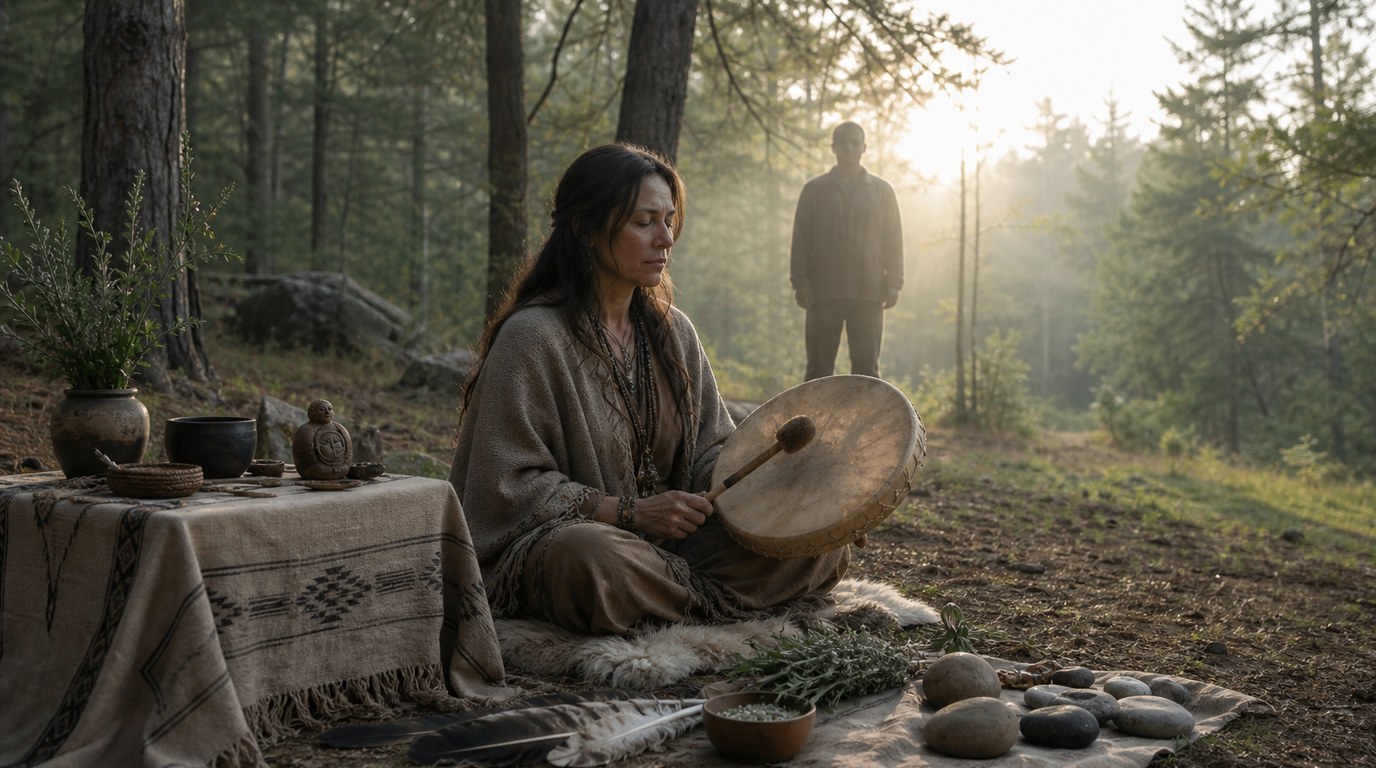
Even when the word “angel” is not traditional, certain roles overlap with angelic imagery. In many shamanic or shamanic-style practices, a helping spirit may protect the practitioner during journeying, guide them through unfamiliar spiritual terrain, bring healing energy, deliver messages, or help restore balance.
These functions resemble popular ideas of angels as guardians, messengers, and healers. A person might encounter a radiant figure, a winged presence, a being of light, or a compassionate guide in the “upper world” and describe it as angelic.
Still, similarity of role does not prove identity. One practitioner may call the being an angel. Another may call it a spirit teacher, ancestor, deity, or symbolic image from the psyche. The meaning depends on context, tradition, discernment, and relationship over time.
Why Some Practitioners Use the Word “Angel”
Many modern spiritual practitioners draw from more than one vocabulary. Someone raised with Christian imagery may naturally call a protective luminous being an angel. Another person influenced by New Age spirituality may use “angel” for any benevolent higher guide. Others may use the term simply because it communicates gentleness, protection, and divine care.
This does not always mean the practice is traditionally shamanic, nor does it make the experience invalid. It means the practitioner is interpreting the experience through familiar language.
For clarity, it can help to say, “I experienced this being as angelic,” rather than “this is definitely an angel in shamanism.” The first statement honors experience without overstating certainty.
Common Misconceptions About Angels in Shamanism
One misconception is that all shamanic traditions include angels. They do not. Many have their own distinct spirit beings, cosmologies, and ritual relationships.
Another misconception is that any winged or bright being must be an angel. Wings, feathers, light, and sky imagery can symbolize many things: protection, elevation, freedom, bird spirits, celestial realms, initiation, or ancestral blessing.
A third misconception is that angelic beings are always safe, clear, or unquestionably benevolent. In serious spiritual practice, discernment matters. A beautiful image does not automatically equal wisdom.
Finally, some people assume mixing angel work with shamanic practice is always authentic or always wrong. The reality is more nuanced. It depends on cultural context, training, consent, humility, and how the work is framed.
Examples of Angelic Symbolism in Shamanic-style Practice
In a guided journey, someone may meet a luminous figure at the edge of a bright landscape. They might interpret this presence as an angelic guide if it feels protective, loving, and instructive.
Another person may repeatedly see feathers during altar work, dreams, or meditation. Rather than assuming one fixed meaning, they might ask whether the feathers point to bird medicine, ancestral presence, angelic symbolism, or a reminder to lighten the heart.
A practitioner doing healing work may sense wings around their shoulders or a column of light above the head. These images can be understood as symbols of protection, spiritual elevation, or blessing.
In each case, the key is interpretation. The symbol may be meaningful without needing to become a universal rule.
How to Interpret an Angelic Encounter Respectfully

Begin by recording the experience plainly. What did you see, feel, hear, or know? Avoid rushing to label it. Write “winged figure,” “warm light,” or “protective presence” before deciding what it means.
Next, consider your spiritual background. Are angels part of your inherited faith, family language, or personal practice? If so, the image may be speaking through symbols you already understand.
Then ask about relationship and results. Did the encounter bring humility, steadiness, compassion, healing, or clearer responsibility? Or did it create fear, superiority, confusion, or dependence?
If you work within a specific tradition, consult qualified elders, teachers, or lineage holders. At home, you might place a simple glass of water, candle, or prayer on your altar and ask for clarity, protection, and truth.
Angels, Ancestors, and Spirit Guides: Key Differences
Angels are usually understood as divine messengers or heavenly beings, especially in Abrahamic and modern spiritual contexts. Ancestors are deceased family, lineage, or community members who are honored and petitioned through remembrance, offerings, and relationship. Spirit guides is a broader term that may include teachers, animal allies, nature spirits, deities, or other helping presences.
These categories can overlap in personal experience, but they are not the same. An ancestor may feel protective without being an angel. A guide may appear radiant without belonging to angelic tradition. Clear naming helps your altar work stay respectful and grounded.
A Simple Reflection Practice for Angelic or Guide Imagery
Sit quietly near your altar or a clean, peaceful space. Light a candle if appropriate. Place water nearby as an offering for clarity.
Ask inwardly: “What did this image come to teach, and what is mine to do with it?” Notice sensations, emotions, and memories without forcing an answer.
Write three lines: what appeared, how it felt, and what action would honor it. Close by thanking your ancestors, guides, and protective powers in the language you trust.
FAQ
Do Shamans Believe in Angels?
Some individual shamans or shamanic practitioners may believe in angels, especially if their culture or personal religion includes them. But shamanism is not one unified belief system, and angels are not universal to all shamanic traditions. It is better to ask about the specific tradition or practitioner.
Can an Angel Be a Spirit Guide?
In modern spiritual language, yes, some people experience an angel as a type of spirit guide. In traditional contexts, the being may be named differently. A careful approach is to describe the role: protective, guiding, healing, or messenger-like, while remaining open about the being’s exact identity.
Are Angels the Same as Ancestors?
No. Ancestors are connected to lineage, family, bloodline, adoption, community, or cultural inheritance. Angels are generally understood as heavenly or divine messengers rather than deceased relatives. Both may offer protection or guidance, but they come from different spiritual categories and should not be automatically combined.
What Does It Mean to See Wings, Feathers, or Light in a Shamanic Journey?
Wings, feathers, and light may suggest protection, uplift, healing, sky-world connection, bird spirits, angelic symbolism, or ancestral blessing. The meaning depends on your tradition, emotions, and the wider journey. Treat the image as a symbol to explore, not instant proof of one fixed message.
Is It Safe to Call on Angels During Shamanic Practice?
For many people, prayerfully calling on protective angels feels safe and comforting. Still, if you are practicing within a specific shamanic lineage, follow its guidance rather than mixing methods casually. Stay grounded, ask for protection and truth, and seek experienced support if experiences become frightening or destabilizing.