
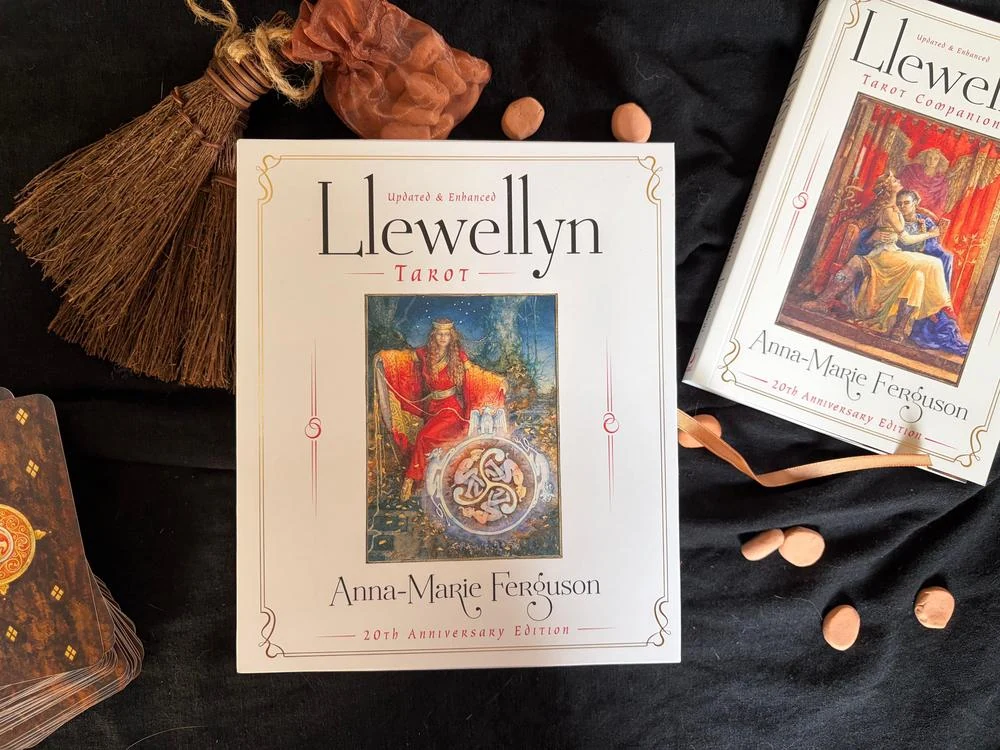
20th Anniversary Edition photograph: Llewellyn Worldwide. The closed package and companion book are shown; the card altar’s opening mechanism is not shown.
A built-in card altar can make a tarot kit worth considering when you already want its deck and guidebook. It is a weaker reason to buy another deck when all you need is somewhere to display a card you own. The useful question is what the complete kit would add to your own practice, including how you would put it away.
The specific example here is Anna-Marie Ferguson’s The Llewellyn Tarot: Updated and Enhanced 20th Anniversary Edition, the 2026 publication with ISBN 9780738780481. Its publisher describes a magnetic-closure box with a card altar built into it. That is a particular product feature, not a requirement for an ancestor altar or a promise that the object will produce a spiritual result.
You can keep a remembrance space without cards, or use cards privately as prompts for reflection. Other people in the household may prefer not to include them. Decide whether this is an object you actually want before considering the packaging as an addition to a shared space.
Identify the Exact Edition Before Comparing the Box
Similar titles and familiar cover art can make two listings look interchangeable. For this purchase, match the author, anniversary wording, date and ISBN together. The publisher identifies an August 2026 deluxe boxed kit. The selected Amazon listing identifies Anna-Marie Ferguson, the Updated and Enhanced 20th Anniversary Edition, ISBN-10 0738780480, ISBN-13 9780738780481 and an August 8, 2026 publication date. Its selected format is Cards.
Those details describe this edition. An older listing called simply The Llewellyn Tarot is not automatically the same kit. The current retail page also recommends another publication with that shorter title; a recommendation or “frequently bought together” entry is a separate purchase, not an additional deck included in this box. Do not combine the descriptions, review counts or component claims of neighboring listings.
Before ordering, save the exact ISBN and edition name with your purchase notes. If an offer’s photographs or description conflict with them, ask the seller which publication and components it supplies. A title match alone does not resolve a contradictory edition or an incomplete used set. You need not place an order to settle the question.
Count the Kit’s Components Separately
For ISBN 9780738780481, Llewellyn lists 78 cards, a 312-page full-color guidebook, and the premium magnetic-closure box with its built-in card altar. These are publisher-stated contents for this edition. The Amazon page’s “Print length: 312 pages” is a publication field, not a count of cards. The card count comes from the publisher’s record for this exact ISBN.
Treat the deck, guidebook and box as three parts of the buying decision. You might want the illustrations but prefer a different reading arrangement. You might want the new guidebook and be indifferent to display. Or the integrated display may make sense because you would use this deck, its book and its original packaging together. None of these preferences makes another reader’s arrangement incomplete.
The publisher’s “Case Quantity: 10” is wholesale packing information. It does not mean a consumer offer contains ten tarot kits. Similarly, an Amazon order selector showing Quantity 1 describes how many units you select; it is not evidence of a factory multipack. Read the actual offer’s contents rather than multiplying components from unrelated numbers.
New and used offers also need different attention. The page advertises both, but an edition-level description does not guarantee that every used offer includes all cards, the guidebook and an intact original box. If the box feature is your reason for choosing this edition, its presence and condition matter as much as the deck’s identity. Obtain that information from the particular offer before relying on it.
What the Anniversary Changes Do—and Do Not—Establish
The publisher describes color-enhanced cards with reduced borders, a new illustration for the Strength card, a full-color guidebook, and gold foil on the kit box and guidebook cover. It also identifies the magnetic closure and built-in card altar as features of this edition. These are useful, specific changes to consider if you already know the earlier deck.
Reduced borders do not, by themselves, establish larger physical cards. Enhanced color does not prove that every reader will find the artwork easier to interpret, and decorative foil does not establish protective performance. If one particular illustration or an accessibility need determines your purchase, check the publisher’s available edition-specific material or ask a precise question before ordering.
For someone who already owns a complete, usable deck, the choice is therefore narrower than “old versus better.” Do you want these particular revisions and the accompanying book enough to buy another complete publication? If you mainly want a place to leave one existing card visible, you can keep your deck and use an arrangement already available to you. The box does not create an obligation to replace anything.
Distinguish an Integrated Display from Verified Operating Instructions
The built-in feature means the display component belongs to the supplied box, according to the publisher. It does not establish how that component unfolds, its working angle, how many cards it holds, or how much clear table space an open kit occupies. Neither the product description nor the saved retail specifications used here provides a complete operating diagram.
The publisher lists the product size as 7 × 8.44 × 2.25 inches. These are product-item dimensions, not verified card dimensions, usable inner clearance or an open-box footprint. Do not use that rectangle as a promise that the working display will fit a particular shelf. The publisher photograph shows the anniversary package and companion book; it does not establish the card altar’s opening mechanism, working angle or open-box footprint.
If your space is tight, ask the publisher or seller for the opened footprint and the supplied display instructions. If those remain unknown, leave the fit decision unresolved rather than planning around a guessed hinge or fold. You can postpone the purchase or choose to use a deck you already have. There is no need to add a separate stand, cloth or candle merely to complete the shopping list.
When you have the actual kit, follow its supplied instructions before trying the built-in feature. Do not force an unfamiliar panel to match an illustration of a different box. First check opening, access to the deck and book, and returning everything to storage on an ordinary clear surface. Check access and storage before placing the kit on a shared remembrance surface.
Decide Whether This Whole Kit Serves Your Use
Consider three situations. A reader who wants Ferguson’s revised artwork and the accompanying color guidebook can reasonably consider the integrated box as part of the complete publication. A reader happy with an existing deck but seeking display alone has less reason to buy this kit. A reader interested in the anniversary edition but unable to confirm that its opened box fits a small shared shelf can keep the purchase pending until that information is available.
For use near a remembrance space, decide what will be visible and who is comfortable with it. You might select one card privately, read a passage from the guidebook elsewhere, or leave the entire kit stored between uses. You do not need to display the book and full deck together. If you share a surface, agree on where the kit can go and how it will be put away without displacing another person’s objects.
The publisher’s description places the artwork in a Celtic mythic setting. That describes this publication’s creative context. It does not make tarot a universal ancestral tradition or establish that this deck represents your family’s beliefs. A product called a card altar is not evidence of communication with the dead. Keep any interpretation personal, voluntary and separate from factual claims about relatives, history or what another person must believe.
If a card prompts a family story, distinguish your own reflection from a documented recollection. Ask before sharing another person’s private words or photographs. You can write a separate note without presenting the card as proof that an event occurred or that someone held a particular view.
Check the Particular Offer, Then Keep the Purchase Optional
For the exact 2026 edition discussed here, check current availability of The Llewellyn Tarot 20th Anniversary Edition. As an Amazon Associate, Ancestor Altars earns from qualifying purchases. Check the selected edition, condition, included components, seller and delivery destination before ordering. The observed retail page used Bulgaria as its delivery context; current US stock, regional delivery and the completeness of any particular used offer are unknown.
Keep the ISBN with your receipt or order record so that a gift recipient or seller can identify the intended publication. If the received components differ from the offer, resolve that discrepancy with the seller rather than improvising a missing display component or assuming another box works the same way. Preserve any supplied setup and storage instructions with the kit.
The box matters when it makes a deck and book you already want more convenient to use together. It matters less when it creates a new purchase just to solve a display preference. Either decision can leave you with a complete personal practice: use the integrated feature as instructed, keep the cards elsewhere, continue with your current deck, or choose no cards at all.