
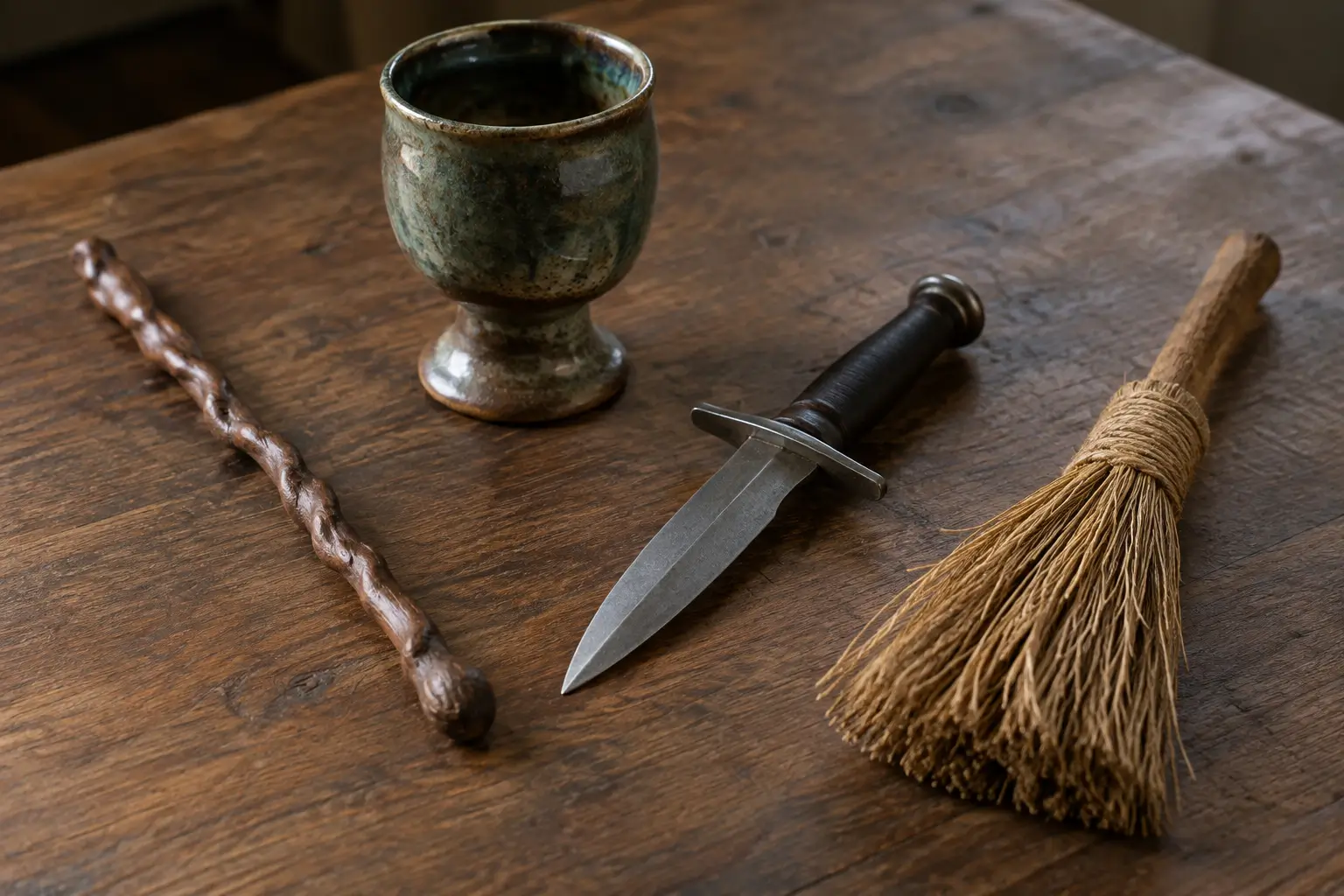
Search for a definitive list of Wiccan tools and you may encounter totals of eight, nine, or 13. Rather than asking which list has “won,” ask how each list defines, groups, and counts its contents.
The supplied evidence identifies several recurring implements, but it does not establish a universally binding total. A dependable beginner’s model is therefore:
> A list of tools is a context-dependent description, not necessarily a universal equipment requirement.
This distinction prevents a descriptive list from becoming an unsupported test of identity. It also leaves room to notice important qualifications: an “or” can indicate an alternative, while “may include” signals that an item is possible rather than compulsory.
Why Eight, Nine, and 13 Are Not Universal Totals
The available evidence does not identify eight, nine, or 13 as the universally correct number of Wiccan tools. It also does not connect those totals to particular traditions. Treating one number as authoritative would therefore go beyond what the sources support.
Two documented facts provide relevant context for this variation.
First, the Washington religious handbook states that Wicca has no specific scriptural text. That fact does not, by itself, explain every difference among tool lists. It does mean that the supplied evidence offers no single cited scripture from which a binding numbered inventory can be derived.
Second, an academic study describes Wiccan practice as occurring both solitarily and in covens. This establishes diversity in the settings where Wicca is practised. It does not show that solitary practitioners follow one numbered list while covens follow another, so no such division should be assumed.
The careful conclusion is that the sources do not present Wicca as having one uniform setting governed by one universal inventory. Different totals may reflect different decisions about grouping alternatives or including optional items. The number alone does not reveal whether two lists are describing genuinely different collections or counting similar material in different ways.
For a beginner, the useful first question is therefore “What is this list counting?”, not “Which number proves the others wrong?”
What the Sources Actually Name—and How Counting Can Shift
The academic source names the wand, athame, cup or cauldron, and broom among principal Wiccan tools. This provides a documented cluster of implements, but not a complete universal inventory.
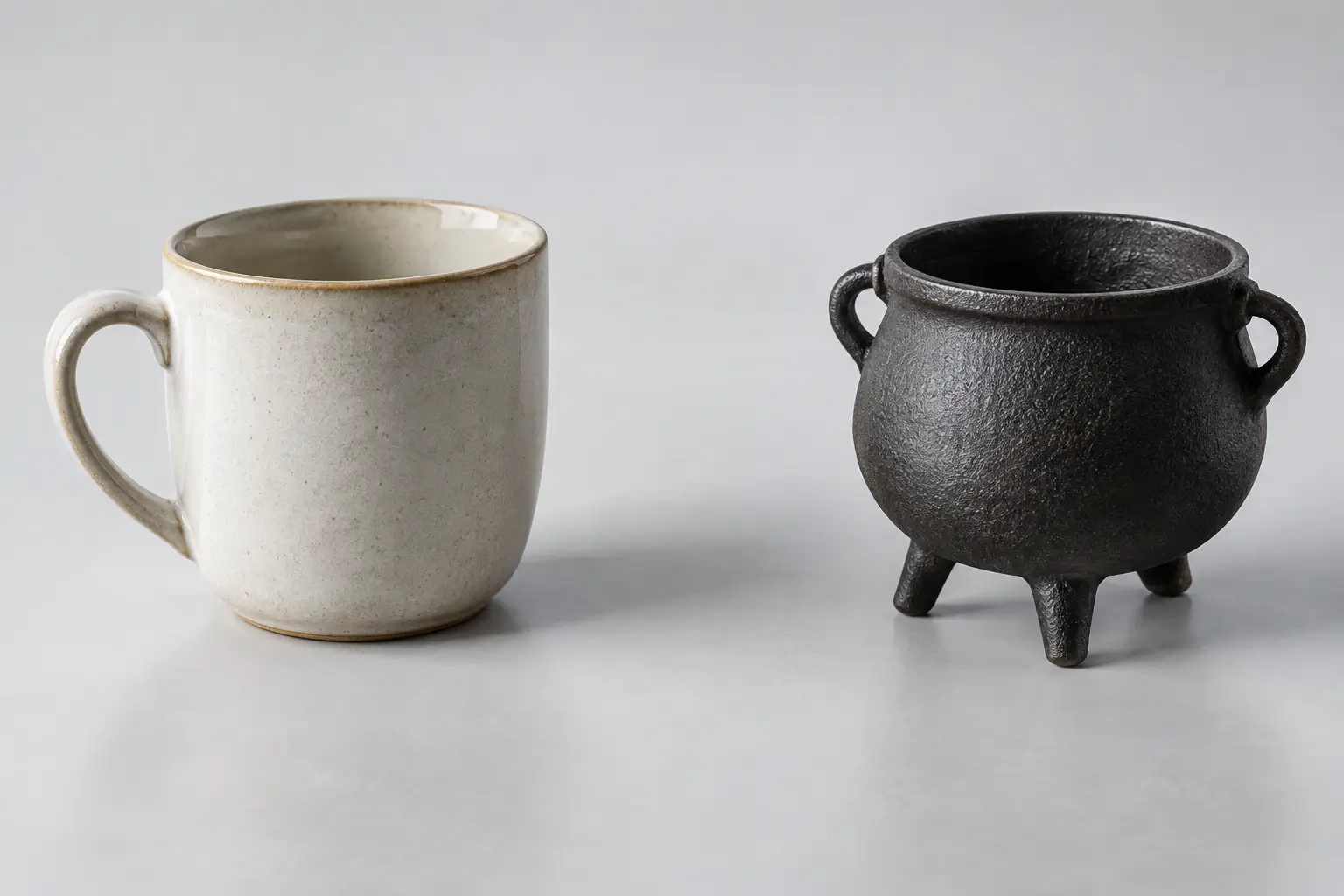
The wording “cup or cauldron” is especially important. The source presents an alternative rather than stating that both objects are mandatory. That distinction can change a list’s visible total:
- If “cup or cauldron” is retained as one alternative category, it occupies one place.
- If cup and cauldron are separated into two numbered entries, the list becomes longer.
Separating the terms does not establish that both objects are required. It only demonstrates how a choice about grouping can alter the count.
The Washington handbook adds another qualified item when it says altar items may include a pentacle. “May include” indicates possible inclusion, not a universal obligation. A list that includes the pentacle will be longer than one that does not, but the numerical difference does not prove that either list is more authoritative.
The documented wording can be summarized cautiously:
| Documented wording | Appropriate reading |
|---|---|
| Wand | Named among principal tools in the academic source. |
| Athame | Named among principal tools in the academic source. |
| Cup or cauldron | Presented as an alternative, not clearly as two mandatory items. |
| Broom | Named among principal tools in the academic source. |
| Pentacle | An item that the handbook says an altar may include. |
This table is not a new canonical list. It records only what the supplied sources name and preserves the qualifications attached to those names.
Together, the alternative “cup or cauldron” and the optional pentacle show why lists can produce different totals. They do not, however, explain or validate the specific numbers eight, nine, or 13. The evidence supports the general principle of variable counting, not a particular numbered system.
What These Lists Cannot Tell You
Naming an implement in a source does not prove that every Wiccan must own it.
The academic source’s description of certain objects as principal tools indicates their prominence within that account. It does not make possession of every object a condition of Wiccan identity. Likewise, the handbook’s statement that altar items may include a pentacle documents a possibility rather than a requirement.
The supplied research also does not explain the ritual functions or symbolism of the wand, athame, cup or cauldron, broom, or pentacle. Those meanings cannot be inferred from the fact that the objects are named. Accounts from particular traditions may offer interpretations, but they are outside the boundaries of the evidence provided here.
The sources also do not establish:
- which traditions, if any, use totals of eight, nine, or 13;
- that one of those totals takes precedence over the others;
- that every named object must be owned simultaneously;
- that optional language creates an obligation;
- or that a list of principal tools is an initiation standard.
Commercial presentation must remain separate from documented practice. The supplied claims establish nothing about retailer bundles, product categories, or merchandising conventions. A boxed collection may look complete, but this evidence gives no reason to treat either its contents or its item count as a religious standard.
Nor does ownership demonstrate personal standing. Nothing in the supplied evidence makes a complete-looking collection proof of initiation, authenticity, experience, or commitment. A source can recognize an object as part of practice without turning that object into a credential.
Close attention to wording helps maintain these boundaries:
- “Principal” indicates importance within the cited account, not universal ownership.
- “Or” presents an alternative rather than automatically adding another requirement.
- “May include” permits an item without requiring it.
- A numbered total reflects a way of counting unless evidence establishes something stronger.
These distinctions keep descriptive sources from being treated as rulebooks they never claimed to be.
A Beginner’s Evidence-based Starting Point
The clearest practical guidance in the supplied evidence is narrow but useful: the Washington handbook explicitly allows a wooden wand to substitute for an athame.
This documented substitution means that acquiring every named implement need not be treated as a prerequisite for beginning a personal practice. If a wooden wand can stand in for an athame, at least one documented approach does not require simultaneous ownership of both.
That conclusion should not be expanded into an unlimited catalogue of replacements. The evidence does not say that any household object can replace any Wiccan tool, nor does it document substitutes for the cup, cauldron, broom, or pentacle. The wooden-wand-for-athame allowance is the only substitution supported by the supplied research.
For the same reason, these sources do not establish a fixed minimum starter set. Their practical implications are more limited:
- Several tools recur in documented descriptions.
- Some wording presents alternatives, as in “cup or cauldron.”
- Some items are optionally included, as with the pentacle.
- At least one explicit substitution—a wooden wand for an athame—is allowed.
A beginner can therefore begin by understanding the terms and expectations of the particular context they are exploring, rather than trying to satisfy an unsupported numerical checklist. The evidence gives no reason to treat possession of eight, nine, 13, or any other number of objects as a measure of spiritual standing.
The practical principle is simple: pay attention to context, alternatives, and optional wording. Intentional practice within one’s circumstances matters more than making a collection conform to a number the available sources do not establish as universal.