
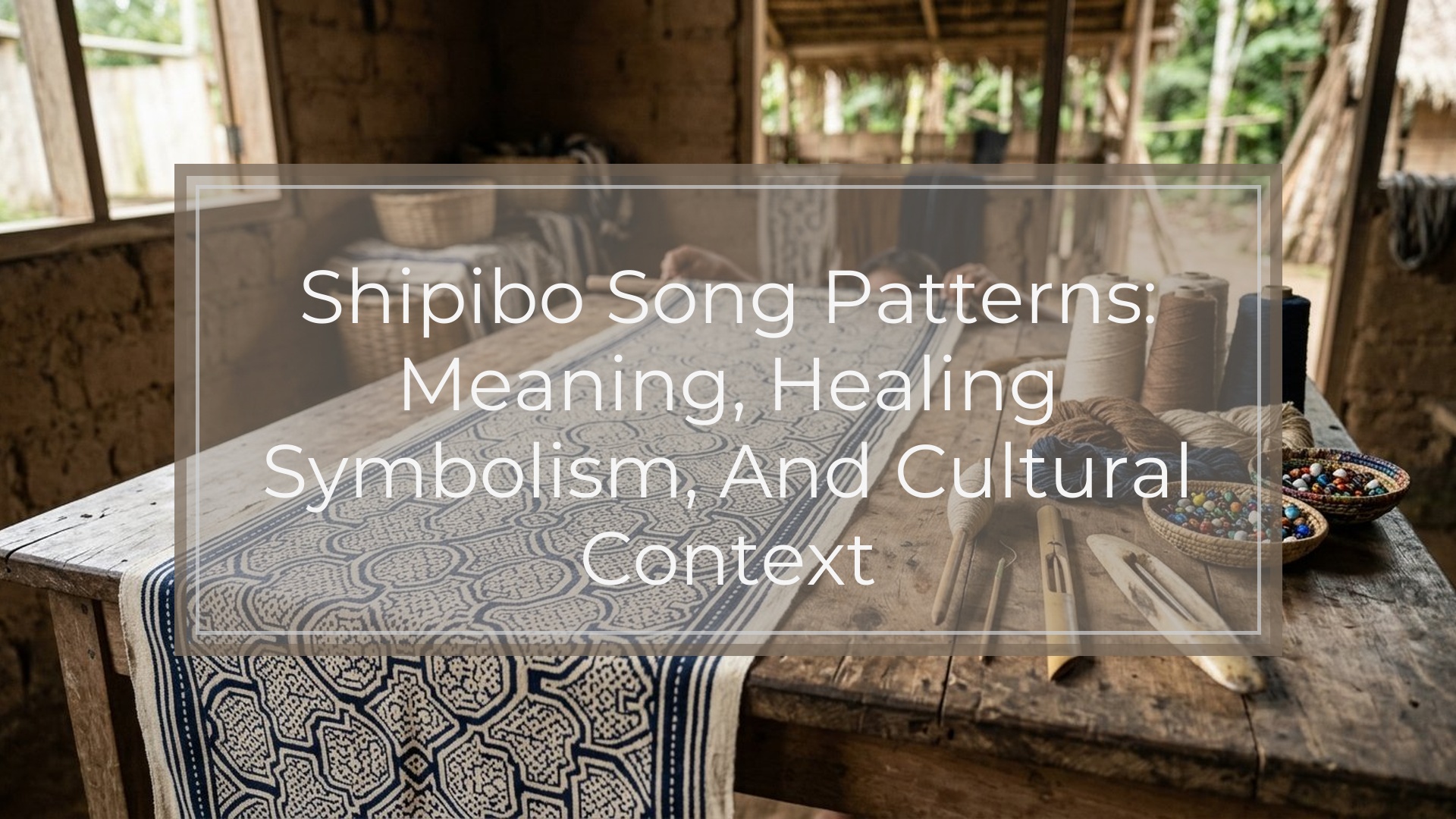
Shipibo song patterns are commonly understood as the relationship between Shipibo-Konibo visual designs, known in many contexts as kené, and sung or chanted ritual melodies, often discussed as ícaros in healing settings. In plain terms, they refer to the idea that pattern, sound, and spiritual order can be connected.
This does not mean every Shipibo design is a simple written song, or that an outsider can “read” a textile like sheet music. Some Shipibo-Konibo artists, healers, and scholars describe a meaningful correspondence between visual pattern and song, especially in ceremonial and healing contexts. The exact meaning depends on the maker, lineage, setting, and purpose. Any explanation should be offered with respect and caution.
That same care is useful when looking at Shipibo textile patterns, where meaning can shift with maker, setting, and use.
A Clear Definition of Shipibo Song Patterns
Shipibo song patterns are visual and sonic expressions associated with Shipibo-Konibo culture, an Indigenous people of the Peruvian Amazon. The phrase usually points to the way geometric designs and healing songs are said to mirror, guide, or express one another.
The visual side is often called kené: intricate, flowing, symmetrical designs seen on textiles, ceramics, painted objects, body painting, beadwork, and contemporary art. The sonic side may include ritual songs or chants used by trained practitioners in healing ceremonies.
A careful definition is this: Shipibo song patterns are not merely decoration and not simply musical notation. They are culturally rooted forms in which design, song, beauty, memory, healing, and spiritual relationship may be understood as connected.
Cultural and Spiritual Context
The Shipibo-Konibo people live primarily along the Ucayali River and nearby areas in the Peruvian Amazon, with communities also present in urban and diasporic contexts. Their artistic and ritual traditions are living practices, not relics of the past.
Kené designs are often associated with women’s artistic knowledge, especially in textiles and ceramics, though contemporary practice is more varied. These designs may be learned through family, apprenticeship, observation, dreams, ceremonial experience, or personal artistic development, depending on the person and community.
In spiritual and healing contexts, songs may be used by trained healers to cleanse, protect, diagnose, or restore balance. Some accounts describe songs as carrying patterns, and patterns as holding or reflecting song. These statements should not be flattened into a single universal rule. Shipibo-Konibo traditions are diverse, and sacred knowledge is not always public knowledge.
How Visual Designs and Songs Are Said to Relate
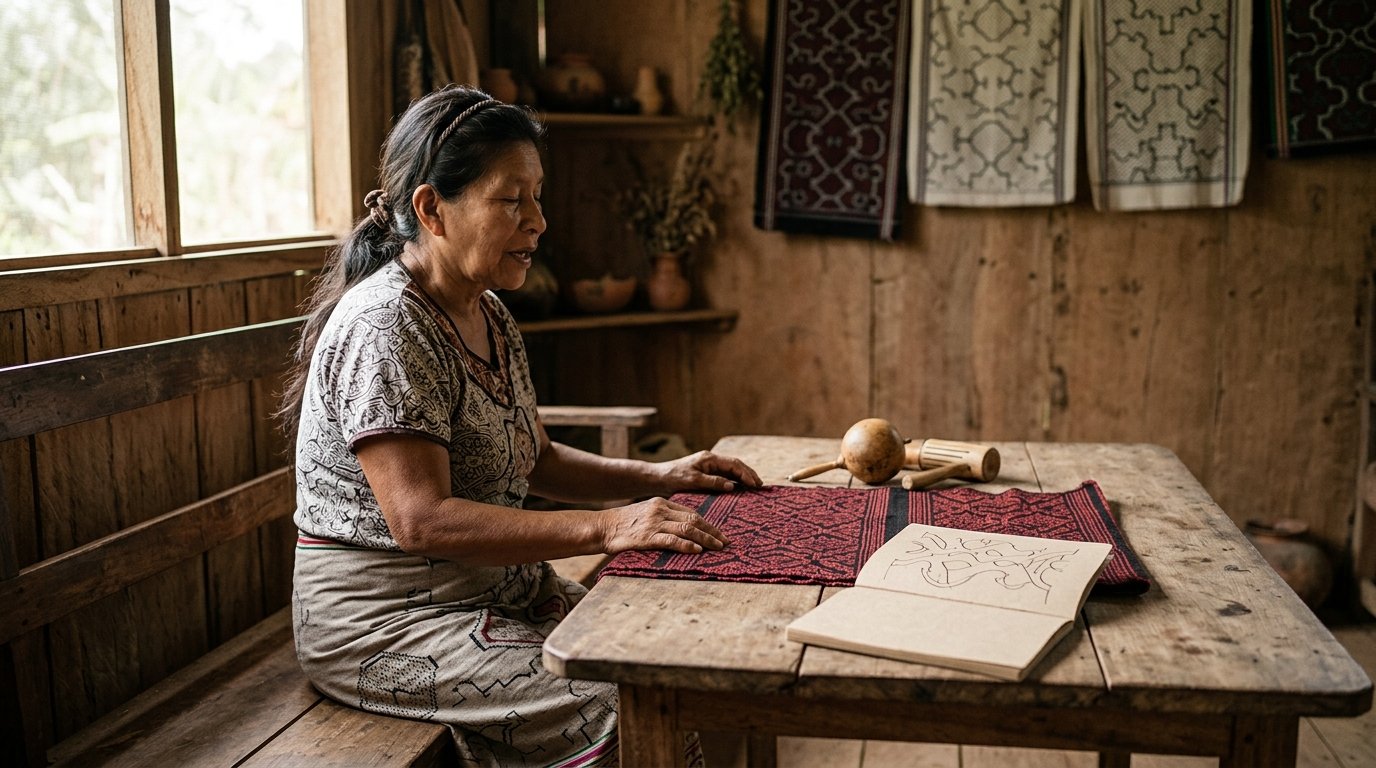
One of the most widely discussed ideas about Shipibo song patterns is that visual designs and melodies correspond to one another. Some artists and healers describe seeing patterns while singing, singing patterns into the body, or translating a felt energetic structure into design. In this view, pattern is not only visual; it is also vibrational, relational, and spiritual.
A common explanation is that the flowing lines of kené can be understood as paths of harmony or balance. In healing settings, a song may be used to bring a person, object, or space into better alignment. The design may visually express that ordered state.
Still, it is important to avoid overclaiming. It is not accurate to say that all Shipibo designs can be decoded by outsiders as exact songs. Nor is it respectful to treat sacred songs as aesthetic material alone. The relationship is better understood as a culturally specific correspondence between sound, vision, and healing knowledge.
Examples of Shipibo Song Pattern Expressions
Shipibo song patterns may be discussed across several forms of expression:
- Textiles: Cloths, garments, and embroidered or painted fabrics may carry kené designs with flowing, maze-like geometries.
- Ceramics: Bowls, jars, and vessels may be painted with designs that reflect balance, movement, and skilled visual rhythm.
- Body painting: Designs used on the body may connect beauty, protection, identity, and ceremony.
- Healing songs: In ritual contexts, trained practitioners may sing songs understood to cleanse, guide, protect, or restore harmony.
- Contemporary art: Shipibo-Konibo artists may adapt traditional visual language into murals, paintings, fashion, and public art.
These examples show the range of expression, but they do not give outsiders ownership over private meanings. Context matters.
Symbolism: Pattern, Harmony, and Healing
Factually, Shipibo-Konibo visual designs are known for intricate geometric patterning, and songs are significant in many healing and ceremonial contexts. Interpretively, many people understand the patterns as symbols of harmony, spiritual order, protection, beauty, and energetic balance.
For those approaching the topic through ancestral or altar practice, the most respectful symbolic lesson may be this: pattern can remind us that healing is not random. It may involve rhythm, repetition, attention, right relationship, and beauty.
However, symbolic inspiration is different from cultural authority. One may appreciate the idea of harmony without claiming to know the full sacred meaning of Shipibo-Konibo designs or songs.
Common Misconceptions About Shipibo Song Patterns

A common misconception is that Shipibo patterns are “Amazonian sheet music.” This is too simplistic. While some people describe correspondences between pattern and song, that does not make every design a readable musical score.
Another misconception is that the designs are only decorative. This also misses the depth of the tradition. Many designs carry cultural, spiritual, aesthetic, and personal significance.
A third misunderstanding is that all Shipibo-Konibo people interpret the patterns in one identical way. Living traditions vary by community, family, artist, healer, and context.
It is also misleading to treat ayahuasca tourism as the center of Shipibo culture. Ayahuasca ceremonies are one context in which songs and patterns are discussed, but Shipibo-Konibo life, art, language, kinship, land, and history are much broader than that.
Finally, copying a design from the internet does not make someone a carrier of the tradition.
Respectful Ways to Learn About Shipibo Song Patterns
A respectful approach begins with humility. Learn from Shipibo-Konibo artists, writers, scholars, and community-led sources whenever possible. If you buy art, purchase directly from Indigenous artists or ethical organizations that name and compensate the makers.
Avoid using sacred-looking designs as exotic decoration without context. Do not claim to teach, transmit, or “activate” Shipibo patterns unless you have legitimate training and permission from the appropriate community or teacher.
For home spiritual practice, you can honor the broader lesson—beauty, song, pattern, and healing belong together—without imitating restricted forms. Support living artists, cite sources, and let reverence guide your choices.
What We Can Say Carefully—and What We Should Not Claim
We can say that Shipibo-Konibo kené designs and ritual songs are meaningfully connected in many accounts, especially around healing, beauty, and spiritual order. We can also say that the relationship is culturally specific and not fully accessible through surface observation.
We should not claim that every pattern has a fixed translation, that outsiders can decode sacred designs, or that using these patterns automatically brings healing power. Respect requires both appreciation and restraint.
FAQ
Are Shipibo Song Patterns the Same as Musical Notation?
Not exactly. Some Shipibo-Konibo artists and healers describe relationships between visual designs and songs, but that does not make the patterns equivalent to Western sheet music. They are better understood as culturally specific visual-sonic expressions connected to harmony, healing, beauty, and spiritual knowledge.
What Are Kené Designs?
Kené refers to Shipibo-Konibo geometric designs, often seen on textiles, ceramics, body painting, beadwork, and contemporary artworks. The designs may be visually beautiful, spiritually meaningful, and culturally significant. Their meanings can vary by maker, context, and use, so they should not be reduced to decoration.
Are Shipibo Song Patterns Connected to Ayahuasca?
They can be, in some contexts. Shipibo-Konibo healers may sing ícaros during ayahuasca ceremonies, and some accounts connect visions, songs, and patterns. But Shipibo song patterns should not be reduced to ayahuasca alone. The broader artistic and cultural tradition is much larger.
Can I Use Shipibo Patterns on My Altar?
Use caution. If the item was made by a Shipibo-Konibo artist and acquired respectfully, placing it on an altar as an honored artwork may be appropriate. Copying sacred-looking designs without permission is different. You can also honor the theme of pattern and song without reproducing Shipibo forms.
Is It Cultural Appropriation to Copy Shipibo Designs?
It can be, especially if designs are copied without permission, sold for profit, stripped of context, or presented as your own spiritual authority. A more respectful path is to support Shipibo-Konibo artists directly, learn from community-led sources, and avoid imitating sacred or culturally specific designs.