
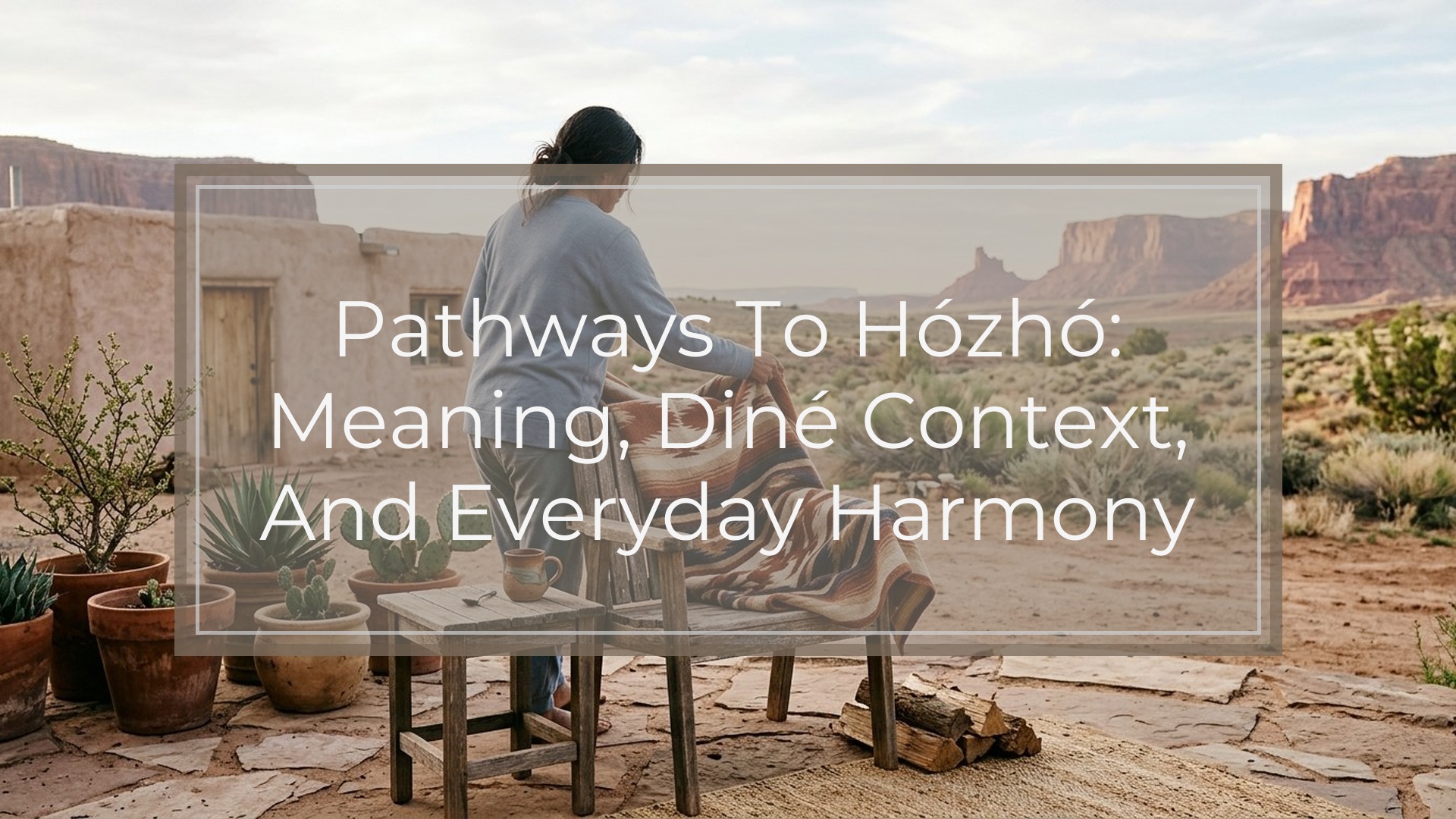
Hózhó is a Diné/Navajo concept often translated as beauty, balance, harmony, goodness, and right relationship. No single English word fully carries its meaning. It points to a way of living in alignment with self, family, community, land, spirit, and the wider order of life.
When people speak of “pathways to Hózhó,” they may mean the many ways a person returns to balance: through respectful speech, responsible action, gratitude, repair, prayer, kinship, and attention to beauty. For those outside Diné traditions, the phrase should be approached with humility. Hózhó is not a generic wellness slogan, but a living concept rooted in a specific Indigenous worldview.
What Does Hózhó Mean?
Hózhó is sometimes described as “beauty,” but that translation is only a doorway. In Diné thought, beauty is not merely visual attractiveness. It can refer to a state of order, blessing, wellness, peace, and proper relationship. It suggests that life is at its best when people, places, words, actions, and spiritual responsibilities are aligned.
A cautious way to understand Hózhó is as a living ideal: walking in beauty, restoring balance when it is disturbed, and recognizing that the human being is part of a larger web. It includes inner condition and outer conduct. It may involve how one speaks to others, how one treats the land, how one honors kin, and how one moves through difficulty.
Because Hózhó belongs to Diné language and culture, any explanation in English is partial. It can be respectfully discussed, but not fully extracted from its cultural home.
The Cultural Context: a Diné/navajo Worldview
Hózhó comes from Diné culture, often referred to in English as Navajo culture. The Diné people have their own language, histories, homelands, ceremonial systems, kinship structures, and teachings. Hózhó should be understood within that living context, not treated as a universal term detached from its people.
In many Indigenous worldviews, including Diné ways of knowing, balance is relational. A person is not separate from the land, the ancestors, the holy powers, the seasons, the family, or the community. Wellbeing is not only personal mood; it is connected to responsibilities and relationships.
It is important to avoid pretending that a short article can teach Diné ceremonial knowledge. Some teachings are community-specific, family-held, or shared only in proper settings. Respectful learning means recognizing limits. We can appreciate the broad idea of harmony while leaving sacred protocols to Diné people and qualified cultural authorities.
Pathways to Hózhó: What the Phrase Can Mean
“Pathways to Hózhó” can be understood as the many movements that help restore or maintain balance. These pathways are not necessarily dramatic. They may be as ordinary as speaking honestly, apologizing when needed, caring for elders, tending a home, offering gratitude, or stepping outside to remember one’s place in creation.
For non-Diné readers, the phrase is best approached as an invitation to reflect on harmony rather than as a claim to possess Diné spiritual practice. A respectful pathway is not imitation of ceremonies found online. It is the slower work of right relationship: learning carefully, crediting the source, supporting Indigenous voices, and examining how one’s own traditions speak about balance, beauty, and responsibility.
Hózhó and Ancestral Relationship
For a site centered on ancestor altars and home ritual, Hózhó can be thoughtfully connected to ancestral relationship, but with care. Many cultures understand that the living are shaped by those who came before. Ancestral veneration can support balance when it encourages gratitude, ethical memory, repair, and continuity.
This does not mean turning Hózhó into a general ancestor altar formula. Rather, it can remind us that harmony includes lineage: how we remember our dead, how we carry inherited blessings, and how we address inherited wounds. A simple ancestral practice, rooted in your own culture or family, may ask: What restores peace in this house? What kind of beauty do my ancestors ask me to continue? What patterns need healing?
Everyday Practices That Support Balance and Harmony
Respectful examples of “walking toward harmony” do not need to borrow restricted rituals. They can be grounded in ordinary life and in your own ancestral or spiritual background.
You might begin the day with a moment of gratitude before speaking to others. You might clean your altar or home with the intention of restoring order, not as a performance but as care. You might place water or flowers for your own ancestors according to your tradition, then sit quietly and listen inwardly. You might repair a strained relationship through a sincere message, apology, or boundary. You might spend time outdoors without taking anything, simply noticing the sky, soil, trees, or wind.
Other practices include mindful speech, reducing gossip, cooking for family, remembering names of the dead, giving to community, and resting when the body asks for rest. These are not “Hózhó rituals.” They are everyday ways many people can cultivate balance while respecting that Hózhó itself remains Diné.
Common Misconceptions About Hózhó
One misconception is that Hózhó simply means “positive vibes.” That flattens a deep cultural concept into a mood. Hózhó includes beauty and peace, but it also implies responsibility, restoration, and relationship.
Another misconception is that anyone can freely use the term as branding, decoration, or a spiritual aesthetic. While words travel, sacred and culturally rooted concepts deserve care. Using Hózhó without context can feel extractive, especially when Diné voices are ignored.
A third misconception is that harmony means conflict never happens. Balance often requires repair after disruption. It may involve grief, accountability, patience, and difficult truth.
Finally, Hózhó should not be treated as a secret technique promising guaranteed peace. It is better understood as a guiding orientation within a living worldview, not a quick method for control over life.
Fact, Interpretation, and Respectful Learning
A reliable framing is that Hózhó is a Diné concept associated with beauty, balance, harmony, goodness, and right relationship. It is also fair to say that English translations are incomplete and that the concept belongs to a living Indigenous culture.
Interpretation begins when outsiders connect Hózhó to their own spiritual reflection. That can be meaningful, but it should be named as interpretation, not presented as Diné teaching. If you want to learn more, seek work by Diné writers, artists, educators, and cultural authorities. Let them define their own language and worldview. Respectful learning includes citation, humility, and restraint.
A Gentle Reflection for Walking Toward Harmony
If you are drawn to the idea of pathways to Hózhó, pause before reaching for a ritual. Ask instead: Where is balance asking to be restored? Is it in my speech, my home, my body, my family, my relationship with the land, or my memory of the ancestors?
Walk gently. Let beauty be more than appearance. Let harmony be more than comfort. Let right relationship become a daily practice of attention, gratitude, repair, and respect.
FAQ
Is Hózhó the Same as Harmony?
Harmony is one helpful translation, but it is not complete. Hózhó can also suggest beauty, balance, goodness, wellness, peace, and right relationship. It carries cultural meaning rooted in Diné language and worldview, so no single English word fully captures it.
Can Non-navajo People Use the Word Hózhó?
Non-Navajo people may discuss the word respectfully, especially when learning from and crediting Diné sources. However, using it casually as branding, décor, or a generic spiritual slogan can be inappropriate. A good approach is humility, context, and support for Diné voices.
Are There Specific Rituals for Hózhó?
There are Diné ceremonial traditions connected to restoring balance and beauty, but they should not be copied from fragments online or taught casually by outsiders. Some knowledge belongs in specific cultural and ceremonial settings. Non-Diné readers can focus on respectful reflection and their own traditions.
How Can I Honor the Idea of Balance in My Ancestor Altar Practice?
You can honor balance by keeping your altar clean, offering water or flowers according to your own tradition, speaking the names of ancestors with respect, and using the altar as a place for gratitude and repair. Avoid presenting this as a Diné ritual unless it truly comes from Diné guidance.
Does Walking in Hózhó Mean Life Will Always Be Peaceful?
No. Balance does not mean trouble disappears. Life includes grief, conflict, illness, and change. Walking toward harmony can mean responding to disruption with care, responsibility, prayer, support, and repair. Hózhó points toward restored relationship, not a guarantee of constant ease.