
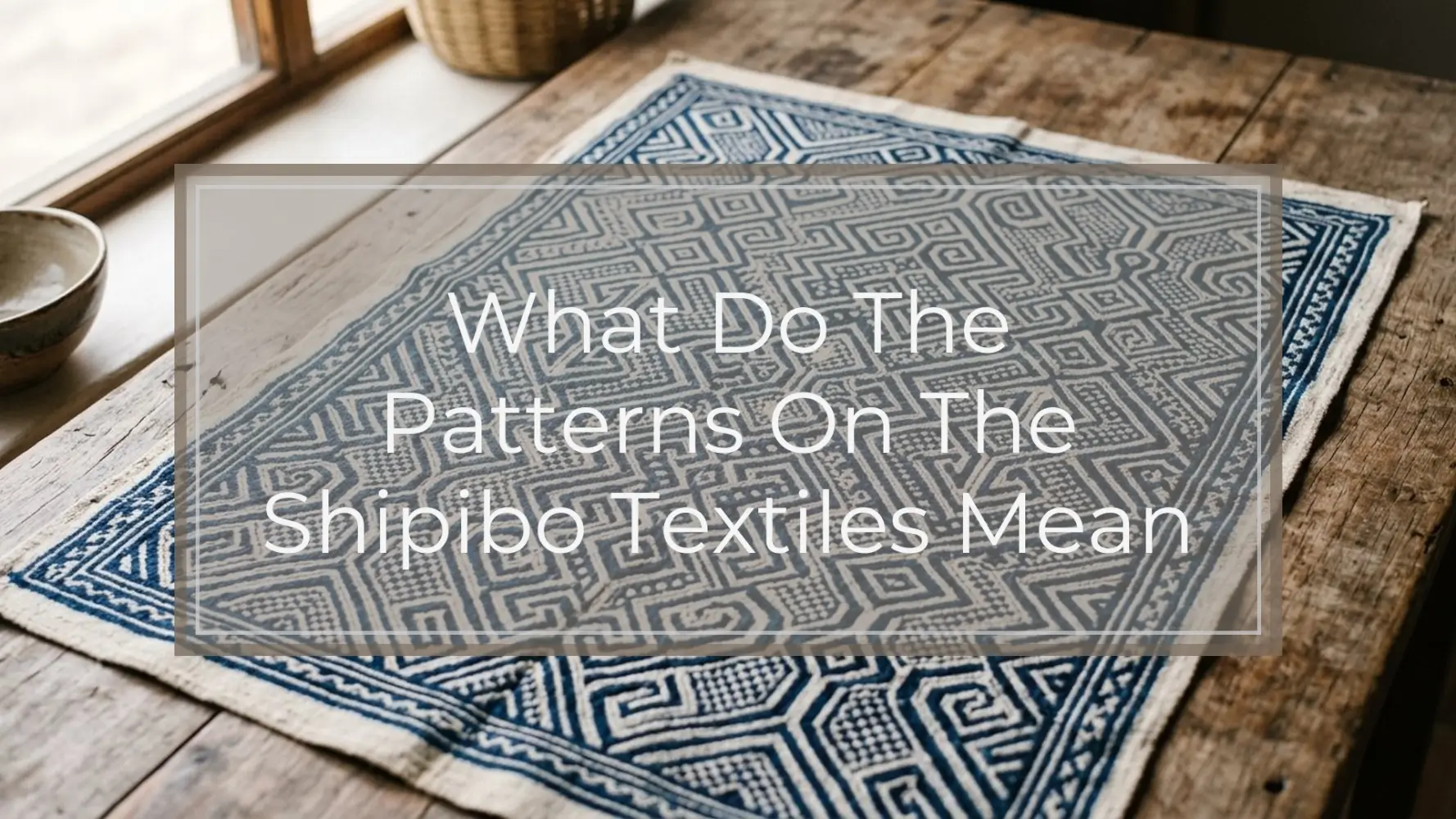
The patterns on Shipibo textiles are visual expressions of Shipibo-Konibo cosmology, memory, healing songs, and relationships with the natural and spiritual worlds. Many designs are understood as geometric pathways, energetic maps, or visual translations of songs known as ikaros.
Their meanings can vary by maker, family lineage, ceremonial context, and intended use, so they should not be reduced to one fixed dictionary of symbols. A winding line, repeated diamond, or border may suggest certain ideas, but the full meaning of a textile often belongs to the artist, the community, and the situation in which it was made.
Quick Meaning: What Shipibo Textile Patterns Represent
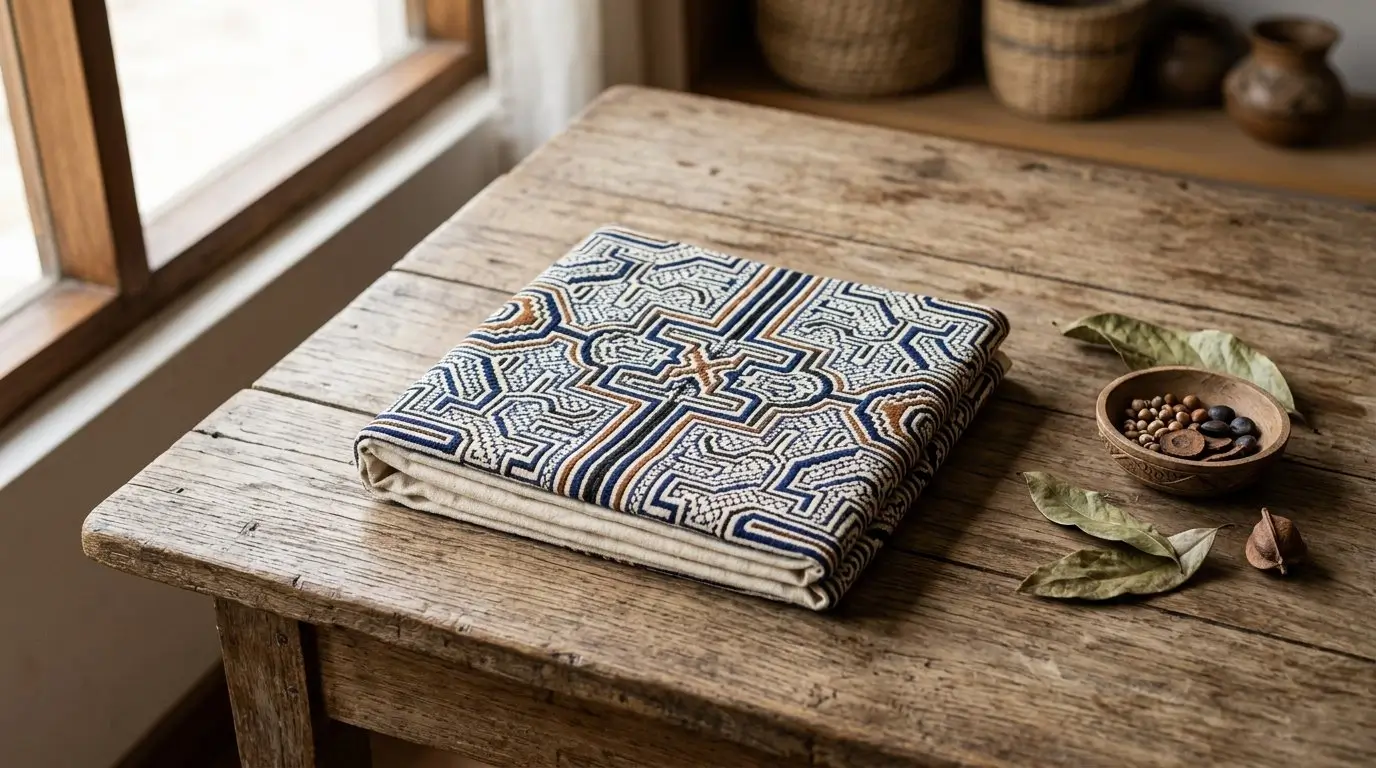
Shipibo textile patterns are not random decoration. They are part of a living artistic tradition among the Shipibo-Konibo people of the Peruvian Amazon. The designs often communicate relationships between sound, vision, nature, ancestry, spiritual knowledge, and the ordered beauty of the world.
Many people describe Shipibo designs as “songs made visible.” This is because some patterns are associated with ikaros, songs or chants connected with healing, protection, teaching, and ceremonial practice. The repeating lines, flowing pathways, and dense geometric forms can be understood as visual expressions of rhythm, vibration, and movement.
At the same time, Shipibo patterns are not a simple code where one shape always equals one meaning. The same visual element may carry different associations depending on the artist, family teachings, community, purpose, or ceremonial context. A pattern made for personal use may not mean the same thing as one made for sale, display, or contemporary art.
A respectful way to understand Shipibo textiles is to see them as layered visual language. They may hold references to rivers, plants, animals, songs, dreams, protection, balance, and spiritual relationships. But outsiders should be careful not to claim full authority over meanings that may be personal, sacred, or context-specific.
The Shipibo-Konibo Worldview Behind The Designs
The Shipibo-Konibo are an Indigenous people from the Peruvian Amazon, especially associated with communities along the Ucayali River and surrounding areas. Their artistic traditions include textiles, ceramics, body painting, beadwork, song, and ceremonial practices. Across these forms, geometric design plays a central role.
A key idea often connected with Shipibo art is the creation of beauty, balance, and order. Patterns can cover a surface with intricate precision, yet they often feel alive and flowing rather than static. Lines bend, repeat, meet, separate, and return, creating a sense of movement across the cloth.
These designs may reflect relationships between humans and the wider world: rivers, forests, medicinal plants, animals, ancestors, and unseen forces. They may also be shaped by dreams, visions, songs, family instruction, and close observation of the natural environment.
For many viewers, the patterns look abstract. But within Shipibo cultural contexts, abstraction does not mean emptiness. A design can be geometric and meaningful at the same time. It can suggest a pathway, a sound, a spiritual teaching, a protective field, or a memory held in visual form.
It is important to approach this tradition with humility. Some meanings are shared openly by artists and teachers. Others may belong to family lineages, ceremonial settings, or personal experiences. Shipibo textile design is not an ancient frozen code waiting to be decoded by outsiders; it is a living practice carried by real artists and communities.
Common Design Elements And Their Possible Meanings
The table below offers a practical overview of common features seen in Shipibo textiles and the kinds of meanings often associated with them. It is not an authoritative symbol dictionary. Meanings may change depending on the artist, use, and context.
| Design feature | What it may suggest | Important context |
|---|---|---|
| Flowing or winding lines | Rivers, movement, song pathways, energetic flow, journeys | The Amazonian river environment is important, but not every curved line should be read as a literal river. |
| Maze-like pathways | Movement through worlds, complexity, spiritual navigation, memory | These patterns can feel like maps, but they are not usually “maps” in a simple geographic sense. |
| Symmetry | Balance, harmony, order, protection, relational alignment | Symmetry may create a sense of stability and beauty within the overall design. |
| Repeated geometric motifs | Rhythm, continuity, song structure, inherited pattern knowledge | Repetition can work visually like a beat or refrain in music. |
| Cross-like forms | Meeting points, directional balance, intersection, connection | Avoid assuming these forms carry the same meaning as crosses in other traditions. |
| Diamond shapes | Centers, seeds, eyes, portals, contained energy, fertility associations | Meaning depends strongly on the specific design and the artist’s explanation. |
| Borders and frames | Containment, protection, transition between inside and outside | Borders can organize the textile visually and may mark a symbolic space. |
| Dense all-over patterning | Totality, immersion, vibration, interconnectedness | Dense designs may create the feeling that the whole surface is alive with movement. |
Color can also affect the mood and emphasis of a textile. Some pieces use strong contrasts, while others rely on earth tones, plant-dyed shades, or limited palettes. It is better to describe how color functions in a specific piece than to claim that every color has one universal meaning.
For example, a dark line on a light ground may make a pattern feel sharp, protective, or highly rhythmic. A softer palette may create a more meditative or woven-together feeling. But these are interpretive impressions, not fixed translations.
The safest approach is to combine visual observation with artist context whenever possible. Ask: What did the maker say? Was the pattern inherited, dreamed, sung, taught, or improvised? Was the textile made for family use, ceremony, trade, or artistic display?
Why Shipibo Patterns Are Often Called Visual Songs
One of the most important ideas in understanding Shipibo textiles is the connection between pattern and song. Ikaros are songs or chants associated with healing, teaching, protection, and ceremonial practice in many Amazonian contexts. In Shipibo-Konibo traditions, visual design and song are often discussed together.
Some artists and interpreters describe textile patterns as visual forms of song. The design may be understood as carrying the rhythm, movement, or structure of an ikaro. In this sense, a pattern is not just something to look at. It may be experienced as something that has flow, vibration, and presence.
You can see why this comparison is powerful. Shipibo designs often contain:
- repeating lines that feel rhythmic
- curves and angles that guide the eye like melody
- dense sections that feel intense or layered
- open spaces that create pause
- mirrored forms that create balance and return
This does not mean every Shipibo textile is a ceremonial object or that every item sold outside the community carries the same sacred role. Some textiles are made for household use, trade, contemporary art markets, or decorative display. Others may be more closely connected to ceremonial knowledge or personal spiritual experience.
It is also important not to make unsupported claims about healing effects. A textile may be culturally associated with healing songs or protective meanings, but that does not mean it guarantees physical, emotional, or spiritual results for the owner. The meaning belongs first to the cultural context, the maker, and the intended use.
How Meanings Change By Artist, Use, And Context
The meaning of a Shipibo textile depends on more than the shapes on the cloth. It also depends on who made it, why it was made, and how it is used.
A textile made for family use may carry personal or lineage meanings. A piece made for ceremony may relate to songs, plant knowledge, protection, or spiritual relationships. A textile made for trade or tourism may still be meaningful and skillfully made, but its purpose may be different. A contemporary art piece may combine inherited design knowledge with personal experimentation.
Patterns may be:
- inherited through family teaching
- learned from elders or community artists
- inspired by dreams or visions
- connected with songs or ceremonial experience
- created through personal artistic imagination
- adapted for buyers, galleries, or global audiences
This is why it can be misleading to ask, “What does this symbol mean?” as if every element has one fixed answer. A better question is, “What does this design mean in this piece, according to this artist or community?”
If you are buying, collecting, or studying a specific textile, ask the seller or artist for context when possible. Useful questions include:
- Who made this textile?
- What community is the artist from?
- Did the artist give a title or explanation?
- Is the pattern traditional, personal, or both?
- Was it made for use, ceremony, trade, or display?
Not all meanings are public, and not every seller will know the full background. Still, asking these questions shows respect for cultural authorship and helps avoid treating Shipibo design as anonymous decoration.
How To Appreciate Shipibo Textiles Respectfully
Respectful appreciation starts with recognizing Shipibo textiles as works made by Indigenous artists within a living cultural tradition. They are not generic “tribal patterns,” exotic motifs, or open-source designs without history.
When possible, learn the artist’s name, community, and stated meaning of the piece. Buying directly from Indigenous artists, cooperatives, fair-trade sources, or transparent sellers helps support the people who carry the tradition. It also gives you a better chance of learning accurate context.
Be cautious with mass-produced items that copy Shipibo-style patterns without attribution or benefit to Shipibo makers. Even if a copied design looks beautiful, it may separate the pattern from the people, knowledge, and labor behind it.
Respectful appreciation also means being thoughtful about use. A Shipibo-inspired pattern should not be treated as generic exotic decoration, especially if it appears sacred, ceremonial, or closely tied to Indigenous identity. If you do not know the origin of a design, avoid presenting yourself as an authority on its meaning.
When viewing a textile, try these simple prompts:
- Notice the whole composition before focusing on details.
- Follow the main lines with your eyes.
- Look for rhythm, repetition, and mirrored forms.
- Notice how borders frame or contain the design.
- Observe the color palette and contrast.
- Ask how the design makes your eye move.
- Seek artist context before making strong claims.
This approach lets you appreciate the beauty and complexity of the textile without pretending to decode everything.
A Simple Way To Read A Shipibo Textile Without Overclaiming
You can interpret a Shipibo textile thoughtfully by using careful language and staying close to what you can actually observe.
Start with the whole pattern. Does it feel balanced, dense, open, flowing, or maze-like? Then follow the lines. Do they move like rivers, pathways, sound waves, or vines? Notice repetition. Are the motifs steady and rhythmic, or do they shift and change across the cloth?
Next, look at the borders. Do they frame the design tightly, create a protected center, or guide the eye around the textile? Then consider color. Does the palette create contrast, softness, intensity, or calm?
Finally, seek context. If the artist, cooperative, or seller gives an explanation, let that guide your interpretation. Use phrases such as “may suggest,” “is often associated with,” or “the artist describes this as” rather than absolute statements.
Shipibo textile patterns are best understood as layered visual language. They are beautiful, meaningful, and alive with cultural knowledge, but they are not simple ornaments or one-to-one symbol charts.
FAQ
Are Shipibo textile patterns a written language?
Shipibo textile patterns are not a written language in the usual alphabetic sense. They are better understood as a visual language of design, memory, rhythm, song, and cultural meaning. Some patterns may be read by knowledgeable artists or community members in ways outsiders cannot fully access.
Do all Shipibo patterns have the same meaning?
No. Meanings vary by artist, family lineage, community, purpose, and context. Similar shapes may appear in different textiles but carry different associations. It is more accurate to ask what a specific design means to its maker.
What are ikaros in relation to Shipibo textiles?
Ikaros are songs or chants associated with healing, teaching, protection, and ceremonial practice. Some Shipibo textile patterns are described as visual expressions of these songs, using rhythm, repetition, and line movement to make song-like structures visible.
Can non-Shipibo people use Shipibo patterns?
Non-Shipibo people should be careful and respectful. Buying authentic work from Shipibo artists is different from copying patterns without permission or attribution. Avoid using sacred-looking designs as generic decoration, branding, or costume, especially without understanding their origin.
How can I find the meaning of a specific Shipibo textile?
The best source is the artist, cooperative, or knowledgeable seller connected to the piece. Ask who made it, where it comes from, whether the artist gave an explanation, and whether the design is personal, inherited, ceremonial, or made for sale.