
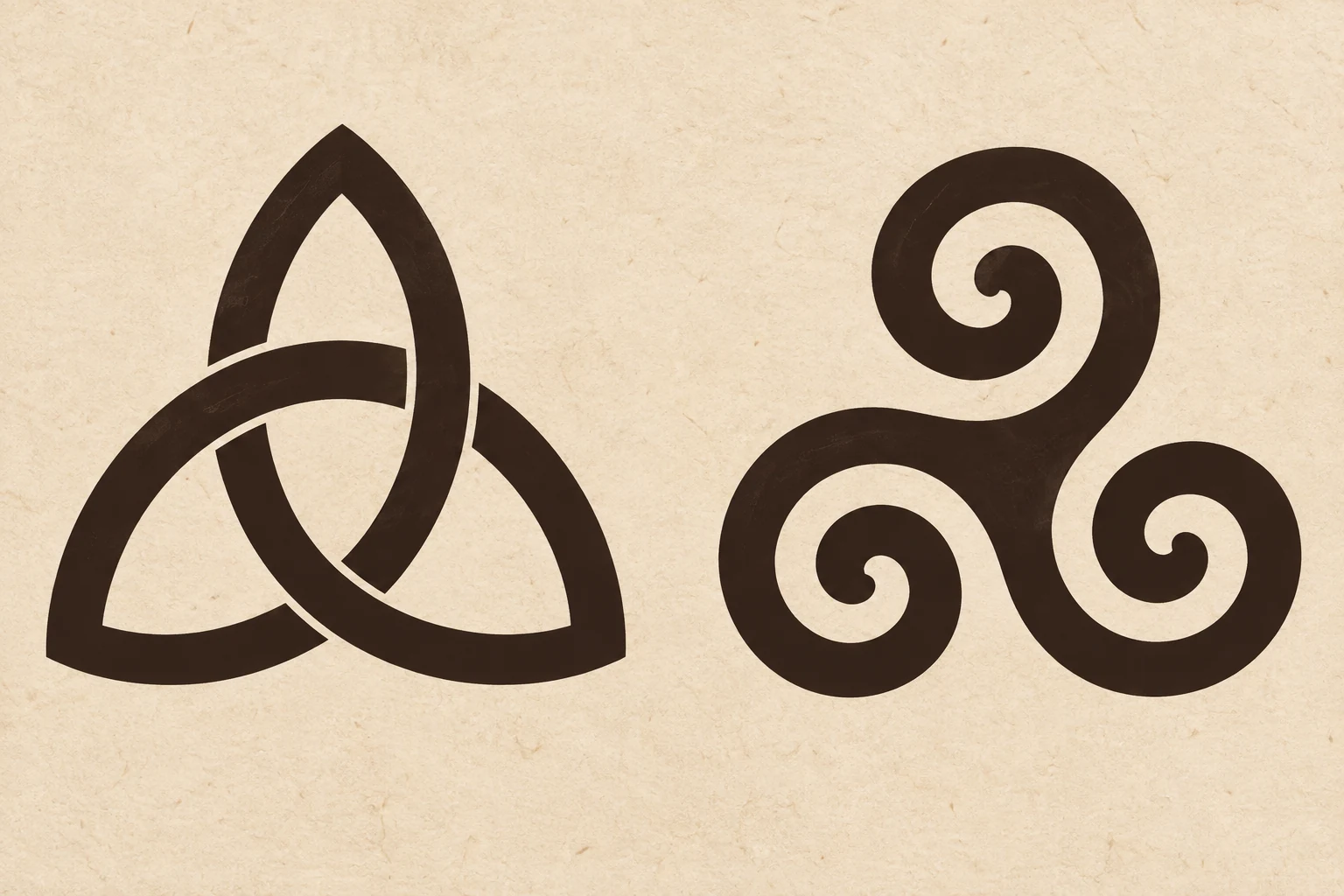
Triquetra Vs. Triskele: the Difference at a Glance
The simplest distinction is structural: a Triquetra is a continuous, interlaced figure with three lobes or pointed arcs, while a Triskele is formed from three arms, legs, or spirals radiating around a center. In short, look for interlacing in a triquetra and three-way rotation in a triskele.
A typical triquetra resembles three connected loops woven into a compact knot. Its line may appear to pass over and under itself, creating three outward-facing points around a central opening. A surrounding circle or extra knotwork does not necessarily change the basic identification: if the central device remains a single interlaced, three-part form, triquetra is generally the more useful name. The British Museum, for example, uses “triquetra” for a distinct device shown on a warrior’s shield, demonstrating that the term can identify a specific visual motif within a larger composition .
A triskele, by contrast, looks as though three elements are turning around a common midpoint. Those elements might be curved spirals, bent legs, rounded branches, or comparatively straight arms. They do not need to be woven together. The National Museum of Ireland’s description of a rush cross as a “three-armed triskele” shows that the category can include forms made from radiating arms rather than three conventional spiral curls .
For a quick jewelry check, imagine a pendant with one unbroken line making three interwoven petals: that points toward Triquetra. If the pendant instead has three curls sweeping outward like a rotating fan, that points toward Triskele. Apply the same distinction to carvings, prints, tattoos, altar objects, and decorative art: identify how the three parts are constructed before considering what the wearer or maker says they represent.
Some designs blur the boundary. A jeweler might place a triquetra inside a circle, stretch its lobes until they appear curved, or surround a triskele with knotwork. Focus first on the central motif. If it is clearly interlaced and three-lobed, call it a triquetra; if three separate or visually distinct arms radiate from the center, call it a triskele. When elaborate decoration obscures that structure, a qualified description—such as “a triquetra-like knot” or “a triskele-style triple spiral”—is more accurate than forcing certainty.
Meaning alone is not a reliable shortcut. Labels such as “protection,” “eternity,” or “threefold unity” do not reveal how the symbol is constructed. For identification, the visible design is the strongest starting point: woven three-part loop equals triquetra; rotating three-arm form equals triskele.
How Their Visible Structures Compare
To compare a Triquetra and a Triskele, mentally trace the design rather than focusing on its decoration. In a typical Triquetra, the line forms three connected lobes or arcs. Watch for places where the line passes over and under itself: those intersections create the interlaced, knot-like structure.
A typical Triskele is organized differently. Begin at the center and follow each element outward. Three arms or spirals radiate from that central area, producing a sense of rotation. The arms may curve tightly, open into broad spirals, or appear more angular, but their radial arrangement remains the key structural feature.
The center also offers a useful contrast. A Triquetra’s middle is shaped by the meeting and crossing of its three lobes. A Triskele’s middle acts more like a hub from which three separate-looking elements extend. One emphasizes interweaving; the other emphasizes turning movement around a center.
Added details can obscure this distinction. A circle may surround or pass through a Triquetra, while knotwork may frame a Triskele. Gemstones, borders, doubled lines, and ornamental curls can complicate both. Temporarily ignore those additions and trace only the main three-part device; if the underlying path remains unclear, describe the visible structure without forcing a precise label.
Documented Historical Contexts
Historical identification should begin with a particular object, date, and setting—not with the assumption that every three-part symbol comes from one continuous tradition. The available evidence here is especially useful for tracing specific triple-spiral and Triskele examples, but it does not provide an equally detailed historical sequence for the Triquetra. This difference in evidence limits how symmetrically the motifs can be compared.
One documented example comes from Newgrange, where Heritage Ireland identifies the tri-spiral carved on the entrance stone as Neolithic art . That attribution establishes a triple-spiral design in a specific prehistoric setting. It does not, by itself, show that every later three-armed symbol descended directly from this carving or belonged to the same cultural tradition. Nor does visual resemblance alone establish that later examples served the same purpose.
A much later example appears on a bowl fitting in the British Museum. The museum describes the fitting as Celtic Romano-British, dates it to the fourth century, and identifies its three-spiral design as a triskele . This evidence connects the Triskele name to a particular artifact within a specific Romano-British context. It should not be expanded into a claim that all Triskele forms belong exclusively to one Celtic culture or historical period.
Placed side by side, these objects demonstrate why broad labels require care. The Newgrange example is identified as a Neolithic tri-spiral, while the bowl fitting is identified as a fourth-century three-spiral triskele . Their shared threefold spiral structure supports a visual comparison, but their widely separated contexts do not establish an uninterrupted cultural lineage. Similarity of form is not sufficient evidence of identical origin, use, or significance. When dating or describing another object, the safer method is to consult its own archaeological, museum, or collection context rather than infer its history from appearance alone.
The evidence is also asymmetrical. These sources document particular spiral-based examples relevant to the Triskele, but they do not supply a corresponding dated artifact history for the Triquetra. That gap should remain visible rather than being filled with assumptions. It would be misleading to present the two motifs as though these sources establish parallel origins, simultaneous development, or equal association with the same communities. The absence of parallel evidence here does not prove that the Triquetra lacked historical use; it means only that such a history is not demonstrated by the supplied examples.
For a historically careful description, name what the evidence actually supports. The Newgrange carving can be described as a Neolithic tri-spiral based on the site documentation . The British Museum fitting can be described as a fourth-century Celtic Romano-British object bearing a three-spiral triskele . A Triquetra encountered elsewhere requires its own object record and context before comparable historical claims can be made. This object-by-object approach preserves documented associations without turning either motif into an exclusively Celtic symbol across all periods.
Documented Uses, Revival, and Modern Spiritual Meanings
A documented use should be stated as narrowly as the evidence allows. The National Museum of Ireland records a three-armed Triskele form among St Brigid’s crosses . This establishes that the motif appears within that named tradition. It does not, by itself, establish one meaning for every triskele, explain what all makers intended, or prove that the form carried the same significance in every period and setting.
The distinction matters when interpreting an object. If a museum record identifies a triskele on a particular St Brigid’s cross, readers can responsibly describe the motif, the object, and their documented association. Moving from that evidence to a statement such as “the triskele has always meant this” would be a much larger claim—one the object record alone cannot support. The documented context belongs to that object or tradition; any broader spiritual interpretation requires separate evidence.
Revival art adds another layer. The National Museum describes a later Neo-Celtic trend that deliberately imitated older Celtic artistic styles . Consequently, an object can look old or historically inspired without itself belonging to the earlier period whose style it echoes. A revival design may use a Triquetra, a Triskele, or related ornament to evoke heritage, continuity, identity, or a chosen aesthetic, but its appearance alone does not establish its date or recover the intentions behind older examples.
For modern spiritual practice, personal meaning and historical documentation can coexist without being treated as the same kind of claim. Someone might associate either motif with a three-part spiritual concept, use it as a reminder of personal commitments, or incorporate it into a ritual. Such an interpretation may be sincere and useful to that person. It should be described as a present-day, community-specific, or personal association unless evidence connects it to a particular historical object or tradition.
The same interpretive boundary applies symmetrically to both symbols. The documented St Brigid’s cross example supports a specific use of the Triskele , while the supplied evidence here does not provide a parallel named-object use for the Triquetra. That difference in available documentation should not be converted into a judgment that one symbol is more spiritually authentic than the other. It simply limits what can be claimed from this evidence.
When describing jewelry, artwork, or a spiritual object, separate the layers explicitly: “This piece uses a triquetra and the wearer interprets it as…” or “This is a triskele associated here with….” That wording preserves the owner’s intended meaning while avoiding the unsupported implication that the interpretation is ancient, universal, or inherent in the motif itself.
Which Name Fits the Symbol You Are Looking at?
For jewelry, artwork, or a spiritual object, begin with the design’s construction. Use Triquetra when the symbol forms a continuous, interlaced three-part device, usually read as three connected lobes or arcs. Added circles, knotwork, gemstones, or decorative borders do not necessarily change that identification if the interwoven three-part form remains clear.
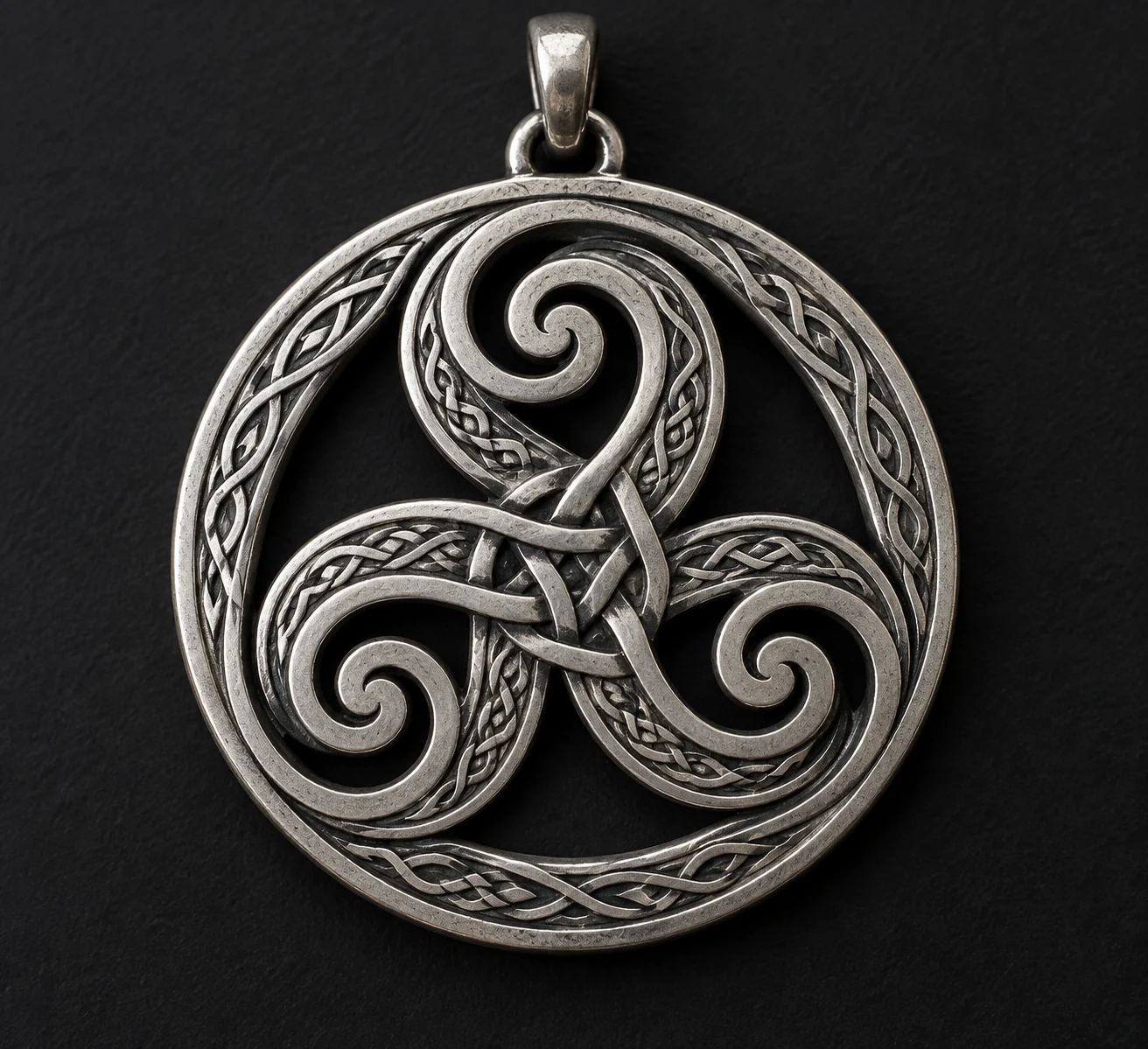
Use Triskele when three arms, curves, or spirals radiate from a shared center. The key feature is rotational movement around that center rather than strands crossing over and under one another. Decorative knots surrounding the motif should not outweigh this underlying three-armed structure.
Some stylized pieces blur the distinction. If you cannot trace a continuous interlaced form or clearly separate three radiating elements, describe what is visible—for example, “a three-part spiral motif” or “an interlaced triangular knot”—instead of forcing a definite label.
The name should follow the visible structure, not the seller’s description or an attributed spiritual meaning. For historical claims, rely on the specific object’s date, location, and documented context. For personal practice, meanings such as unity, cycles, protection, or transformation may still be valuable, but they are best treated as contextual interpretations rather than proof that the symbol is a Triquetra or Triskele.