
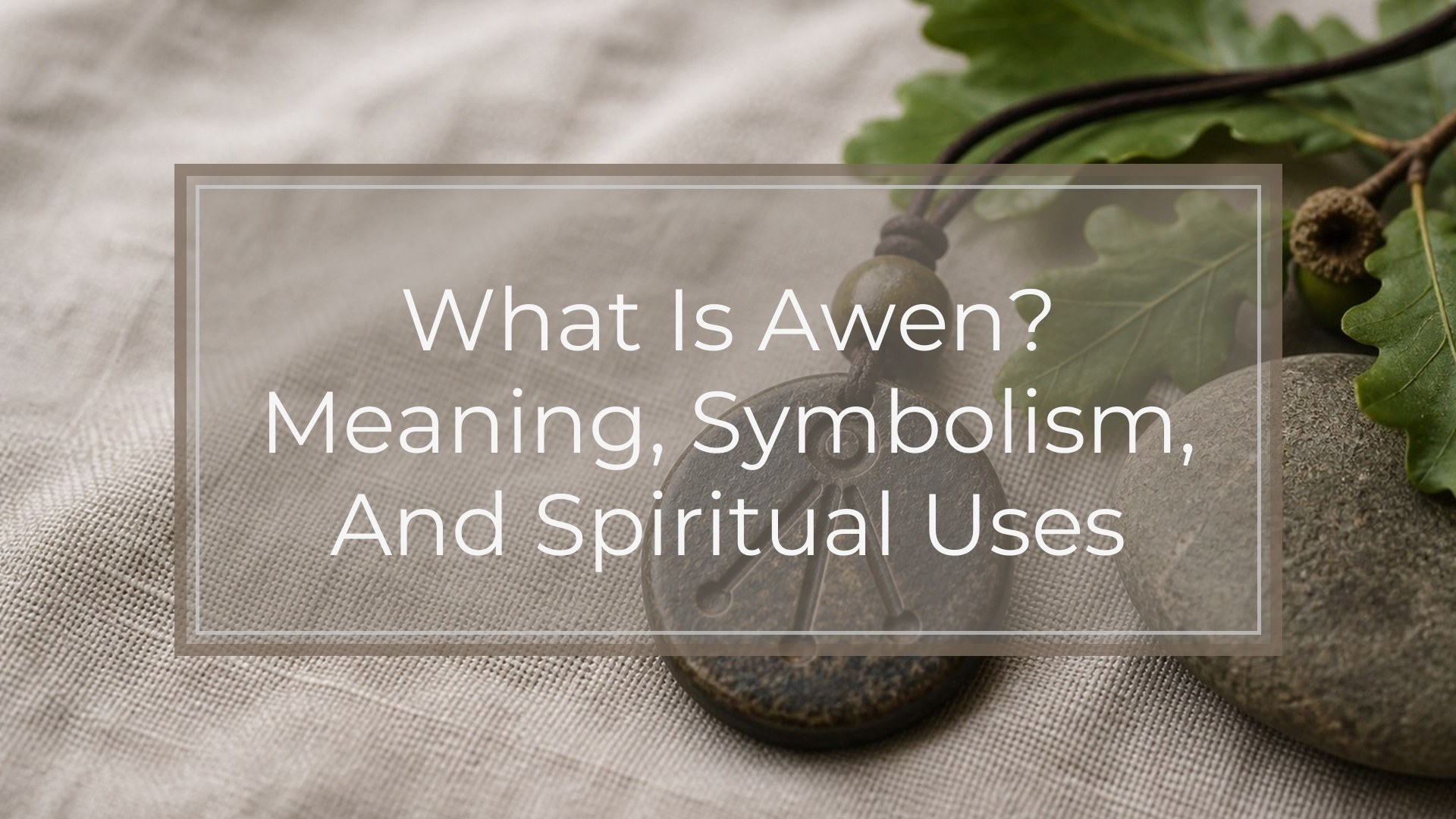
Awen is a Welsh word often translated as “inspiration,” but its spiritual meaning is richer than ordinary creativity. In Welsh and bardic tradition, awen refers to a flowing force of poetic insight, divine inspiration, sacred breath, and awakened perception. It is especially associated with poets, storytellers, seers, druids, and anyone who seeks wisdom through beauty, nature, and spirit.
Today, awen is understood both as a concept and as a symbol. The familiar awen emblem, often shown as three rays of light, points to inspiration descending or arising through the human soul. For spiritual practitioners, awen can be a way to honor creativity, ancestral memory, sacred speech, and the unseen source behind meaningful expression.
What Does Awen Mean?

Awen means inspired flow: the moment when insight, beauty, truth, and expression seem to move through you rather than being forced by you. It is not simply “having an idea.” Awen suggests inspiration with sacred depth.
A helpful mental model is breath or current. Just as breath moves through the body, awen is imagined as a subtle current moving through speech, poetry, song, prayer, ritual, and perception. It can arrive as a line of verse, a sudden understanding, a felt connection with nature, or a sense that words are carrying more than personal opinion.
In this way, awen connects creativity with reverence. It asks: what wisdom wants to be spoken, sung, remembered, or embodied?
The Origins of Awen in Welsh and Bardic Tradition
Awen comes from Welsh language and culture, where it has long been linked with poets and inspired speech. In medieval Welsh literature, bards were not only entertainers. They preserved memory, lineage, praise, satire, sacred story, and cultural identity through language.
The word is often associated with the inspired gift that allows a poet or seer to speak with unusual clarity. This makes awen more than artistic talent. It is a quality of vision: the ability to receive and shape meaning.
In modern Druidry and Celtic-inspired spirituality, awen remains central as a name for divine inspiration. However, it is important to approach it respectfully. Awen is rooted in Welsh cultural and linguistic tradition, not a generic mystical label detached from its source.
Is Awen a Spirit, a Symbol, or an Energy?
Awen can be understood in several ways, depending on the tradition or practitioner. For some, it is an energy or current of inspiration. For others, it is a blessing, a spiritual state, or a poetic name for divine presence. Some people relate to awen almost as a living force, though it is not usually described as a single deity.
The awen symbol is a visual representation of this concept, not the whole of it. In other words, the symbol points toward awen; it does not contain or limit awen.
For beginners, the simplest answer is: awen is sacred inspiration, and the symbol is one way people honor or focus that inspiration.
The Awen Symbol: Three Rays of Inspiration
The awen symbol is commonly drawn as three vertical or slightly spreading rays, often with three dots above them. These rays are usually interpreted as streams of light, inspiration, or spiritual illumination.
The three rays have been understood in different ways. They may represent harmony between body, mind, and spirit; earth, sea, and sky; past, present, and future; or the balance of opposites with a unifying center. The two outer rays can suggest polarity, while the central ray suggests integration.
The three dots are sometimes seen as seeds, drops, stars, or points of awakened awareness. Like many spiritual symbols, awen is not limited to one fixed meaning. Its power comes from layered associations: light, breath, speech, inspiration, and sacred balance.
Quick Reference: Meanings of Awen
| Layer of Awen | Common Meaning |
|---|---|
| Word meaning | Inspiration, poetic flow, sacred insight |
| Spiritual sense | Divine or sacred creative current |
| Symbol form | Three rays, often with three dots |
| Associated roles | Bards, poets, druids, storytellers, seekers |
| Practice use | Meditation, ritual, altar focus, creative blessing |
| Core reminder | Let wisdom move through speech and action |
Spiritual Significance of Awen
Spiritually, awen points to the mystery of receiving rather than only producing. It reminds practitioners that creativity can be devotional. A song, prayer, poem, offering, or spoken blessing may become a vessel for something deeper than the ego.
For those who work with ancestors, awen can also suggest the living current of memory. Family stories, inherited songs, old languages, dreams, and intuitive knowing may all carry forms of inspiration. Awen invites careful listening: to the land, the dead, the body, and the sacred.
It also teaches humility. Inspiration is not fully owned. It is welcomed, tended, shaped, and shared with responsibility. This is why awen is so often linked with truthful speech and reverent expression.
How Awen Is Used in Modern Spiritual Practice

Modern practitioners may use awen in meditation, Druid ritual, poetry, music, journaling, altar work, or seasonal ceremony. Some chant “awen” slowly as a way to center the breath and open awareness. Others place the awen symbol on an altar, journal, candle, pendant, or ritual cloth.
Writers and artists may invoke awen before beginning creative work, asking for clarity rather than control. People engaged in ancestor veneration may use it when listening for inherited wisdom, composing prayers, or speaking names aloud.
There is no single required method. The key is intention: awen is best approached as sacred inspiration, not as decoration alone. Use it with respect for its Welsh roots and with awareness of your own spiritual context.
A Simple Awen Reflection Practice
Sit quietly near your altar, a candle, a window, or a natural object such as a stone, leaf, or bowl of water. Take three slow breaths.
On the first breath, ask: “What am I ready to hear?”
On the second breath, ask: “What truth wants gentle expression?”
On the third breath, ask: “How can I carry inspiration responsibly?”
You may softly say “awen” after each breath. Then write a few lines, speak a prayer, or sit in silence. Do not force a message. Let the practice be an invitation to inspired attention.
What Awen Is Not
Awen is not a shortcut to instant psychic ability, guaranteed artistic success, or spiritual superiority. It is also not simply a trendy Celtic-looking design. The symbol has cultural and spiritual roots that deserve respect.
Awen should not be used to claim authority over Welsh tradition without study or relationship. It is better approached humbly: as a word, symbol, and sacred concept that invites listening, creativity, balance, and reverence.
FAQ
What Is Awen in Simple Terms?
Awen is sacred inspiration. It describes a flowing sense of insight, creativity, and spiritual perception, especially connected with poetry, speech, nature, and bardic tradition. In simple terms, awen is the inspired current that helps truth, beauty, or wisdom come through.
Is Awen a Pagan Symbol?
Awen is widely used in modern Druidry and pagan or Celtic-inspired spirituality, but its roots are specifically Welsh and bardic. The symbol is often meaningful to pagans, poets, and spiritual seekers, though it should be approached with respect for its cultural background.
What Do the Three Lines of the Awen Symbol Mean?
The three lines are often interpreted as rays of inspiration or illumination. They may symbolize body, mind, and spirit; earth, sea, and sky; past, present, and future; or the balance of two opposites through a central harmonizing force.
Can I Use the Awen Symbol on an Altar?
Yes, you can use the awen symbol on an altar if you do so respectfully. It may be placed on a candle, cloth, card, stone, or journal to honor inspiration, sacred speech, creativity, or ancestral wisdom. Learn its meaning rather than using it only as decoration.
How Do You Pronounce Awen?
Awen is commonly pronounced “AH-wen,” with the first syllable like “ah” and the second like “wen.” Pronunciation can vary slightly by speaker and accent, but “AH-wen” is a clear and widely recognized English-friendly approximation.