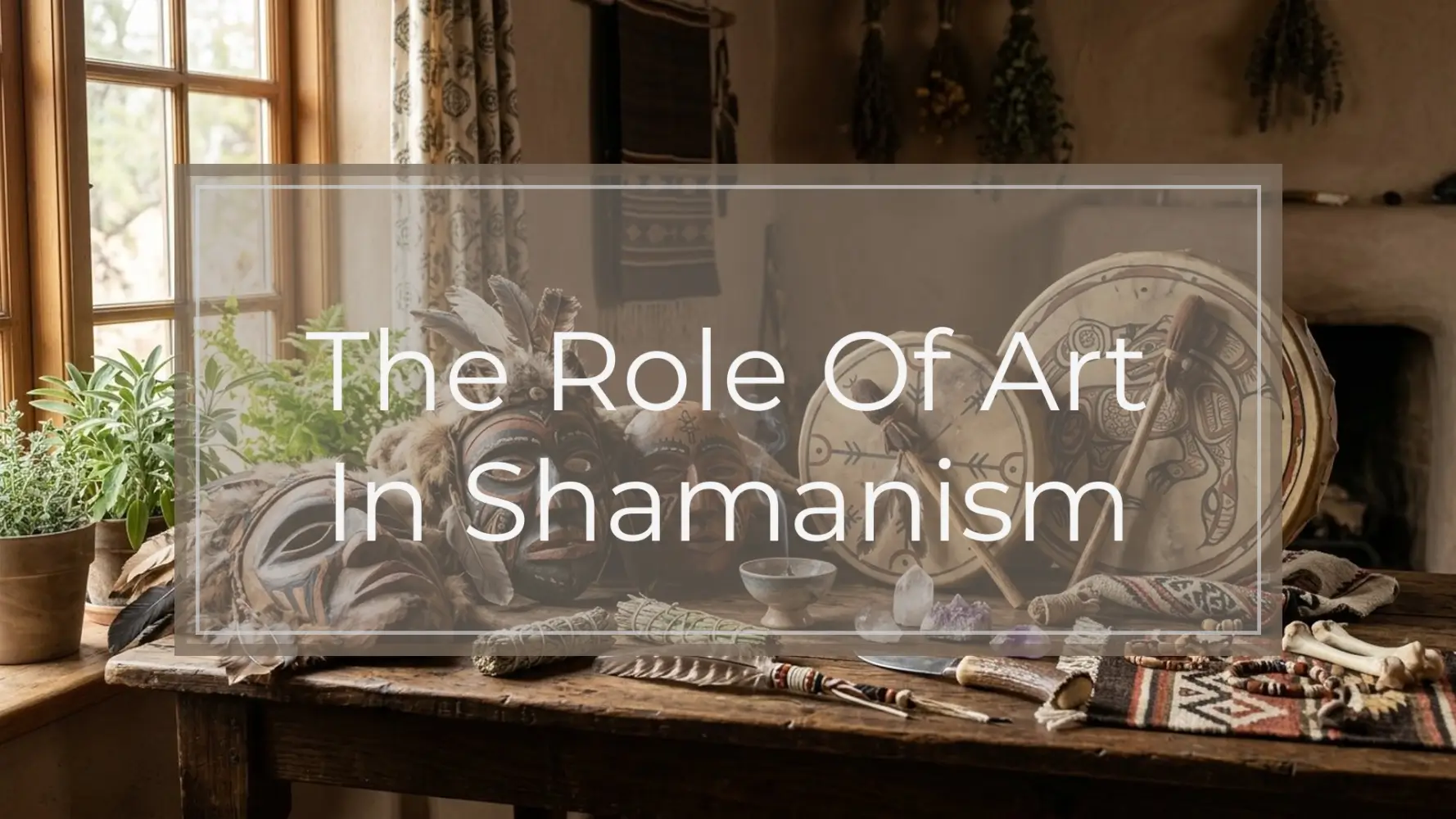
Art in shamanism is not usually treated as decoration alone. It can function as a ritual tool, teaching language, memory aid, symbolic map, and way of communicating relationships with spirits, ancestors, animals, plants, land, and community.
Across traditions, visual designs, masks, drums, carvings, songs, dance, costume, and altar objects may help focus intention, mark sacred space, support trance or ceremony, and preserve cultural knowledge. The exact meaning depends on the specific culture, lineage, and practitioner, so shamanic art should be approached with respect rather than generalized as one universal system.
What Is The Role Of Art In Shamanism?
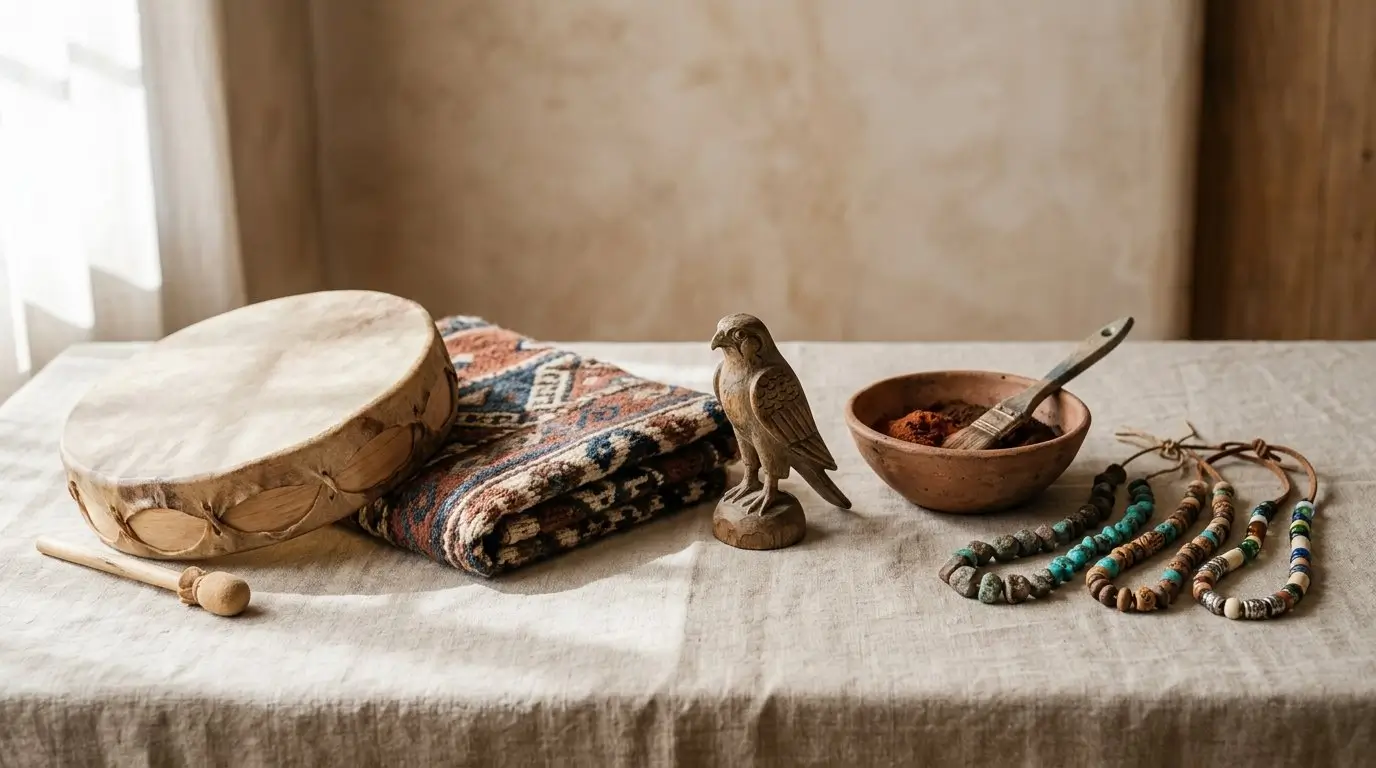
The role of art in shamanism is to give form, sound, movement, and structure to spiritual relationships and ritual experience. In this broad sense, “art” can include image-making, music, chanting, dance, masks, clothing, body adornment, altar arrangement, carving, weaving, painting, and symbolic design.
In some traditions, a drum is not only an instrument. It may be a sacred object used to focus rhythm, support ceremony, or represent a relationship with helping powers. A mask may not be “costume” in the ordinary sense. It may represent a spirit, ancestor, animal presence, or ceremonial role, depending on the cultural context.
Shamanism is not one single religion, aesthetic style, or fixed set of symbols. Practices vary widely by community, geography, lineage, and history. For that reason, shamanic art is best understood as art in relationship: relationship with the unseen, the land, the ancestors, the living community, and the responsibilities of ritual practice.
Art As A Bridge Between Visible And Invisible Worlds
Many forms of shamanic art help translate spiritual experience into something visible, audible, or embodied. A pattern, song, carved figure, or altar object can point toward something that may be difficult to explain in ordinary language.
Symbols may represent ancestors, animal helpers, elemental forces, plants, stars, mountains, rivers, or directions. A design might mark protection, belonging, gratitude, transformation, or remembrance. A chant may carry a teaching. A dance may enact a journey. A ceremonial object may hold memory through repeated use.
This does not mean art automatically “opens portals,” summons spirits, or guarantees healing. A more careful way to say it is that art can serve as a ritual bridge. It helps the practitioner and community focus attention, enter a sacred frame, remember teachings, and honor relationships that are understood as spiritually meaningful.
For ancestor-centered practice, this idea is especially important. A photograph, cloth, candle, bowl, carving, or handmade object on an altar may become meaningful because of the prayers, memories, offerings, and relationships gathered around it.
Common Forms Of Shamanic Art And What They Can Do
Shamanic art can be visual, musical, physical, or material. The same object may have more than one role: practical, symbolic, ceremonial, and educational. The examples below are general and should not be treated as universal meanings.
| Art Form | Possible Ritual Role | Important Context |
|---|---|---|
| Drums and rattles | Support rhythm, focus, chanting, journeying, or ceremony | May be sacred tools, not just instruments |
| Masks | Represent spirits, ancestors, animals, or ceremonial roles | Meanings are culture-specific and may be restricted |
| Body painting or adornment | Mark transition, protection, identity, or ritual readiness | Designs may belong to particular communities or rites |
| Textiles and patterns | Carry memory, cosmology, clan identity, or protective symbolism | Patterns should not be copied without context |
| Carvings or figures | Represent beings, helpers, ancestors, or sacred stories | Some figures may be devotional, ceremonial, or private |
| Altar objects | Focus prayer, offerings, remembrance, and relationship | Meaning develops through use, lineage, and intention |
| Songs and chants | Carry teachings, prayers, rhythm, and ceremonial structure | Some songs are inherited, initiated, or not for public use |
| Dance and movement | Embody stories, journeys, animals, spirits, or transformation | Movement may follow formal ritual rules |
A drum, for example, may be both an object of sound and an object of relationship. A mask may be powerful not because of its appearance alone, but because of the ceremony, story, and permission surrounding it. A pattern may encode teachings that are not obvious to outsiders.
Because meanings are not interchangeable across cultures, respectful interpretation matters. A symbol from one tradition should not be assumed to mean the same thing in another.
Symbolism, Story, And Cultural Memory
Shamanic art often preserves knowledge that belongs to a community, not only to an individual artist. It can carry origin stories, seasonal teachings, animal relationships, ancestral memory, moral guidance, and ways of understanding the land.
Some symbols are public and widely shared. Others may be restricted, initiated, sacred, or not meant for outsiders. A simple-looking mark, color, or pattern may have layers of meaning known only through apprenticeship, family transmission, ceremony, or community teaching.
Common symbolic themes can include animals, directions, celestial bodies, plants, water, fire, mountains, bones, spirals, and geometric patterns. But the meaning of these themes depends on the tradition. An eagle, snake, bear, drum, tree, or star does not carry one universal “shamanic” meaning everywhere.
This is why shamanic art is closely connected to oral tradition. The object or image is often only part of the teaching. The story, song, ritual timing, maker, materials, and community setting may be just as important as the finished piece.
How Art Supports Ritual Practice
In many shamanic contexts, art supports ritual by shaping attention and creating a meaningful ceremonial environment. It can help participants understand when ordinary space has shifted into sacred space, when a rite has begun, and what relationships are being honored.
Common ritual functions of art may include:
- Marking sacred space: Cloths, circles, altars, poles, carvings, or arranged objects may define the ritual area.
- Focusing intention: A drumbeat, image, candle, or offering bowl can help gather attention around prayer or ceremony.
- Carrying memory: Objects used repeatedly may become associated with ancestors, teachers, initiations, or important communal events.
- Teaching through symbol: Patterns, colors, animals, and stories can communicate teachings that are remembered through image and repetition.
- Supporting embodiment: Dance, costume, rhythm, and gesture can help participants experience teachings through the body, not only the mind.
- Honoring relationship: Handmade or carefully chosen objects can express gratitude toward ancestors, spirits, land, plants, animals, or community.
These functions do not make every object automatically sacred. Rather, they show how art can become meaningful through context, intention, permission, and repeated ritual use.
Misconceptions About Shamanic Art
One common misconception is that shamanic art is simply exotic decoration. While some objects may be beautiful, their purpose often goes beyond appearance. They may support ritual focus, mark sacred space, teach stories, or express relationships with ancestors, spirits, animals, or land.
Another misconception is that all shamanic symbols mean the same thing everywhere. In reality, meanings are culturally specific. A color, animal, mask, pattern, or object may have one meaning in one community and a very different meaning in another.
A third misconception is that anyone can freely use any sacred design. Ethical use requires humility, context, and permission where appropriate. Copying restricted ceremonial designs, sacred regalia, or symbols from living traditions can be harmful, especially when separated from the people and responsibilities that give them meaning.
Finally, shamanic art should not be treated as a guaranteed source of healing, protection, or spiritual power. Traditions may understand certain objects or practices as sacred or supportive, but results should not be promised. The meaning of the art comes through relationship, practice, and cultural setting.
How To Approach Shamanic Art Respectfully Today
If you are drawn to shamanic art, begin by learning context before interpreting or using symbols. Ask where a design comes from, who has the right to use it, and whether it is public, ceremonial, or restricted.
When possible, support Indigenous and traditional artists directly rather than buying mass-produced imitations. Learn from artists’ own descriptions of their work, and avoid reducing complex cultural symbols to generic “tribal” or “mystical” decoration.
For personal practice, it is often more respectful to create from your own life and relationships. You might make art inspired by your dreams, family memories, ancestral altar, local landscape, prayers, grief, gratitude, or seasonal observations.
There is a meaningful difference between creating personal symbolic art and copying sacred ceremonial designs from cultures you do not belong to. Respectful practice leaves room for inspiration without taking what is not yours to use.
Recommended Reading Path
If you are exploring this topic for personal study, start with the broad concept of shamanic art as relationship rather than style. From there, look more closely at the cultural context of specific objects, such as drums, masks, textiles, altar pieces, or ceremonial songs.
A helpful path is to move from general symbolism to lived practice: first learn what kinds of art appear in shamanic settings, then study how those forms are used by particular communities, and finally reflect on what respectful personal creativity might look like in your own ancestral or devotional practice.
FAQ
Is shamanic art always sacred?
Not always. Some art connected to shamanic cultures may be everyday, decorative, educational, or ceremonial. Whether it is sacred depends on the tradition, object, maker, use, and community context.
Why are animals so common in shamanic art?
Animals may represent kinship, guidance, teachings, landscape relationships, or spiritual presence in some traditions. Their meanings vary widely, so one animal should not be given a single universal interpretation.
Can I make my own shamanic-inspired art?
Yes, especially if it comes from your own dreams, ancestors, prayers, and local environment. Avoid copying restricted symbols, ceremonial designs, or sacred regalia from cultures you are not part of.
What is the difference between shamanic art and spiritual decoration?
Spiritual decoration may create atmosphere or express personal taste. Shamanic art, in a ritual context, often carries specific relationships, teachings, ceremonial roles, or cultural memory beyond appearance alone.