
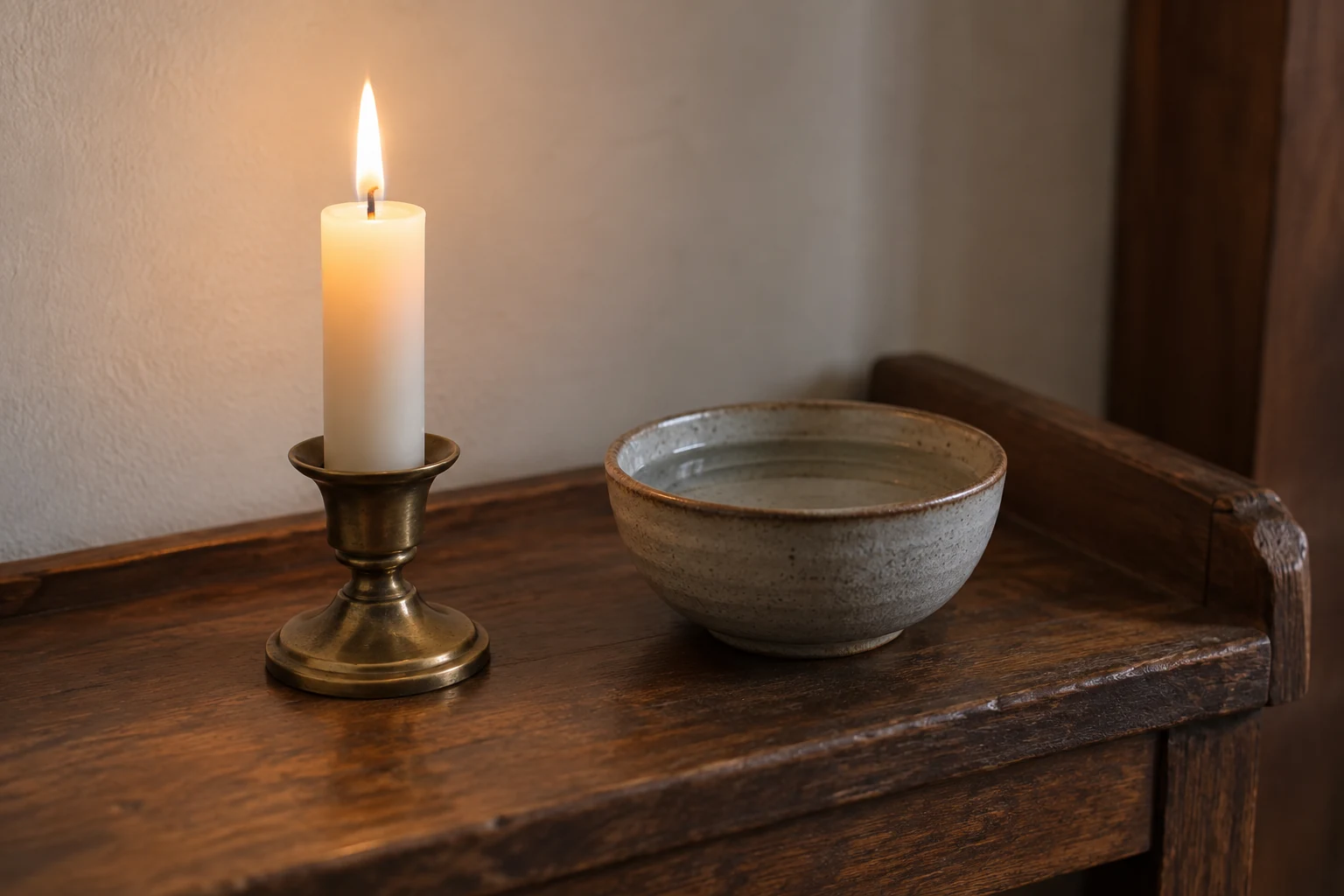
If you have an intention for your altar work, you can choose a weekday whose symbolism helps express it. Start with what the work is about, find a fitting association, and check whether that day works for you. Waiting for a particular weekday is optional.
This guide uses a Western planetary-magic framework found in practitioner sources. It offers symbolic associations, not a proven way to make a spell succeed. Pagan traditions differ; you can use this map where it fits your practice and set it aside where it does not.
What Weekday Timing Means
In this framework, each weekday has a classical ruler: the Sun, Moon, Mars, Mercury, Jupiter, Venus or Saturn. “Planetary” is the traditional name for the system, although the Sun and Moon are not planets in modern astronomy. A correspondence is the symbolic pairing between a day, its ruler and themes a practitioner may choose to explore.
These pairings describe a planetary correspondence convention. Use the day names as labels for this map rather than inferring every English name's literal origin from the ruler listed beside it.
You do not need to memorize the rulers before making a choice. Read the themes below, then ask which one best expresses your intention. They are starting points rather than an exclusive list of what each day can mean.
Sunday and Monday: Beginnings and Reflection
Sunday — Sun — beginnings. Sunday can fit when you want to mark the start of something in your own life. If you are beginning a personal project, for example, you might focus on approaching its first step with attention and commitment. The beginning itself is the theme; you need not know how the project will turn out to choose it.
Monday — Moon — introspection. Monday offers a different emphasis: pausing to look inward before deciding what to do next. You might reflect on your feelings about a choice or sort out which priorities matter most. An intention such as “I want to understand what I need before I decide” fits this theme.
If both days appeal to you, consider what you want to mark now. Are you ready to begin the project, or do you first want space to reflect? That distinction can guide your choice without turning either day into a deadline.
Tuesday and Wednesday: Strength and Communication
Tuesday — Mars — self-assertion and personal strength. Tuesday can suit an intention focused on your own resolve. You might want to practice saying what you need, hold to a decision you have made, or meet a challenge with steadiness. Grove and Grotto includes cultivating personal strength among its Tuesday examples; another practitioner source connects Tuesday with self-assertion. Both cues concern what you are working to do, not gaining influence over someone else.
Wednesday — Mercury — learning and communication. Wednesday can fit when your central task is to understand something or express yourself clearly. You might focus on studying a difficult subject, organizing your thoughts before writing, or preparing a message you intend to deliver. Both cited practitioner sources associate Wednesday with communication.
To distinguish them, ask where the effort lies. If you know what you mean but need the resolve to speak, Tuesday may express your intention better. If you are ready to speak but need to learn more or find clear words, Wednesday may be the closer match.
Thursday, Friday and Saturday: Growth, Connection and Endings
Thursday — Jupiter — prosperity. You might choose Thursday for an intention concerning resources or personal growth. For example, you could focus on giving sustained attention to a professional opportunity or reviewing how you manage your budget. In this map, prosperity supplies the symbolic theme; choosing Thursday does not mean money will arrive.
Friday — Venus — friendship and self-love. Friday can fit an intention about how you care for yourself or show up in a friendship. You might focus on making time for a friend, treating yourself with more kindness, or becoming a more attentive listener. Frame the intention around your own care and conduct rather than trying to direct another person’s feelings.
Saturday — Saturn — endings. Saturday can help you acknowledge that a chapter is closing. You might mark the end of a commitment or decide what requests you can no longer take on. Framing a boundary as an ending keeps the focus on what you will practice. Grove and Grotto lists endings among Saturday’s associations; a personal boundary is one way to apply that theme.
These days offer different points of focus: resources and growth, care and connection, or something you are ready to end. Choose the one that describes your main purpose, rather than trying to make every part of an intention fit a single category.
Choose a Day from Your Intention
Begin with one plain sentence about what your altar work is for. Keep it specific enough to reveal a theme: “I want to approach my studies with more attention,” for instance, tells you more than “I want to pick the right day.”
Next, identify the sentence’s main symbolic theme. In the study example, learning is central, so Wednesday’s Mercury association is a straightforward match. You would be choosing to emphasize learning—not following a prescribed spell or predicting a result.
Before settling on Wednesday, check whether it works for your schedule. If it does, state the reason for your choice: “I chose Wednesday to emphasize learning.” That small step makes the decision yours rather than a rule you followed without thinking about it.
A change in emphasis could change the choice. If what matters most is starting a study project, Sunday’s beginnings theme might fit better. If you have already started and want to attend to the learning itself, Wednesday remains the clearer match. Choose the association that reflects what you mean to focus on now.
When More Than One Day Fits
Suppose you are preparing for a difficult conversation. Tuesday and Wednesday may both appeal: you need the strength to speak up, and you want to express yourself clearly. The overlap is an invitation to sharpen your intention, not a sign that you have used the map incorrectly. Tuesday is associated here with self-assertion and personal strength; Wednesday with communication.
Ask which part is your main purpose for this work. If you know what you want to say but keep putting off the conversation because speaking up feels difficult, choose Tuesday to emphasize your resolve. If you are ready to speak but need to gather your thoughts and find accurate, considerate words, choose Wednesday to emphasize clear expression. Either choice concerns how you prepare and act, not how the other person will respond.
Suppose you want to reconnect with a friend after setting a limit. Friday's friendship and self-love themes could frame your own willingness to reconnect; Saturday's ending theme could frame a decision to stop a pattern you cannot continue. If the next step is a considerate message, Friday may express your purpose. If you first need to decide your boundary, Saturday may fit better. Neither choice determines how the other person will respond.
Practitioner associations and examples can differ, so you need not search for one indisputably correct day. Make a reasoned choice from the purpose that matters most to you. If that purpose changes, it is reasonable for your choice to change too.
If Your Preferred Day Is Unavailable
If the weekday you prefer does not work for your schedule, you can do your altar work when you are able instead. If you chose Wednesday for learning but cannot make time then, for example, you can keep that intention and use a day when you can give it your attention. A cited practitioner source prioritizes doing the work when available.
Missing a symbolic match is not a failure. Neither a missed day nor a matched one establishes whether the work will succeed. The correspondence is there to help you express an intention, not to impose a requirement.
Record the Choice and Reflect Later

A short note lets you revisit why you chose a day. One practitioner source recommends recording the choice; you can include your intention and the association that mattered to you.
> Chosen day: Wednesday
> Intention: Prepare to explain my needs clearly in a conversation.
> Why this day: I chose Mercury’s communication association because finding clear words is my main focus.
Later, you might add, “Writing down my thoughts helped me decide what I wanted to say,” or “I realized I needed more time to prepare.” That records your experience and actions without attributing what followed to the weekday.
Do You Need Planetary Hours?
No. Planetary hours subdivide timing further and can involve exact sunrise and sunset calculations. They are an optional subject for further study, not a prerequisite for choosing a weekday.
For now, you can stop once you have stated your intention, found an association that expresses it and decided whether the day is available. That is enough to make a thoughtful symbolic choice without a more elaborate timing system.