A journey into astrology begins with learning the basic building blocks: the zodiac signs, planets, houses, and aspects. Together, these symbols form a birth chart, which many people use as a reflective tool for understanding personality patterns, timing, relationships, and life themes. Start with your Sun, Moon, and Rising signs, then gradually explore the rest of your chart without treating astrology as a fixed prediction system.
Astrology is best approached as a symbolic language. It can help you ask better questions, notice patterns, and reflect on your choices, but it should not replace personal responsibility, professional advice, or real-life communication. If you are new, the most helpful path is simple: learn the core symbols, study one chart at a time, and build your understanding through observation.
What It Means to Begin a Journey Into Astrology
Beginning a journey into astrology means learning how celestial symbols are interpreted through a birth chart. A birth chart, sometimes called a natal chart, is a map of where the planets appeared from your birth location at the time you were born. Astrologers read this map symbolically, looking at the zodiac signs, planetary placements, houses, and relationships between planets.
For many people, astrology is a tool for self-reflection. It can offer language for temperament, motivation, emotional needs, relational patterns, and cycles of change. For others, it is part of a spiritual practice, a way of feeling connected to nature, time, ancestors, seasons, and the wider cosmos.
A healthy astrology practice does not treat the chart as a life sentence. Your chart does not remove your agency or guarantee a specific outcome. It should not be used as medical advice, financial guidance, legal direction, or a reason to avoid practical action.
The beginner path is usually easiest when taken in layers:
- Learn the zodiac signs.
- Understand the planets.
- Explore the houses.
- Study aspects.
- Practice combining these pieces into a chart interpretation.
The Core Symbols: Signs, Planets, Houses, and Aspects
Before reading a birth chart, it helps to understand the four main parts of astrology. Think of them as a symbolic grammar. Each part answers a different question.
Zodiac signs describe style, tone, or archetypal expression. For example, Aries may suggest directness and initiative, while Virgo may suggest analysis and refinement. The signs do not describe an entire person by themselves; they show how a planet’s energy may express itself.
Planets represent functions or drives. The Moon relates to emotional needs and instinctive responses. Mercury relates to communication and thought. Venus relates to values, affection, beauty, and attraction. Mars relates to desire, action, and assertion. Outer planets can describe broader themes such as growth, structure, change, imagination, and transformation.
Houses show life areas. A planet in the fourth house may connect to home, roots, and family themes. A planet in the tenth house may connect to vocation, visibility, reputation, or long-term direction.
Aspects describe relationships between planets. They can suggest ease, tension, emphasis, or complexity. A harmonious aspect may show natural flow between two parts of the chart, while a challenging aspect may show an area that requires awareness, practice, or integration.
| Astrology Element | What It Represents | Beginner Example |
|---|---|---|
| Zodiac Signs | The style or tone of expression | Mars in Leo may act boldly and creatively. |
| Planets | Inner functions, drives, or energies | Mercury shows how you think and communicate. |
| Houses | Life areas where themes appear | Venus in the seventh house may emphasize partnership. |
| Aspects | Relationships between planets | Moon square Mars may suggest strong emotional reactions that need care. |
A simple formula many beginners use is: planet = what, sign = how, house = where. For example, Venus in Taurus in the second house could be read as values, pleasure, and affection expressed steadily and sensually in the area of money, self-worth, and material stability. That is not a fixed prediction; it is a symbolic starting point.
Start With Your Big Three: Sun, Moon, and Rising
The easiest entry point into astrology is the “Big Three”: your Sun sign, Moon sign, and Rising sign. These three placements give beginners a strong foundation without requiring the whole chart at once.
Your Sun sign points to core identity, vitality, and conscious self-expression. It can describe what helps you feel purposeful, alive, and connected to your sense of self.
Your Moon sign reflects emotional needs, inner rhythms, instinctive responses, and what helps you feel safe or nourished. While the Sun is often more visible, the Moon can describe your private emotional world.
Your Rising sign, also called the Ascendant, shows first impressions, your approach to life, and the starting point of the chart. It shapes the house system, which is why an accurate birth time matters. Without a reliable birth time, you may still learn your planets and signs, but your Rising sign and house placements may be uncertain.
Here is a simple example: someone with a Capricorn Sun, Pisces Moon, and Libra Rising might appear diplomatic and socially aware, feel deeply sensitive inside, and approach goals with seriousness and patience. None of those placements cancels the others out. They blend together, sometimes smoothly and sometimes with tension.
This is why astrology becomes more nuanced as you move beyond Sun signs. A person is not “just a Leo” or “just a Scorpio.” The full chart contains many voices.
How to Read a Birth Chart Without Getting Overwhelmed
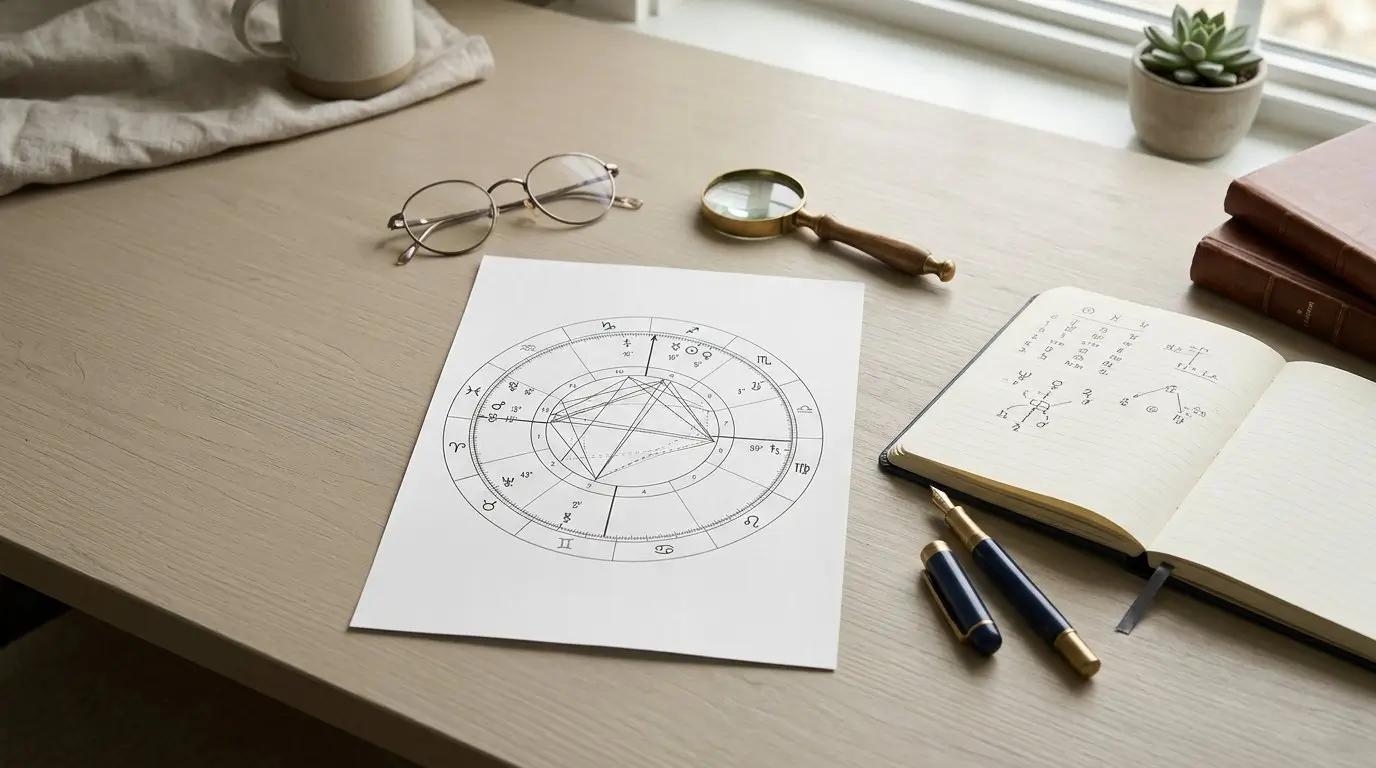
A birth chart can look complicated at first: symbols, lines, numbers, houses, and planetary glyphs all competing for your attention. The best approach is to move slowly and read in layers.
Start with one chart, ideally your own. You will need your birth date, birth place, and, if possible, your exact birth time. If you do not know your birth time, begin with the placements you can confirm, such as the Sun, Mercury, Venus, Mars, Jupiter, Saturn, Uranus, Neptune, and Pluto by sign. The Moon may also be known, but it can change signs within a day, so check carefully.
Use this step-by-step method:
1. Note the Big Three
Write down your Sun, Moon, and Rising signs. Add a few keywords for each, but keep them simple. Ask:
- What feels familiar?
- What feels exaggerated or inaccurate?
- Which traits show up more in public versus private?
2. Look at the personal planets
Next, study Mercury, Venus, and Mars. These are close to daily experience.
- Mercury: thinking, learning, speaking, listening
- Venus: affection, values, pleasure, style of relating
- Mars: action, motivation, anger, desire, boundaries
These placements can explain why two people with the same Sun sign behave very differently.
3. Notice houses with several planets
If multiple planets gather in one house, that life area may feel especially important. For example, several planets in the sixth house may draw attention to routines, service, work habits, and daily responsibilities. Several planets in the eleventh house may emphasize friendships, community, and shared ideals.
4. Look for repeated elements and themes
The four elements are fire, earth, air, and water. Fire often relates to action and inspiration, earth to practicality and stability, air to ideas and connection, and water to emotion and intuition.
The three modalities are cardinal, fixed, and mutable. Cardinal signs initiate, fixed signs sustain, and mutable signs adapt. If your chart has a strong emphasis in one element or modality, it may shape your overall style.
5. Study aspects last
Aspects are powerful, but they can overwhelm beginners. Learn what each planet, sign, and house means before analyzing every line in the chart. Start with major aspects, such as conjunctions, squares, trines, oppositions, and sextiles.
Most importantly, keep a journal. Instead of searching for one perfect interpretation, write observations. How do placements show up in your choices, moods, relationships, and creative life? Astrology becomes more useful when it is tested gently against lived experience.
Common Beginner Mistakes to Avoid
One common mistake is reducing people to one Sun sign. Sun signs are easy to remember, but they are only one part of the chart. A thoughtful reading considers the Moon, Rising sign, personal planets, houses, aspects, and repeating patterns.
Another mistake is treating difficult placements as “bad.” A square, opposition, Saturn placement, or intense Pluto theme does not mean someone is doomed. Challenging symbols may describe effort, growth, friction, boundaries, or depth. They deserve nuance, not fear.
Beginners may also use astrology to make absolute judgments about compatibility. It can be tempting to say, “I should never date that sign,” or “This match is perfect.” Real relationships are more complex. Astrology can highlight patterns worth discussing, but it should not replace honesty, kindness, shared values, or clear communication.
It is also wise to avoid obsessing over predictions. Transits, progressions, and timing techniques can be meaningful, but astrology should not become a way to avoid decisions or hand your life over to the chart.
A grounded practice asks: What does this symbol invite me to notice? How does it compare with my real experience? What choices are still mine to make?
Simple Ways to Keep Learning Astrology
The best way to continue your journey into astrology is to learn gradually. You do not need to memorize every sign, planet, house, aspect, transit, and technique at once.
Start an astrology journal. Track lunar phases, personal moods, dreams, creative energy, conversations, and important events. Notice what happens around New Moons, Full Moons, and major personal transits, but keep your reflections balanced. Patterns are more helpful than one-time assumptions.
Choose one topic at a time. For example, spend a week learning Mercury through each sign, or study one house each day. This keeps the learning process manageable.
Compare chart themes with real life. If your Venus is in Gemini, do you value conversation, variety, curiosity, or mental connection in relationships? If your Mars is in Cancer, do you act more strongly when protecting someone or something you care about? These questions make astrology personal without becoming rigid.
You can also learn through books, reputable astrology educators, workshops, courses, podcasts, and chart study groups. Look for teachers who encourage nuance, ethics, and self-awareness rather than fear-based claims or guaranteed predictions.
Astrology is a lifelong symbolic language. The goal is not to master it overnight, but to become more fluent over time.
FAQ
What should I learn first when starting astrology?
Start with the Big Three: Sun, Moon, and Rising. Then learn the basic meanings of the planets, zodiac signs, houses, and aspects. This gives you a clear foundation before exploring advanced techniques.
Do I need my exact birth time to read my chart?
An exact birth time is important for your Rising sign and house placements. Without it, you can still study many planetary signs, but some parts of the chart may be uncertain or incomplete.
Is astrology mainly about predicting the future?
Astrology can include timing techniques, but it is not only about prediction. Many people use it for reflection, self-understanding, spiritual practice, pattern recognition, and exploring life themes with more awareness.
How long does it take to understand astrology basics?
You can learn basic terms within a few weeks, but understanding how they work together takes longer. Most beginners make steady progress by studying one chart, keeping notes, and learning one symbol at a time.