To read tea leaves, brew loose-leaf tea in a light-colored cup, drink until a small amount of liquid remains, swirl the cup, invert it onto a saucer, then study the leaf shapes, positions, and impressions left behind. Begin with the strongest symbols you notice first, consider where they appear in the cup, and interpret them as reflective guidance rather than fixed prediction.
Tea leaf reading, also called tasseography, is a symbolic practice. The leaves create marks, clusters, lines, and shapes that can be read like a visual meditation. Some people use it for intuition, journaling, spiritual reflection, or conversation with a trusted friend.
The most important rule is simple: do not force the message. A useful tea leaf reading should feel grounded, proportionate, and connected to the question you asked. It is not a substitute for medical, legal, financial, or safety advice, and it should not leave you feeling trapped by fear.
Below is a beginner-friendly method for preparing the cup, reading the symbols, understanding placement, and knowing when the reading is complete.
Quick Start: How To Read Tea Leaves In One Sitting
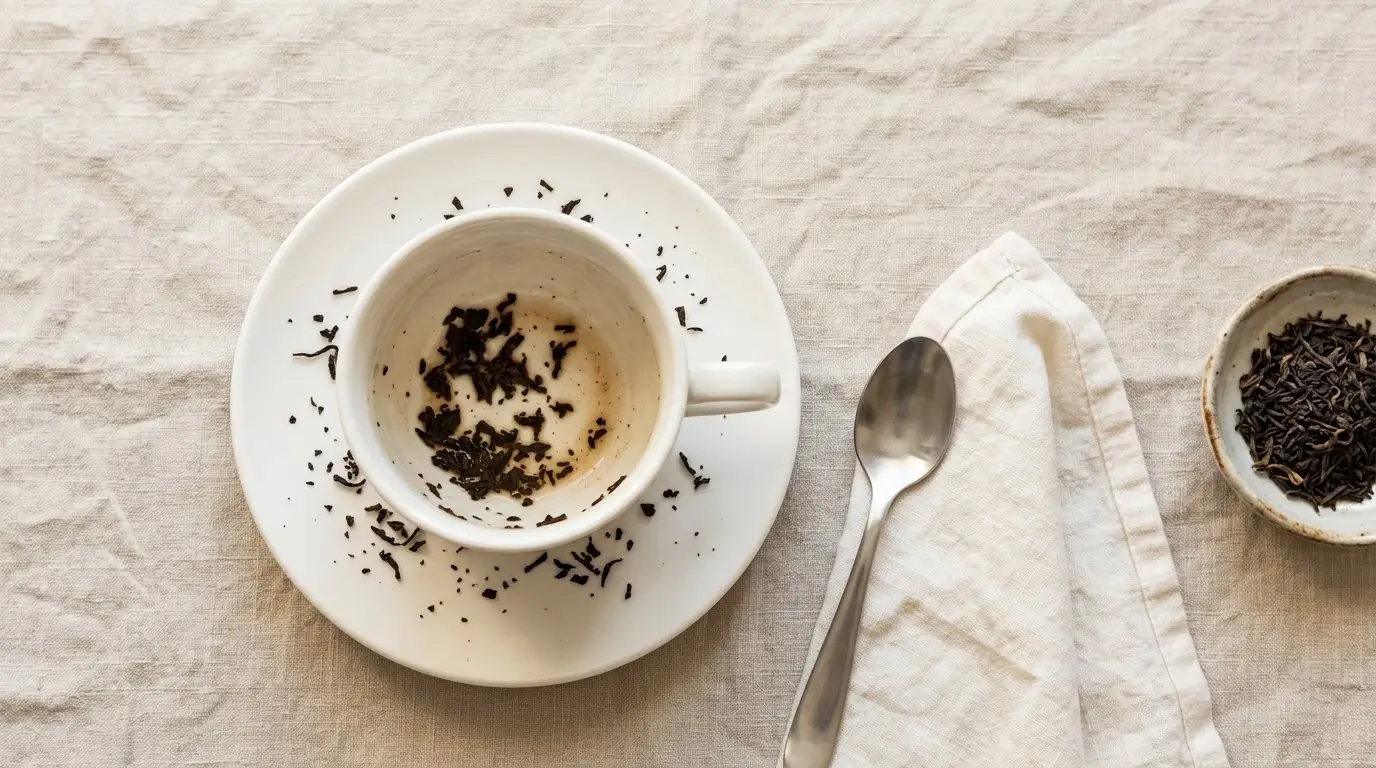
Tea leaf reading begins with loose tea leaves left inside a cup after drinking. Instead of using cards, coins, or charts, you read the natural patterns made by the leaves. The practice is intuitive, but it also has a simple structure beginners can follow.
Here is the quick version:
- Choose loose-leaf tea. Use a tea with visible leaves rather than fine dust.
- Brew it in a pale cup. A white or light-colored interior makes symbols easier to see.
- Ask an open question. Try “What should I understand about this decision?” instead of “Will this happen?”
- Drink slowly. Keep the question in mind as you sip.
- Leave a small amount of liquid. About a teaspoon of tea should remain with the leaves.
- Swirl the cup. Many readers swirl three times, but the number is symbolic rather than mandatory.
- Invert the cup onto a saucer. Let extra liquid drain for a moment.
- Turn the cup upright. Look at the leaves before trying to explain them.
- Notice the strongest shapes first. Look for animals, letters, numbers, roads, circles, clusters, or blank spaces.
- Interpret gently. Combine the symbol, its location, and your question into a practical reflection.
Many readers divide the cup into zones. The rim is often read as near-term events, conscious thoughts, or what is close at hand. The middle can suggest developing themes. The bottom may point to deeper roots, slower-moving concerns, or something less visible. The handle often represents the person receiving the reading, their present self, or their home base.
You do not need to feel “psychic certainty” to begin. Tea leaf reading works best when you combine pattern recognition, personal association, and calm intuition. If a shape looks like a bird to you, start there. Ask what a bird means in the context of your question: news, freedom, movement, perspective, or something else?
Think of the cup as a mirror for reflection, not a courtroom verdict. The reading should help you ask better questions, not make you afraid of your future.
What You Need Before You Begin
A good tea leaf reading does not require expensive tools. The most helpful materials are simple, readable, and comfortable to use.
You will need:
- Loose-leaf tea
- A light-colored teacup, preferably white or pale inside
- A saucer
- Hot water
- A kettle
- A notebook or journal
- A pen
- Optional candle, cloth, or quiet setting if that helps you focus
Loose-leaf tea is better than tea bags because the leaves create visible patterns. Tea bags usually contain smaller particles, dust, or broken leaf fragments that can clump into mud-like shapes. You may still get impressions from tea bag contents, but it is harder for a beginner.
Good starter teas include:
- Black tea with medium-sized leaves
- Green tea with visible leaf pieces
- Oolong tea
- Simple herbal blends with food-grade leaves or flowers
- Mint, chamomile, or other familiar herbal teas, if they form readable patterns
Avoid blends that are mostly powder, glitter, artificial decorations, or tiny dust. Also avoid any herb you are unsure about. If you are pregnant, nursing, taking medication, managing a health condition, or sensitive to herbs or caffeine, choose a familiar food-grade tea you already know is safe for you. Tea leaf reading should not require consuming anything risky.
The cup matters too. Choose a teacup with a plain, pale interior. Busy patterns, dark glaze, or heavy staining can make it difficult to tell whether you are seeing a symbol or the cup design.
Before you begin, take a moment to settle. You might place both hands around the cup, breathe slowly, and ask a clear question. Open-ended questions work best because they invite insight rather than a rigid yes or no.
Helpful question examples include:
- “What should I understand about this transition?”
- “What energy surrounds this creative project?”
- “What pattern am I being asked to notice?”
- “What would help me approach this relationship with clarity?”
- “Where should I place my attention this week?”
The calmer the question, the clearer the reading tends to feel.
Step-By-Step Tea Leaf Reading Method
The following method gives you a complete beginner-friendly tea leaf reading from start to finish. Traditions vary, so treat this as a practical framework rather than the only correct way.
Step 1: Choose a question or theme
Begin with one question, situation, or theme. A focused reading is easier to interpret than a general one.
Good themes include:
- A decision you are considering
- A relationship pattern
- A creative project
- Personal growth
- A recurring emotional pattern
- The energy of the week ahead
Avoid questions that demand certainty, especially if the issue involves health, safety, legal matters, or money. Instead of asking, “Will I definitely get this job?” you might ask, “What should I understand about my next step in work?”
Step 2: Brew loose tea
Place loose tea directly in the cup, or brew it in a pot and pour both liquid and leaves into the cup. If you do not like leaves in your mouth, use larger leaves or sip carefully. The point is to allow some leaves to remain in the cup after drinking.
Steep the tea normally. Do not overbrew it just for the reading. The ritual should be pleasant, not uncomfortable.
Step 3: Sip slowly and leave a little liquid
Drink the tea while keeping your question gently in mind. You do not need to concentrate intensely. Let the question sit in the background.
When you reach the bottom, leave about one teaspoon of liquid with the leaves. There should be enough moisture for the leaves to move when swirled, but not so much liquid that everything washes away.
Step 4: Swirl the cup
Hold the cup in your non-dominant hand if that feels meaningful. Some readers use the non-dominant hand because it is associated with receptivity and intuition. If that feels awkward, use whichever hand lets you handle the cup safely.
Swirl the remaining tea and leaves three times. In some traditions, the direction of the swirl matters, but beginners do not need to worry too much about this. The number three is often used symbolically, but it is not a test. What matters is that the leaves move and settle into readable patterns.
Step 5: Invert the cup
Turn the cup upside down onto the saucer. Let it rest for a moment so the excess liquid drains away. Some people rotate the inverted cup once before lifting it. Others simply wait quietly.
When you are ready, turn the cup upright carefully. Try not to shake it or disturb the leaf patterns.
Step 6: Observe before interpreting
Before reaching for a symbol list, look. Give yourself a few quiet moments.
Notice:
- The first shape that draws your eye
- Strong clusters of leaves
- Lines, roads, or trails
- Letters or numbers
- Animal shapes
- Human figures
- Objects such as keys, rings, houses, or anchors
- Empty spaces
- The overall mood of the cup
The first impression is often important because it arrives before the mind starts overcomplicating the image. Write it down, even if it seems strange.
Step 7: Read the cup by area
Cup placement gives context to the symbol.
A common beginner system is:
- Handle: the seeker, present self, home, or personal center
- Rim: immediate influences, conscious awareness, near-term matters
- Middle of the cup: developing situations or themes taking shape
- Bottom of the cup: roots, deeper emotions, hidden factors, or slower-moving concerns
- Left side: past influences or what is receding, in some systems
- Right side: future movement or what is approaching, in some systems
You do not have to use every zone. Start with handle, rim, middle, and bottom. That is enough for most beginner readings.
For example, a heart near the handle may feel personal and immediate. A heart at the bottom may suggest deeper emotional roots, old attachments, or feelings that need time to surface.
Step 8: Record your impressions
Write down what you see before consulting any symbol dictionary. This helps protect your own intuition.
In your notebook, record:
- Date and time
- Tea used
- Question asked
- Main symbols noticed
- Where they appeared in the cup
- Your first emotional impression
- A short interpretation
- Any practical reflection or next step
Over time, your journal becomes more useful than any generic list. You may discover that a symbol means something specific to you. For one person, a bird may mean freedom. For another, it may mean a message from family, travel, or nervous energy.
Step 9: Form a grounded interpretation
A complete interpretation combines five things:
- The original question
- The symbol
- The symbol’s location
- The emotional tone
- Repeated patterns or supporting symbols
Keep the final message short. For example:
“A road near the rim and a key near the handle may point to an immediate choice where I already have part of the solution. I may need to stop waiting for outside permission and use the access I already have.”
That kind of reading is useful because it is reflective, practical, and non-alarming.
Common Tea Leaf Symbols And How To Interpret Them
Tea leaf symbols are best treated as starting points, not fixed definitions. A bird does not always mean news. A snake does not always mean danger. Meaning changes depending on the question, placement, size, clarity, repetition, and your personal associations.
Use the table below as a flexible guide.
| Symbol seen | Possible meaning | Questions to ask yourself |
|---|---|---|
| Bird | Message, movement, freedom, perspective | What news or insight is trying to reach me? |
| Tree | Growth, roots, family, patience | What needs time, nourishment, or grounding? |
| Heart | Love, emotion, compassion, attachment | What feeling is central to this situation? |
| Road or path | Choice, journey, direction, transition | What path is opening, and what step is next? |
| Mountain | Challenge, ambition, endurance | What obstacle requires patience rather than panic? |
| Circle | Completion, cycle, protection, repetition | What pattern is closing or repeating? |
| Star | Hope, inspiration, guidance, visibility | Where am I being encouraged to trust possibility? |
| Anchor | Stability, commitment, being held in place | What is grounding me, or what is weighing me down? |
| Key | Access, solution, opportunity, permission | What door may already be within reach? |
| Snake | Caution, transformation, hidden tension, healing | Where should I use discernment or shed an old skin? |
| Flower | Beauty, growth, tenderness, unfolding | What is beginning to bloom? |
| House | Home, family, safety, private life | What domestic or inner foundation needs attention? |
| Letter | Initial, message, name, communication | Does this connect to a person, word, or message? |
| Number | Timing, quantity, pattern, repetition | Does this number have personal meaning? |
| Cloud | Confusion, mood, uncertainty, imagination | What feels unclear, and what would bring clarity? |
| Ring | Promise, bond, cycle, agreement | What commitment or repeated pattern is involved? |
When interpreting symbols, pay attention to strength. A large, clear shape near the rim usually carries more weight than a tiny speck hidden among many leaves. Repeated symbols also matter. Three small birds may emphasize communication more strongly than one faint bird.
Try combining symbols into a story. Suppose you see a path near the rim and a key close to the handle. The path may suggest an immediate choice, while the key near the handle suggests that you already hold part of the answer. Together, they may point to action, access, or self-trust.
If you see a challenging symbol, do not jump to frightening conclusions. A snake may mean caution, transformation, or the need for better boundaries. A mountain may mean effort, not failure. A cloud may mean uncertainty that will clear with time or better information.
Tea leaf reading becomes more useful when symbols invite questions rather than declare doom.
How To Trust Your Intuition Without Overreading
The skill of tea leaf reading is not just seeing symbols. It is knowing when to stop.
Intuition usually feels simple, clear, and proportionate. It may arrive as a quiet phrase, a bodily sense, or an immediate association. Forcing a meaning often feels tense, dramatic, or repetitive. If you find yourself staring at one speck for ten minutes trying to make it into a sign, pause.
A helpful approach is the three-pass method:
- First impression: What did you notice before thinking too hard?
- Symbol and location: What might the shape mean, and where is it in the cup?
- Practical context: How does this relate to the actual question?
For example, your first impression may be “a small bridge.” Its location in the middle of the cup may suggest a developing transition. In practical context, it might point to a conversation, compromise, or temporary connection between two parts of your life.
Use neutral language when writing your interpretation. Instead of “This means something bad will happen,” write, “This may point to a need for caution and clearer boundaries.” Instead of “I will succeed,” try, “This may encourage steady effort and confidence.”
This language keeps the reading useful without turning it into an absolute prediction.
Journaling helps you develop discernment. After a week or a month, review your notes. Which interpretations were helpful? Which were too dramatic? Which symbols seem to have personal meanings for you?
Avoid reading repeatedly on the same question in a short period. Doing five readings about the same concern can create confusion and anxiety. If you feel compelled to keep asking, step away from the cup and ground yourself. Talk with a trusted person or seek qualified support if the issue is serious.
Tea leaf reading also has many cultural, family, and regional traditions. Some readers inherit specific methods from relatives or communities. Others learn through books, teachers, or personal practice. It is respectful to approach the art with humility and avoid claiming that one system is universal.
Mistakes, Troubleshooting, And How To Know The Reading Is Complete
Beginner tea leaf readings can feel messy at first. That is normal. The goal is not to see perfect pictures; it is to gather meaningful impressions.
Common mistakes
Using tea dust or a dark patterned cup.
If the leaves are too fine, they may form blobs instead of shapes. If the cup is dark or decorated inside, symbols become difficult to separate from the background. Use larger loose leaves and a pale cup.
Asking vague or fear-based questions.
“What is going to happen to me?” is too broad and may create anxiety. Reframe it into something constructive, such as “What should I pay attention to in this situation?” or “What support would help me move forward?”
Looking up every tiny speck.
Not every dot is a message. Focus on the clearest three to five impressions. A simple reading is often more accurate and useful than an overloaded one.
Treating symbols as fixed predictions.
A symbol is not a sentence. It is a prompt. Its meaning depends on the question, cup placement, and your own associations.
Troubleshooting unclear readings
If you see no shapes, rotate the cup slowly. Soften your gaze, the way you might look at clouds. Search for lines, clusters, letters, or the overall mood rather than perfect images.
If the symbols seem contradictory, check where they appear. A clear star near the rim and a cloud at the bottom may not cancel each other out. They may suggest visible hope alongside deeper uncertainty. Different cup areas can describe different layers of the situation.
If the reading feels unsettling, pause. Put the cup down. Take a breath. Write the most balanced version of the message you can. Ask, “What is the practical reflection here?” rather than “What disaster is coming?” Challenging symbols should be handled as invitations to awareness, not panic.
How to know the reading is complete
A complete tea leaf reading usually produces:
- A short message tied to the original question
- One or two practical reflections
- A sense of clarity or grounded curiosity
- No panic, compulsion, or urgent fear
- A natural stopping point
For example, a complete reading might say: “The tree at the bottom and the road in the middle suggest that this decision is connected to long-term growth. I may need to choose the slower path that supports stability.”
That is enough. You do not need to decode every remaining leaf.
To close the reading, thank the moment in whatever way feels natural. Discard the leaves respectfully, rinse the cup, and write down any follow-up action. The closing step helps signal that the reading is finished and that you are returning to ordinary life with perspective.
FAQ
Can you read tea leaves with a tea bag?
Yes, but it is harder. Tea bags often contain fine particles that form muddy clumps instead of clear symbols. If using a tea bag, cut it open after steeping and use the leaves in a pale cup.
What is the best tea for reading tea leaves?
The best tea has visible loose leaves that create readable shapes. Black tea, green tea, oolong, and simple herbal blends can work well. Choose food-grade tea you know is safe for your body.
Do tea leaf symbols have fixed meanings?
No. Symbol lists are helpful starting points, but meanings change with the question, cup placement, clarity, size, and personal association. A symbol should be interpreted as guidance, not a rigid prediction.
Which part of the teacup should I read first?
Start with the strongest symbol you notice, then consider its placement. Many beginners use the handle as the seeker, the rim as immediate matters, the middle as developing themes, and the bottom as deeper roots.
How often should I do a tea leaf reading?
Occasional readings are usually best. You might read weekly, monthly, or when you have a meaningful question. Avoid repeating the same question many times in one day, as that can create confusion or anxiety.