
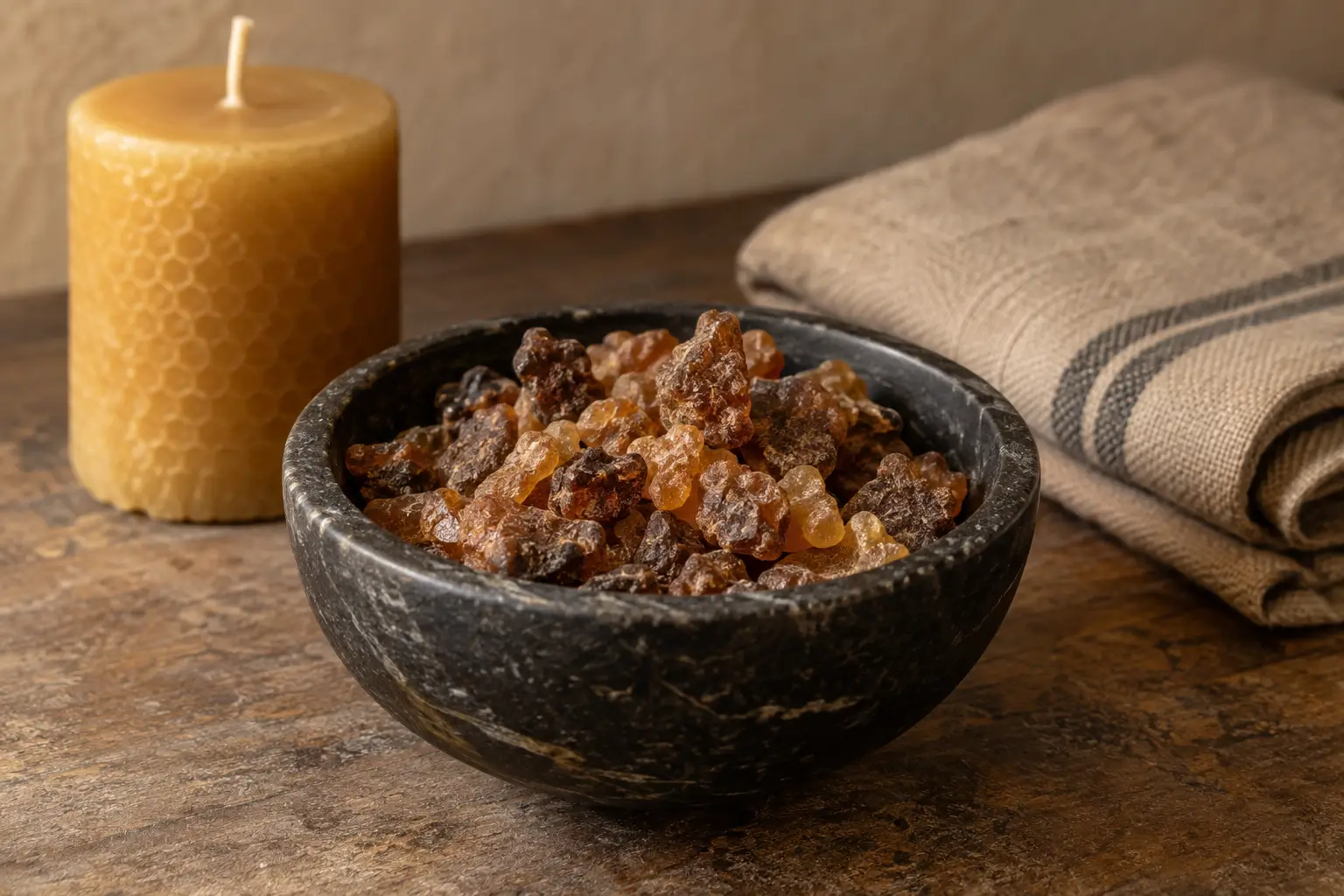
When discussing myrrh’s magickal properties, it helps to separate three questions: What is the material? How was it historically used? What meaning does a practitioner assign to it?
A correspondence is an interpretive connection between a material and a spiritual idea, intention, or ritual role. It may come from religious tradition, historical context, or personal practice. It is not a scientifically established property or a guaranteed supernatural effect.
What Myrrh Is—and Why Its Form Matters
Myrrh is a resinous gum associated with plants in the genus Commiphora. The material exudes after the plant’s bark is incised, then is collected in pieces commonly described as “tears.”
Kew records myrrh in connection with Commiphora and holds oil, gum, and resin specimens identified as coming from Commiphora myrrha. This establishes a documented botanical connection, but it does not show that every historical substance or modern product called “myrrh” comes from the same species or has the same composition.
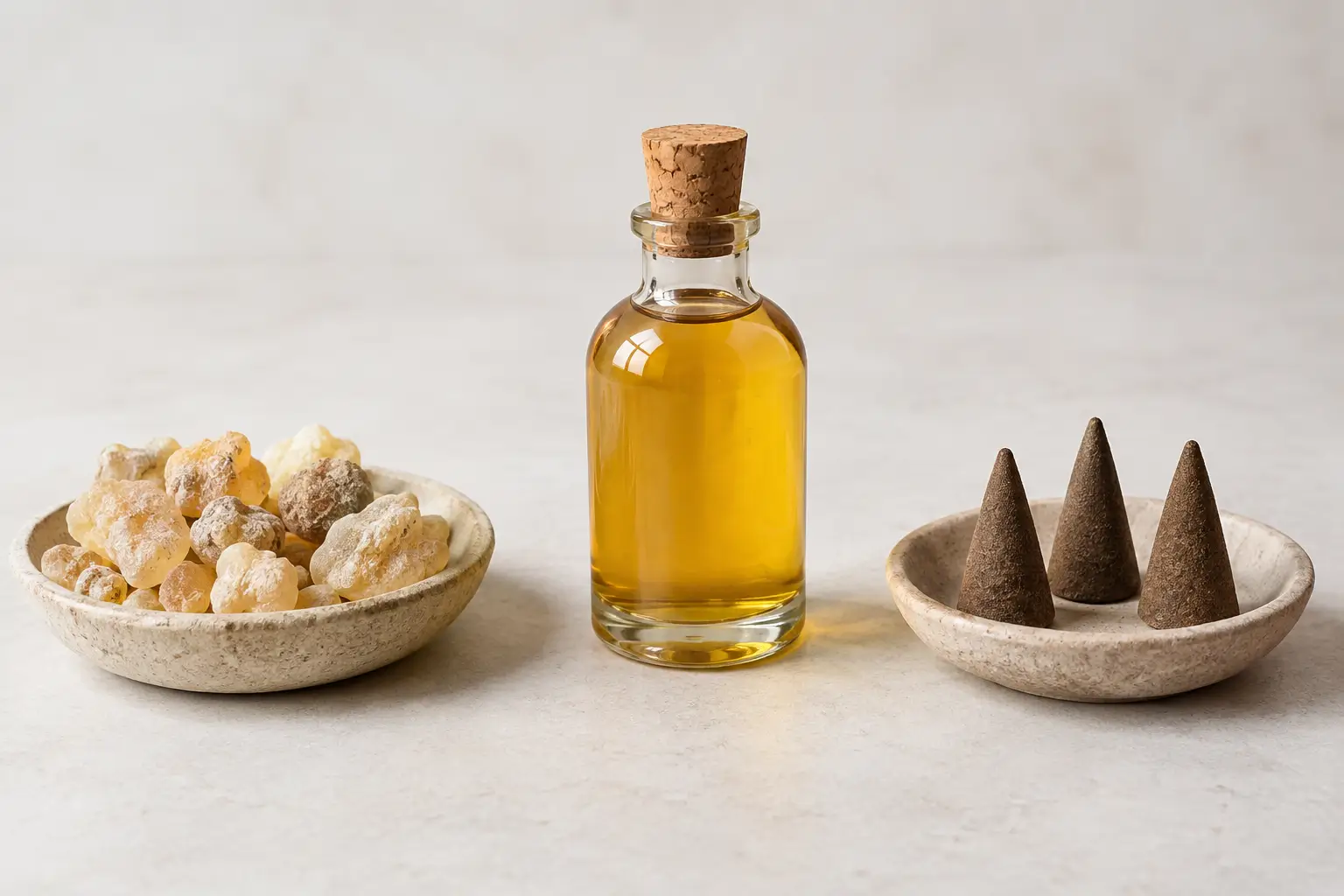
Several different kinds of information can appear on a myrrh product:
- Botanical identity names the plant source, such as Commiphora myrrha.
- Raw resin or gum describes the exuded plant material, often sold as irregular tears or pieces.
- Oil describes another material form documented among Kew’s specimens. It should not be treated as interchangeable with raw resin merely because both carry the same plant name.
- Prepared incense describes a product intended for burning, but the term alone does not establish its exact botanical source or composition.
A label that says only “myrrh” therefore leaves important questions unanswered. It may refer to a traditional material, a scent, or a prepared product while providing little information about the plant source. Conversely, the word Commiphora identifies a genus; it does not mean that every substance derived from a plant in that genus is materially identical to documented Commiphora myrrha gum, resin, or oil.
This distinction matters for altar use. A resin tear placed in a dish, an oil used for fragrance, and an incense mixture intended for burning may share the name “myrrh,” but they are not the same physical material. Their forms shape how they can be handled and what role they can serve.
Before assigning myrrh a ritual role or spiritual meaning, identify two things where possible: the botanical labeling and the material form. If the plant source is not given, acknowledge that uncertainty rather than assuming one. If a product is described only as “myrrh oil” or “myrrh incense,” do not automatically equate it with raw gum or resin.
Beginning with material identity does not invalidate spiritual interpretation. It ensures that the interpretation relates to the item actually present on the altar, rather than to assumptions attached to a broad name.
What Historical Sources Actually Document
Myrrh and frankincense were highly prized commodities that helped sustain ancient trade routes. Their movement through related commercial networks often places them together in historical accounts, but shared trade does not mean they had identical uses.
The Smithsonian documents both frankincense and myrrh as incense materials used across the ancient world, including to sanctify religious ceremonies. This supports describing myrrh as having a documented incense and ceremonial context. It also provides historical background for why some later practitioners might consider it appropriate for a sacred setting or offering.
The supplied historical record extends beyond incense. The Metropolitan Museum of Art reports that myrrh was sought for cosmetics and perfumes. These uses place it in contexts involving fragrance, personal presentation, and valued aromatic preparations.
Care is needed when comparing this evidence with the record for frankincense. In the Met’s account, myrrh is associated with cosmetics and perfumes, while frankincense is specifically associated with religious and funerary incense. That distinction does not conflict with the Smithsonian’s broader evidence that both substances were used as incense in the sanctification of ceremonies. Instead, the sources provide overlapping but not identical accounts.
The supported historical picture is therefore precise:
- Both materials were highly valued within ancient trade.
- Both are documented as incense used in ceremonial sanctification.
- Myrrh is specifically recorded as sought for cosmetics and perfumes.
- The Met’s account specifically connects frankincense with religious and funerary incense.
These distinctions correct the assumption that myrrh and frankincense were interchangeable. They may appear together because they traveled through related trade networks and sometimes occupied related aromatic or ceremonial settings. That does not justify transferring every documented use of one substance to the other.
The sources also establish a boundary around responsible claims. They document commercial, ceremonial, cosmetic, perfumery, and incense contexts. They do not support adding medical benefits or presenting supernatural effects as established ancient facts.
It is therefore more accurate to describe myrrh as a valuable traded material with documented roles in incense, ceremony, cosmetics, and perfume than to claim that it always carried one universal sacred meaning. Historical context can inform modern spiritual interpretation, but it should not be replaced by that interpretation.
How History Can Inform—but Not Prove—Magickal Correspondences
Myrrh’s documented value and uses can provide context for symbolic associations. Because it was highly prized in ancient trade, a practitioner might associate it with preciousness, significant gifts, or offerings of value. Because myrrh and frankincense were used as incense in the sanctification of ceremonies, some traditions or practitioners may connect myrrh with sacred space or ceremonial intention.
Its cosmetic and perfumery uses may likewise inspire associations with fragrance, intentional adornment, or deliberate preparation. These are understandable interpretive links, but they remain links made within a tradition or practice. The historical record does not demonstrate them as inherent powers of the material.
Three kinds of statements should remain distinct:
- A historical statement reports that people valued, traded, or used myrrh in documented settings.
- An interpretive statement connects those settings with ideas such as offerings, sanctity, preciousness, or adornment.
- A guarantee claims that myrrh will produce a particular supernatural result.
The evidence supports the first kind of statement. The second is a correspondence: a symbolic relationship adopted through religion, culture, or personal practice. The third exceeds what the supplied sources establish.
Practitioners can preserve this distinction without abandoning spiritual language. Someone might say, “In my tradition, myrrh represents a valuable offering,” or, “I place myrrh on my altar as a reminder to enter ritual intentionally.” These statements identify the meaning as traditional or personal rather than presenting it as a universal fact.
The same restraint applies to ceremonial associations. Evidence that myrrh was used as incense in the sanctification of religious ceremonies documents what people did with the material in particular settings. It does not prove that myrrh automatically sanctifies every person, object, or space.
Trade value also requires careful interpretation. Myrrh’s status as a prized commodity can contextualize associations with worth, rarity, or meaningful gifts. It does not demonstrate that the material inherently attracts prosperity or creates another fixed result.
The supplied evidence supports no medical benefit, treatment use, or guaranteed magical efficacy. Its value is narrower but important: it allows readers to distinguish documented history from religious meaning, later symbolism, and personal belief.
A Form-aware Approach to Altar Use
An intentional approach to myrrh begins with the product itself. Look for a botanical name, including whether a Commiphora species is identified, and note whether the material is raw gum or resin, an oil, or prepared incense. Kew documents gum, resin, and oil specimens in connection with Commiphora myrrha, but this does not make every item labeled “myrrh” botanically or materially identical.
Next, decide what role the material is meant to serve. Symbolic placement, fragrance, offering, and burning are different uses. A resin tear can be placed on an altar without being burned. An aromatic product serves a different practical purpose from an object used only as a visual offering. Prepared incense introduces combustion, while an oil is not automatically a substitute for raw resin simply because both use the name “myrrh.”
These distinctions concern material form and intention; they do not establish that one form is spiritually stronger than another.
The meaning assigned to myrrh can then be stated clearly. A practitioner might draw on its documented contexts of valued trade, ceremonial incense, cosmetics, or perfume. Its significance might instead come from a specific religious tradition or personal altar practice. In either case, the correspondence is an adopted meaning, not a promise of a fixed outcome.
Burning requires a separate boundary. The supplied evidence documents historical incense use, but it does not assess smoke exposure, combustion safety, ventilation, or modern burning practices. Historical use cannot therefore be treated as proof that inhaling smoke is safe. The evidence also does not evaluate the safe use of myrrh oil. Safety questions must be considered separately for the particular product, form, and setting.
Informed altar use combines four elements: the most specific material identity available, attention to differences among forms, respect for what historical sources actually document, and honesty about whether a meaning comes from evidence, tradition, or personal belief. This approach leaves room for myrrh to hold spiritual significance without turning its history into a supernatural guarantee—or treating every substance sold under its name as the same material.