
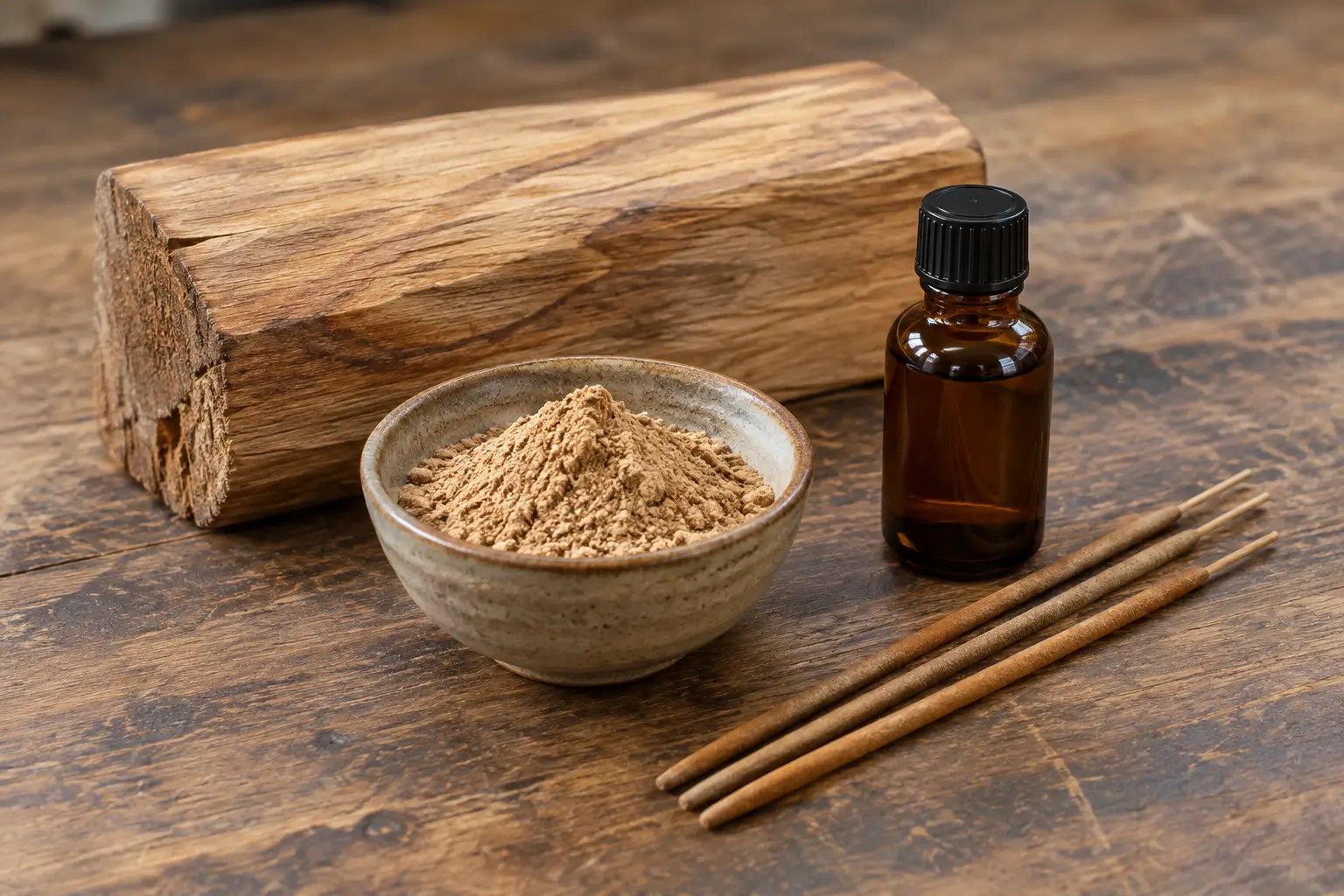
What “Magickal Properties of Sandalwood” Can Responsibly Mean
“Sandalwood” is a common name, not a guarantee of botanical identity. Kew’s plant-name service associates the term with multiple plants, so powder, oil, incense, or fragrance labeled “sandalwood” does not necessarily contain Santalum album, sometimes called Indian sandalwood .
A responsible understanding begins with three separate questions:
- What is the material? Identify the botanical species, when possible, and distinguish among wood, powder, oil, incense, and fragrance products.
- What is the religious context? Ask whether a use is documented within a named tradition rather than treating all sandalwood practices as interchangeable.
- What are the sourcing implications? Consider conservation concerns and how much information is available about the material’s origin and composition.
Sandalwood has documented religious significance. A Smithsonian resource describes sandalwood being applied to a deity image in Hindu practice, while a peer-reviewed review reports religious uses of sandalwood wood and oil in Hinduism, Buddhism, and Islam . These records can inform personal interpretation, but they do not establish one universal set of “magickal properties.”
Documented ritual use also does not prove supernatural efficacy, health benefits, or promised outcomes. Qualities such as sacredness, devotion, purification, or personal significance should be identified either as tradition-specific associations or as meanings intentionally chosen for personal practice—not as powers guaranteed by the material itself.
Species, Heartwood, and Product Form Are Not Interchangeable
Santalum album is a recognized plant species. Kew describes its fragrant heartwood—the dense inner wood of the tree—as a material used for perfume, cosmetics, and carving . This helps explain the plant’s material value and the presence of sandalwood in many aromatic and crafted products. It does not mean that every product using the name contains this species or its heartwood.
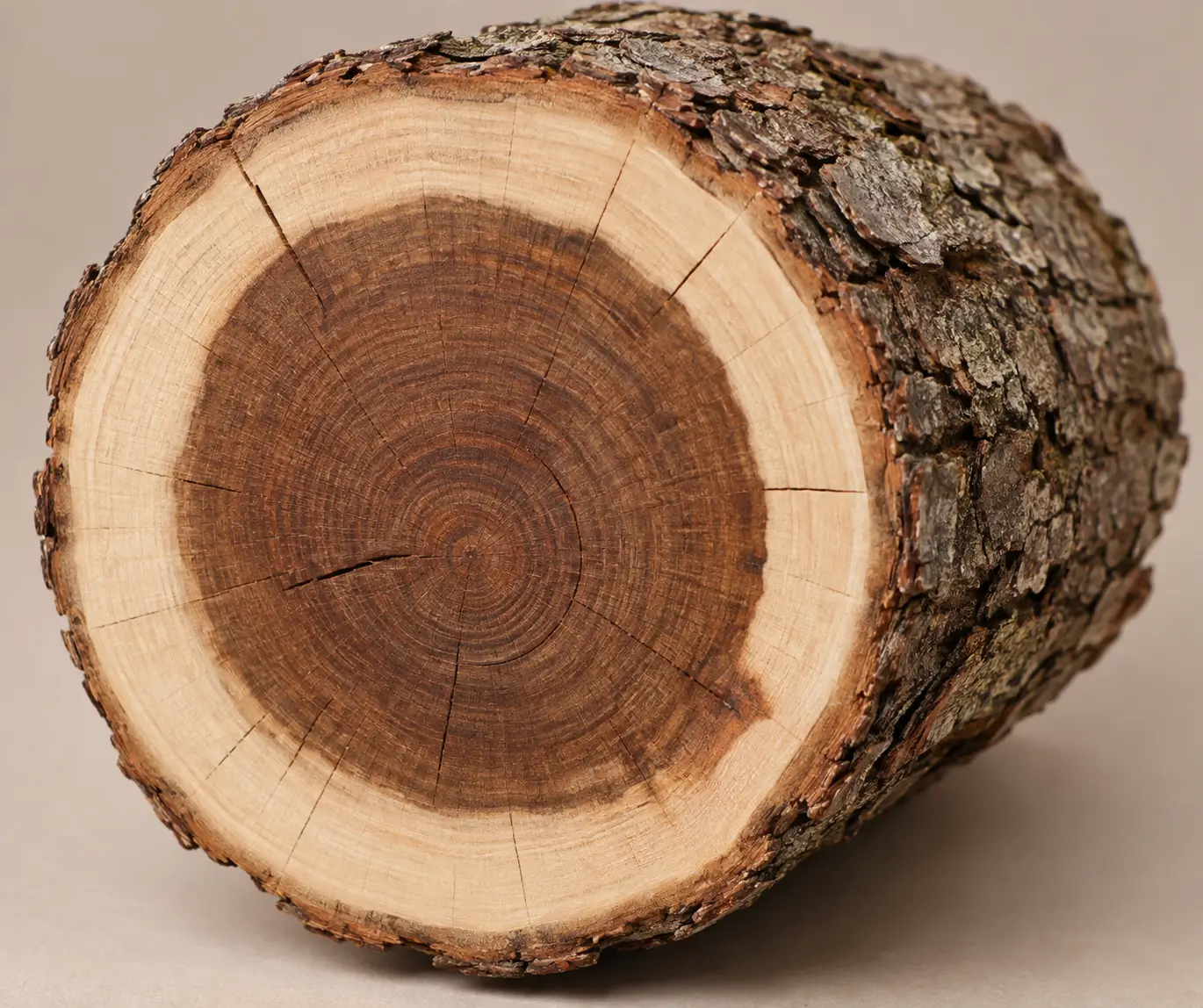
The available evidence about religious use also names both Santalum album and Santalum spicatum. A peer-reviewed review reports religious uses of wood and oil from these species in Hinduism, Buddhism, and Islam . Even in documented religious contexts, therefore, “sandalwood” does not refer exclusively to Santalum album.
Species and product form provide different kinds of information:
- Botanical species identifies the plant from which a material is claimed to come.
- Wood identifies a solid plant material, but the word “sandalwood” alone does not identify the species or confirm that the material is heartwood.
- Powder describes physical form, not species, plant part, purity, or composition.
- Oil identifies a product form but does not by itself establish its botanical source or ingredients.
- Incense describes a product made to be burned; it may contain several ingredients, none of which can be determined from the word “sandalwood” alone.
- Fragrance products may recreate or suggest a sandalwood aroma without establishing that they contain wood or oil from any particular Santalum species.
Scent is not proof of botanical identity. Nor can color, packaging, or a front-label reference to sandalwood verify species, purity, ingredients, or plant part. The supplied evidence does not test or authenticate any particular commercial product.
For altar use, the soundest description is therefore the most specific one the available information permits. “Powder labeled sandalwood” is more accurate than “Santalum album powder” if the botanical name is absent. “Sandalwood-scented incense” avoids implying that an incense contains a particular wood or oil when its ingredients are undisclosed. If a label names Santalum spicatum, that should not be silently replaced with Santalum album simply because both may be called sandalwood.
Botanical and composition information provides a better basis for understanding a product than scent or evocative branding. A full ingredient list may also clarify whether an item consists of wood, oil, added fragrance, or a blend. Even so, label details remain claims to assess; they are not independent proof of purity, sustainability, or religious authenticity.
These distinctions do not diminish sandalwood’s possible significance on an altar. They make that significance more honest by separating what is known about the object from what a practitioner chooses it to mean.
Religious Uses Belong to Particular Traditions and Contexts
A documented Hindu example describes sandalwood being used to anoint a deity image . Anointing means ritually applying a substance to a sacred image. This example establishes a specific use within Hindu practice; it should not automatically be turned into a universal instruction for every altar or spiritual path.
A broader peer-reviewed review reports that Santalum album and Santalum spicatum wood and oil have religious uses in Hinduism, Buddhism, and Islam . This supports the careful statement that sandalwood materials appear in more than one religious tradition. It does not show that those religions use identical materials, follow the same ritual methods, or assign sandalwood a shared meaning.
That distinction prevents separate traditions from being compressed into a generic “ancient sandalwood ritual.” Hinduism, Buddhism, and Islam have their own communities, teachings, histories, and ritual settings. The presence of sandalwood in each does not make their practices interchangeable or create a single cross-tradition system of sandalwood symbolism.
The evidence also differs in specificity. The Smithsonian source supplies a concrete Hindu example: sandalwood is used in anointing a deity image . The peer-reviewed review confirms religious use in Buddhism and Islam but, within the supplied claim, does not explain particular ceremonies, communities, purposes, or interpretations . Detailed instructions about Buddhist or Muslim practices would therefore go beyond the available evidence.
The supplied sources do not establish Jain use. Nor do they support a standardized symbolism shared across Hindu, Buddhist, Jain, and Muslim communities. It would be inaccurate to combine those religions into a list claiming that sandalwood universally represents purification, devotion, protection, enlightenment, or another fixed concept.
Careful attribution keeps these boundaries visible:
- “A Smithsonian resource documents sandalwood anointing in a Hindu ritual context” is supported .
- “Wood and oil from Santalum album and Santalum spicatum have documented religious uses in Hinduism, Buddhism, and Islam” is supported at a broad level .
- “All these traditions give sandalwood the same powers or use it in the same way” is not supported by the supplied evidence.
Attribution also leaves room for personal practice. A person may choose sandalwood as a reminder of devotion, contemplation, sacred attention, or another intention. That association should be described as personal unless a reliable source connects it to a particular tradition. If someone is drawing directly from a living religious practice, naming that context is more respectful than presenting the practice as anonymous, universal, or merely decorative.
Conservation Changes the Meaning of an Ethical Altar Choice
Botanical identity is not only a matter of accuracy. It determines whether conservation information can be applied meaningfully.
Kew reports Santalum album as vulnerable under the cited IUCN category . India’s forestry research system describes the species as highly valuable and becoming endangered . Although these sources use different conservation wording, both indicate that the status and sourcing of Santalum album deserve attention.
The ambiguity of the common name complicates ethical evaluation. Because “sandalwood” is associated with multiple plants, an unidentified product cannot simply be assumed to contain Santalum album . At the same time, a buyer cannot determine whether the conservation concerns documented for Santalum album directly apply when a seller provides only the common name.
Useful information to look for includes:
- the full botanical name;
- the material form, such as wood, powder, oil, or incense;
- an ingredient or composition statement;
- an account of where and how the material was sourced.
These details make a product easier to evaluate, but they do not prove sustainability on their own. A botanical name identifies a claimed species; it does not independently verify how the plant was grown, harvested, traded, or processed. An origin or sourcing statement may provide helpful context, but the supplied research does not offer a method for confirming individual commercial claims.
The evidence also does not assess particular sellers, certification programs, legal requirements, or supply chains. It cannot support vendor rankings, categorical buying recommendations, or guarantees that a particular label represents an ethical product. The presence or absence of a specific claim should therefore be treated as information—not as automatic proof of responsible or irresponsible sourcing.
Uncertainty can still guide an altar choice. When species and sourcing are undisclosed, the justified conclusion is not that a product must be harmful. It is that there is insufficient information to connect it confidently with the documented identity and conservation status of Santalum album. A person might respond by seeking further details, choosing a more clearly described material, using less of it, or declining to use an ambiguous product. Those are personal purchasing decisions rather than conclusions established by the cited research.
In this context, responsible sourcing begins with transparency. Knowing what a product claims to contain makes conservation questions possible, even though transparency alone cannot settle them.
Using Sandalwood on an Altar Without Turning Tradition Into a Promise
An intentional altar practice can begin with precise language. Describe the material according to what is actually known:
- “Santalum album wood” when the species and form are identified;
- “sandalwood powder, species undisclosed” when only the common name and form are available;
- “sandalwood-scented incense” when botanical ingredients are not established;
- “oil labeled Santalum spicatum” when that is the information provided.
This precision does not make the material less meaningful. It separates spiritual intention from assumptions about composition.
When drawing on documented religious use, name the context. The anointing of a deity image with sandalwood can be discussed as a documented Hindu practice rather than recast as a universal altar technique . Evidence of sandalwood use in Buddhism or Islam should remain broad unless more detailed, tradition-specific sources are available . Respectful attribution acknowledges that a practice belongs to a living tradition and may carry meanings not captured by a short description.
Personal associations can then be stated openly. Sacredness, devotion, purification, contemplation, or personal significance may be chosen as intentions or identified with a particular tradition when evidence supports that connection. They should not be presented as automatic effects of possessing, displaying, or burning a sandalwood product. No supplied source supports supernatural guarantees, health benefits, or a universal spiritual formula.
Four questions can keep an altar practice grounded:
- Material clarity: What species, ingredients, and product form are actually identified?
- Traditional clarity: Which documented religious context, if any, is being referenced?
- Ethical clarity: What sourcing information is available, especially given the conservation concerns surrounding Santalum album?
- Interpretive clarity: Which meanings come from documented tradition, and which have been personally chosen?
Sandalwood can carry substantial material, religious, and personal significance without being treated as one uniform substance or a guaranteed source of spiritual effects. A respectful practice depends less on claiming fixed powers than on transparency about the material, accuracy about tradition, awareness of conservation, and honesty about belief.