
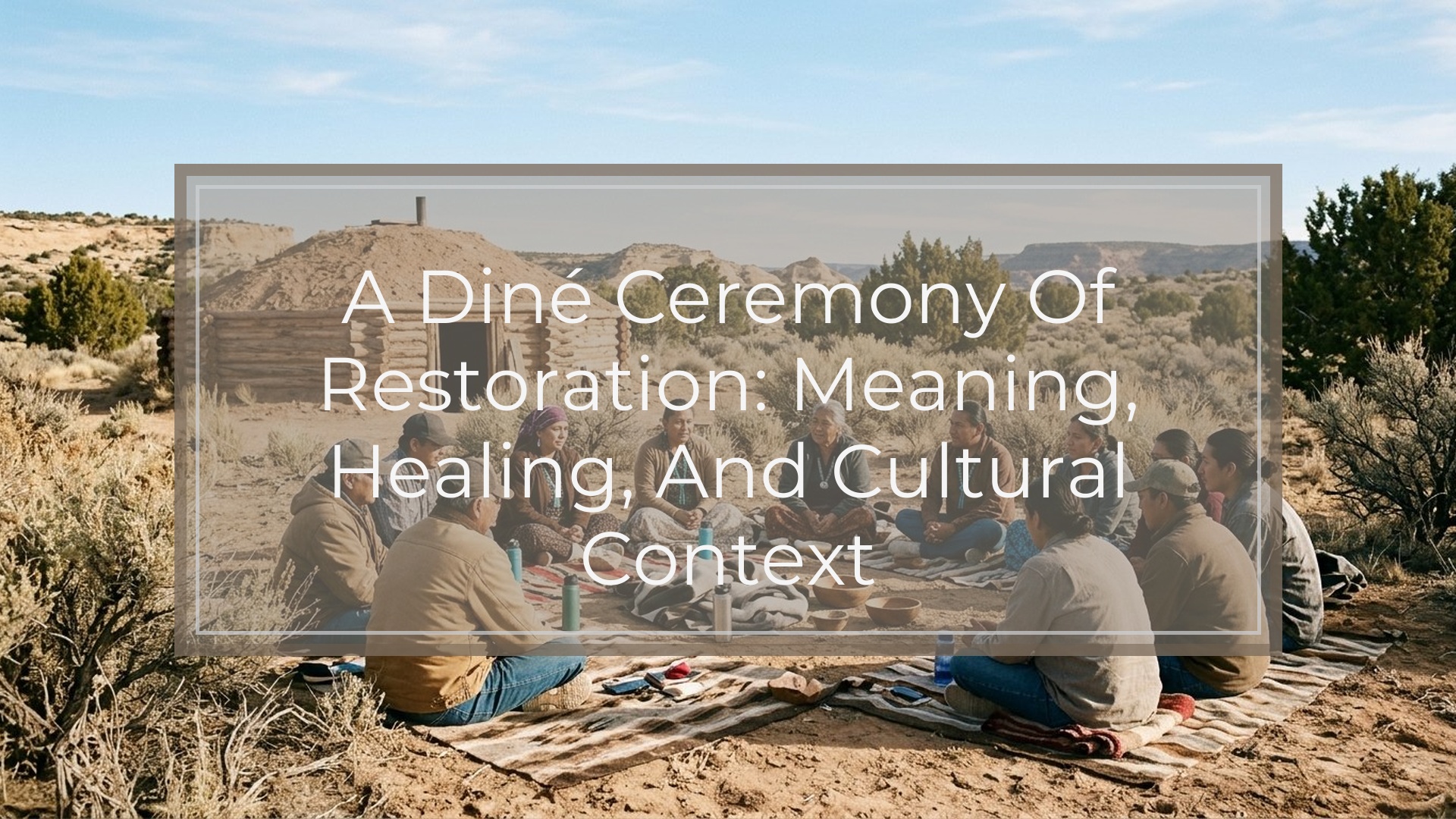
A “Diné ceremony of restoration” is best understood as a respectful English description, not necessarily the official name of one single fixed rite. Diné, often known in English as Navajo, healing traditions include ceremonies intended to restore balance, harmony, protection, and right relationship after illness, grief, disruption, fear, conflict, or spiritual imbalance.
In this context, restoration does not mean a quick cure or a generic cleansing ritual. It points toward returning a person, family, or community toward hózhó: beauty, balance, order, wellness, and proper relationship with the world. Specific ceremonies are traditionally guided by trained Diné ceremonial practitioners, and their details are not appropriate to copy from public summaries. The most respectful approach is to understand the concept without treating it as a do-it-yourself ritual.
What Is Meant by a Diné Ceremony of Restoration?
The phrase “a Diné ceremony of restoration” usually refers to a healing or balancing ceremony within Diné cultural and spiritual life. It may be used by outsiders, writers, or seekers to describe a ceremony that helps restore harmony after something has been disturbed.
However, it is important to be precise: this English phrase does not necessarily name one universal ceremony with the same form in every place or family. Diné ceremonial life is diverse, specific, and guided by cultural knowledge. Some ceremonies are associated with healing, protection, blessing, or rebalancing, but they should not be flattened into one generic “restoration ritual.”
So, the safest definition is this: it is a way of describing Diné ceremonial work aimed at restoring balance, not a public instruction manual.
The Cultural Context: Diné Healing and Hózhó
To understand restoration, it helps to understand hózhó. This Diné concept is often translated as beauty, harmony, balance, goodness, and right order, though no single English word fully carries its meaning. Hózhó can include physical wellness, emotional steadiness, spiritual alignment, respectful relationships, and living in proper relation with the natural and sacred world.
Diné healing traditions do not usually separate body, mind, spirit, land, family, and community as sharply as modern Western categories often do. A disturbance in one area may be understood as affecting the whole pattern of life.
For that reason, a ceremony of restoration may be concerned not only with symptoms, but with the person’s place within a wider web of relationship. This does not mean ceremony replaces medical care. Rather, in many Indigenous contexts, healing can include spiritual, relational, practical, and communal dimensions together.
What Restoration Can Mean in a Ceremonial Setting
In a ceremonial setting, restoration may mean helping a person return to balance after disruption. That disruption could be connected with illness, trauma, grief, frightening experiences, conflict, loss, or contact with forces understood as dangerous or disharmonious.
Restoration may also involve re-establishing protection, strengthening identity, supporting emotional recovery, or helping someone feel rightly placed in the world again. The meaning depends on the person, the situation, the ceremonial practitioner, and the specific tradition involved.
It is better to think of restoration as a process of reordering and rebalancing than as a single dramatic event. The ceremony may be one part of a larger movement back toward hózhó.
Who Leads These Ceremonies and Why That Matters
Diné ceremonies are traditionally led by trained ceremonial practitioners, often called medicine people in English, though Diné terms and roles are more specific. These practitioners may spend many years learning songs, prayers, stories, protocols, diagnoses, and responsibilities.
That matters because the ceremony is not only a set of visible actions. Its meaning rests in language, lineage, spiritual authority, cultural law, and relationship. A public description cannot transmit that authority.
For readers interested in ancestor veneration, home altars, or spiritual healing, this is an important boundary. You can respectfully learn about Diné concepts, but you should not imitate sacred rites from online articles, books, videos, or fragments of description.
Common Elements Readers May Hear About
Public discussions of Diné ceremonies may mention songs, prayers, chants, sandpaintings, pollen, herbs, offerings, sacred stories, ritual objects, or carefully ordered sequences. These elements may appear in some ceremonial contexts, but their meanings are specific and should not be generalized.
For example, a song is not simply “music,” and a sandpainting is not simply “symbolic art.” Within ceremony, such elements may carry sacred, relational, and healing significance. They are embedded in teachings and responsibilities.
Because of that, this article names broad categories only. It does not provide ritual steps, words, designs, timing, or ceremonial instructions. That restraint is part of respectful learning, especially when discussing traditions that have often been misrepresented, extracted, or commercialized.
Examples of Restoration Without Revealing Restricted Practice
A conceptual example might be a person seeking ceremonial help after a frightening event, not only to calm the mind but to restore a sense of safety and spiritual balance. Another example could be a family turning to traditional guidance after grief, asking for support in re-entering life with steadiness.
In a broader sense, restoration may also describe repairing relationship: with family, community, land, ancestors, or one’s own inner life. These examples are interpretive and general. They are not descriptions of a particular private ceremony, nor are they instructions for performing one.
Common Misconceptions About a Diné Ceremony of Restoration
One misconception is that “a Diné ceremony of restoration” is a single, standardized ritual anyone can learn. In reality, Diné ceremonial traditions are specific, protected, and guided by trained practitioners.
Another misconception is that restoration means only physical healing. While physical wellness may be part of the concern, restoration often points toward a wider return to balance.
A third misunderstanding is that respectful interest gives permission to reproduce the ceremony. Appreciation is not the same as authorization. Sacred knowledge may have boundaries.
Finally, some people assume Indigenous ceremonies are interchangeable with general “energy clearing” or modern spiritual practices. That comparison erases cultural context. Diné healing should be approached on its own terms, not absorbed into a generic ritual toolkit.
How to Approach This Topic Respectfully

Approach the topic with humility, not consumption. Use accurate language: Diné is the people’s own name, while Navajo is widely used in English but comes from outside the culture. Both may appear in sources, but Diné is often preferred in respectful discussion.
Do not ask for restricted songs, designs, or ritual steps. Do not copy ceremonial forms for a home altar. Instead, let the lesson be ethical: honor your own ancestors, land, and lineage with sincerity while respecting the boundaries of other peoples’ sacred ways.
If you are connected to the Diné community, seek guidance through appropriate family, community, or cultural channels.
Fact, Interpretation, and Spiritual Meaning
Factually, Diné healing traditions include ceremonies concerned with balance, protection, blessing, and restoration. It is also factual that many details are culturally specific and not meant for casual public use.
Interpretively, “restoration” can help English-speaking readers understand the movement toward hózhó. Spiritually, it may suggest a return to right relationship. Still, that interpretation should remain cautious. It should not replace Diné explanations from qualified cultural knowledge holders.
Key Takeaway
A Diné ceremony of restoration is best understood as a careful English way of pointing to Diné ceremonial healing that seeks to restore balance, harmony, protection, and right relationship. It is not a generic ritual template.
The heart of the matter is respect: learn the concept, honor the cultural context, and do not imitate sacred forms. For those walking a home spiritual path, the appropriate response is not copying, but deepening integrity in your own ancestral and relational practices.
FAQ
Is a Diné Ceremony of Restoration the Same as a Navajo Healing Ceremony?
It may refer broadly to a Diné, or Navajo, healing ceremony, but the phrase is not necessarily the official name of one specific rite. It is safer to understand it as an English description of ceremonial restoration, balance, or healing within Diné tradition.
What Does Restoration Mean in Diné Spiritual Healing?
Restoration can mean returning toward hózhó: balance, beauty, harmony, wellness, and right relationship. It may involve the body, spirit, emotions, family, community, and land. The exact meaning depends on the person’s situation and the ceremonial guidance involved.
Can I Perform a Diné Restoration Ceremony at Home?
No, not if you are trying to reproduce a Diné ceremony without proper cultural authority and training. Sacred ceremonies are not DIY practices. At home, you can honor your own ancestors, pray, make offerings from your own tradition, and respect Diné boundaries.
Are Diné Healing Ceremonies Only Spiritual, or Are They Also Practical?
They can be both, depending on context. Diné healing may include spiritual restoration, emotional support, family participation, cultural identity, and practical care. It should not be treated as a replacement for medical attention, but as part of a wider healing worldview.
Why Is It Important Not to Describe the Full Ritual Steps?
Full ritual steps may include protected knowledge, sacred language, and responsibilities that belong within Diné communities. Sharing or copying them can distort the ceremony and disrespect its keepers. Careful public writing explains meaning and context without exposing what should remain private.